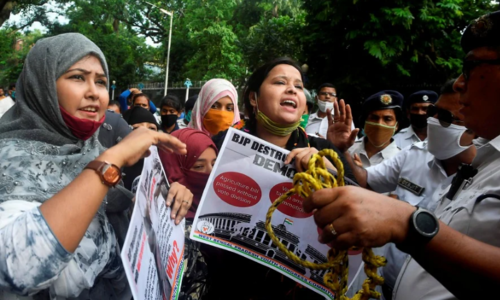
Farmers hold protests across India over agriculture bills


NEW DELHI: Thousands of farmers in India blocked roads and railway tracks on Friday in a protest against new legislation that they say could pave the way for the government to stop buying grain at guaranteed prices, leaving them at the mercy of private buyers.
Prime Minister Narendra Modi’s government has defended the bills — recently approved by parliament — as reforms to help rid India’s vast agriculture sector of antiquated laws and allow farmers to sell to institutional buyers and big retailers such as Walmart.
The government insists the new rules give farmers the option to sell their produce to private buyers while it would still purchase staples such as rice and wheat at guaranteed prices.
But such assurances have failed to mollify millions of farmers who make up an influential voting bloc in states such as Punjab and Haryana — India’s northern farm belt which borders the capital New Delhi.
Modi, who was re-elected with an overwhelming majority in 2019, now faces the biggest farmers’ protest just weeks before an assembly election in Bihar, India’s third-most populous state.
As part of a nationwide shutdown called by India’s leading farmers’ organisations, growers held demonstrations in many parts of the country and blocked highways leading to New Delhi using trucks, tractors and combine harvesters.
Farmer Karam Singh accused the government of trying to make traditional wholesale markets redundant. Farm leaders say India’s more than 7,000 regulated wholesale markets have played a crucial role in ensuring timely payments to growers.
Singh said the new law has made nearly 85 per cent of India’s poor farmers, who own less than five acres of land, vulnerable to being shortchanged by private buyers.
“The private sector will give us a good price for one or two years, but what about after that?” he asked.
“The government should guarantee that the private sector gives us more than the government price.”
As well as in Punjab, Haryana and Uttar Pradesh, farmers held protests in the eastern states of Odisha and West Bengal.
Farmers’ bodies also organised protests in Modi’s home state of Gujarat in eastern India.
The protests have remained peaceful but most growers, who hit the streets in large numbers, did not wear face masks despite a daily surge in coronavirus cases in India.
Authorities on Friday had to cancel several train services as farmers blocked railway tracks.
Police in various states have beefed up security in the hope of heading off any violence, especially around New Delhi.
Published in Dawn, September 26th, 2020