46
46

TIES with the United States are amongst the most tortuous — and important — bilateral relationships this country maintains.
Tortuous because ever since the defeat of the Soviets in Afghanistan, Islamabad and Washington have drifted far apart on a number of issues, with many in this country feeling that the US abandoned Pakistan after it gave the Soviets a bloody nose in the Afghan jihad.
Yet the relationship is important as despite the upheaval in global politics, the US remains an economic and military superpower — one that Pakistan cannot afford to have hostile ties with.
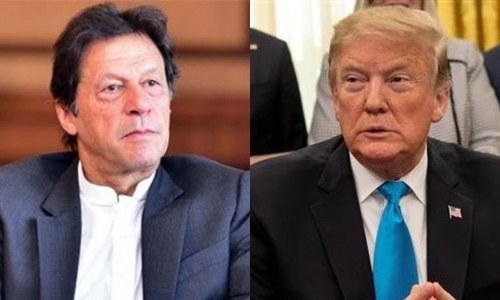
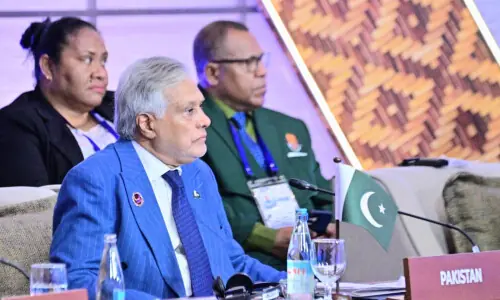
Currently, the relationship can certainly use much tweaking, and perhaps that is what Prime Minister Imran Khan plans to do as he begins his visit to Washington.
To be sure, the optics are quite odd, as along with other officials, Mr Khan has also included the army chief and the ISI head in the delegation.
This may be one of the rare occasions where a head of government is accompanied by the country’s army chief in the meeting with the US president.
Some in Washington may interpret this as weakness on part of the civilian government, while others will ask if Mr Khan has his own reasons for taking him along.
He may well want to send a message to Washington (as well as to his domestic audience) that the civilian and military leadership are on the same page.
Also, since the time of Independence, the military-to-military relationship has been a primary pillar of Pakistan-US ties.
Where the Trump administration is concerned, it views Pakistan primarily through the lens of Afghanistan, while also focusing on counterterrorism.
Although it would be idealistic to assume that this history will be brushed aside and a wide-ranging relationship created after this trip, what is entirely possible is for Pakistan to convince the US that besides military ties, this country’s views on a wide number of issues must also be considered.
So far, under Mr Trump’s watch the relationship has been quite bumpy, a continuation in many ways of what ties were under the Obama administration — the Pakistan-US relationship has yet to move beyond the ‘do more plus’.
True, Afghanistan is important, and there is a realisation in America that without Pakistan’s involvement, stability is not possible in the region.
It is also in Pakistan’s interest to eliminate all transnational militant groups that may be using its soil for terrorism purposes.
But beyond these two issues, Washington needs to pay heed to Pakistan’s concerns on Indian interference in Balochistan, and support in the US for separatists in the province.
The US-India relationship must not come at the cost of isolating this country.
As far as relationships with other regional states — especially China and Iran — go, the US would be better off understanding Pakistan’s policies and commitments, instead of punishing it for pursuing an independent foreign policy.
Published in Dawn, July 22nd, 2019