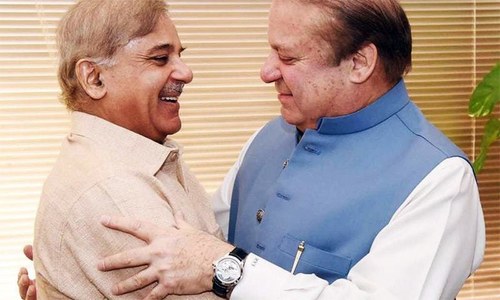
Following the ouster of PML-N leader Nawaz Sharif from the prime minister's seat on July 28, the National Assembly voted in Shahid Khaqan Abbasi as the country's new prime minister today, August 1.
On Saturday, the ruling PML-N had unanimously nominated Abbasi, who was until last week the minister for petroleum and natural resources, as their candidate for the vacancy. He won the election with 221 votes, a thumping margin compared to the runner-up, PPP's Syed Naveed Qamar, who secured 47 votes.
The party had nominated Abbasi as an 'interim' prime minister, which means he will hold the seat till the current Chief Minister Punjab, Shahbaz Sharif, is ready to take over as Pakistan’s chief executive.
Shahbaz Sharif will first have to win an election from a National Assembly constituency, and he is likely to contest the one vacated by his outgoing brother. If he is victorious, which is considered a foregone conclusion, he will take over from Abbasi in the next couple of months.
The opposition parties had failed to agree on a joint candidate: each party in the Assembly fielded its own nominee for the top office. However, even if there had been unanimity in the opposition, the chance of their candidate getting elected was slim, since the majority of the seats in the Assembly belong to the PML-N.
How the prime minister is elected
The prime minister is elected by Members of the National Assembly (MNAs) in accordance with the Second Schedule of the Rules of Procedure and Conduct of Business in the National Assembly, 2007.
To be a candidate for prime minister, one has to be an MNA. As the first step, the candidate has to be proposed for the position of prime minister by any fellow MNA. The nomination then has to be seconded by any another lawmaker. The candidate thus has to have a proposer and a seconder.
Since Pakistan is an Islamic Republic, the head of government also has to be of Muslim faith.
The nomination papers have to be filed to the Secretary the day before the session, by 2pm. The nomination is assessed by the Speaker of the National Assembly on the same day, by 3pm.
If they wish, candidates can withdraw their nomination at any time before polling.
As per the rules,
“Before voting commences, the Speaker shall direct that the bells be rung for five minutes to enable members not present in the Chamber to be present. Immediately after the bells stop ringing, all the entrances in the Lobby shall be locked and the Assembly staff posted at each entrance shall not allow any entry or exit through those entrances until the voting has concluded.”
Then,
“The Speaker shall read out to the Assembly the names of the validly nominated candidates who have not withdrawn, hereinafter referred to as the contesting candidates, in the order in which their nomination papers were received and proceed to hold the poll in accordance with the procedure set out in the Second Schedule.”
After that,
“The Speaker shall ask the members who wish to vote in favour of the candidate[s] to pass in single file through the entrance where tellers shall be posted to record the votes. On reaching the desk of the tellers, each member shall, in turn, call out the division number allotted to him [or her] under the rules.
The tellers shall then mark off his [or her] number on the division list, simultaneously calling out the name of the member. ln order to ensure that his [or her] vote has been properly recorded, the member shall not move off until he [or she] has clearly heard the teller call out his [or her] name. After a member has recorded his [or her] vote, he [or she] shall not return to the Chamber until bells are rung.”
At the end,
“When the Speaker finds that all the members who wished to vote have recorded their votes, he shall announce that the voting has concluded. Thereupon the Secretary shall cause the division Iist to be collected, count the recorded votes and present the result of the count to the Speaker. The Speaker shall then direct that the bells be rung for two minutes to enable the members to return to the Chamber. After the bells stop ringing, the Speaker shall announce the result to the Assembly.”
Once the votes are tallied,
“lf there is only one contesting candidate and he [or she] secures the votes of the majority of the total membership of the Assembly, the Speaker shall declare him [or her] to have been elected.”
However,
“lf there is only one contesting candidate and he [she] fails to secure the votes of the majority of the total membership of the Assembly, all proceedings shall commence afresh.”
And,
“lf there are two or more contesting candidates and if no contesting candidate secures such majority in the first poll, a second poll shall be held between the candidates who secure the two highest numbers of votes in the first poll and the candidate who secures a majority of votes of the members present and voting shall be declared to have been elected as Prime Minister.”
But,
“If the number of votes secured by two or more candidates securing the highest number of votes is equal, further poll shall be held between them until one of them secures a majority of the votes of the members present and voting.”