KARACHI: Utter neglect towards marine pollution costs Pakistan billions of rupees every year that includes the huge expenditures the country incurs on account of vessel repair and maintenance, as constant flow of untreated toxic effluent towards the sea has doubled (metal) corrosion rate.
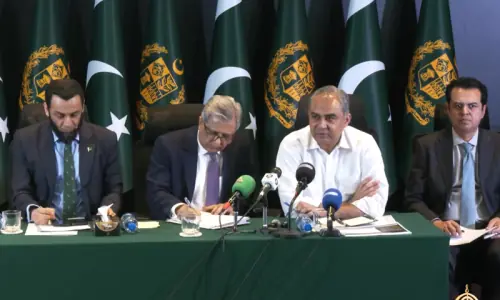
This was stated by Director General of Ports and Shipping Asad Rafi Chandna while talking to journalists on Friday at Jetty No18 of West Wharf, Karachi Port Trust (KPT), where a judicial commission had arrived to observe the level of marine pollution at the harbour.
The commission, led by Justice Mohammad Iqbal Kalhoro, has recently been tasked by the Supreme Court to submit a report on environmental degradation and failure of the state in providing clean drinking water and sanitation facilities in the province.
“Some 25 years ago, these waters were blue where one could see dolphins. Today, marine life is extinct because the harbour has become one hundred per cent polluted,” Mr Chandna said while referring to a study according to which around four million gallons of municipal and industrial waste was discharged into the sea daily.
According to him, the Pakistan Navy alone incurs a loss of Rs1bn annually on vessel repair and maintenance as (metal) corrosion rate owing to toxic effluent in the seawater has doubled.
He regretted the fact that all the three government waste treatment plants were lying closed while the cost of Greater Karachi Sewage Treatment Project, better known as S-III, pending since 2007, had increased from Rs8 billion to Rs39bn due to delay in its completion.
“There is neither an effective regulatory mechanism to force industries to treat their waste at source, nor surveillance of increasing marine pollution. If the Karachi Water and Sewerage Board lacks sufficient funds to build a treatment plant, the children of this city and multinational companies can do that,” he remarked, describing the neglect as criminal.
Saeed Baloch of the Pakistan Fisherfolk Forum, accompanying the commission, spoke about the misery of local residents who suffered not only loss of livelihood, but also health problems caused by marine pollution.
The commission, assisted by water quality experts, boarded a KPT vessel to see the extent of pollution at the breakwater but had to abandon the trip in the middle due to low visibility caused by rain.
Samples from the site were collected by a Pakistan Council of Research in Water Resources (PCRWR) official who would submit its report to the commission.
Earlier in the day, representatives of Korangi and Landhi associations of trade and industry Nehal Akhtar and Ather Ali Khan appeared before the commission. None of them could refer to any data when asked about details on industrial units with treatment plants.
Justice Kalhoro rejected the explanations given over the performance of Sindh Environmental Protection Agency (Sepa) by its director general as he failed to bring any record to prove departmental efficiency.
Published in Dawn January 14th, 2017