0
0

The fact that The Imitation Game is a historical thriller about Alan Turing isn’t the British scientist’s only connection with this review.
This article was written, edited and published on a modern computer; a machine that evolved from the Turing Machine. Aside from being a runner, a cryptanalyst, and a mathematician, Turing also pioneered the field of computer science — though that probably won’t sit well with the many Pakistanis forced into the demanding career.
But I digress. Alan Turing was a complicated individual who (like others in the 1950s) was persecuted for his sexuality, resulting in a disturbed psyche. In terms of Turing’s characterisation, Morten Tyldum paints a wonderfully nuanced picture of the man’s eccentricities and his attempts at fitting into the shape society had been forcing on him.
One of life’s great mysteries answered about what came first — the code or the computer
This is thanks to a surprisingly powerful performance from Benedict Cumberbatch, who has become something of a sex symbol, especially in South Asia. He is the only actor whose relationship status I know due to the countless heartbroken status updates on my Facebook timeline after his marriage.
In The Imitation Game, Cumberbatch manages to create empathy for a man who was perceived as arrogant and anti-social by delivering the right mixture of vulnerability and stubbornness. What’s more, Cumberbatch positively exudes Turing’s intelligence.
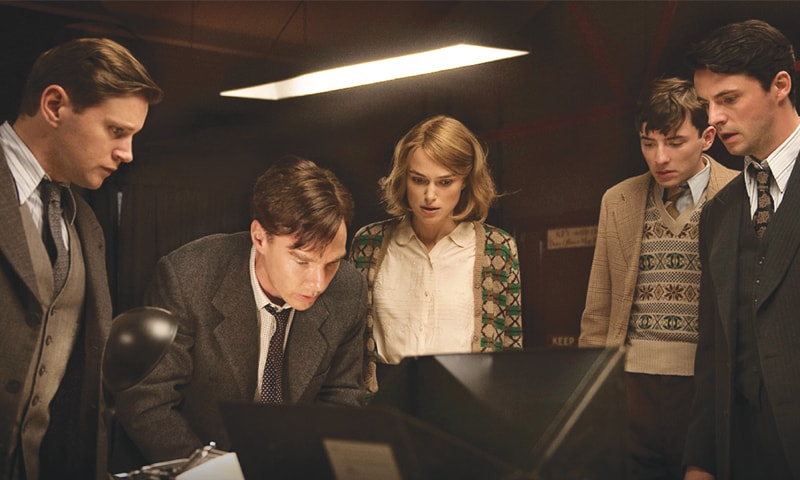 |
Providing support is Keira Knightley (Joan Clarke), who plays the role of a quirky Cambridge graduate. Here she is equally engaging in her role as a highly intelligent woman who forms a deep yet unconventional bond with Turing.
Morten Tyldum paints a wonderfully nuanced picture of the man’s eccentricities and his attempts at fitting into the shape society had been forcing on him.
While The Imitation Game stands tall as an engaging character study, it is surprisingly conventional in terms of narrative. In fact, you could say the film apes World War II era spy films by ticking all of the boxes in the genre. Unfortunately, some of these boxes were needlessly ticked.
Here, Alan Turing is recruited by Commander Alastair Denniston (Charles Dance) to become part of a cryptography team that is tasked with decrypting Hitler’s Enigma Machine. This, of course, was a German machine used by the Nazis to encode secret commands to their troops.
 |
After Alan Turing is considered difficult to work with and on the verge of being fired, he writes a letter to Winston Churchill who, amusingly enough, not only puts him in charge of the team but approves his expensive funding for a proposed machine that Turing strongly believes will help decode Enigma.
Although The Imitation Game works for the most part as an interesting by-the-numbers thriller, some of its attempts at conjuring suspense feel contrived and overly romantic. For instance, the film’s forced double agent mystery falls flat. Meanwhile, its vision of Turing as a one man show surrounded by incompetent men is not only myopic, but inaccurate.
Other fabricated clichés which are difficult to swallow are Turing’s naming of his machine after his first love Christopher, and a fictional detective who is investigating Turing for treason. This angle in particular feels like a tired plot device out of a certain TV detective show Cumberbatch is familiar with.
While one can expect some changes as a part of artistic license in a commercial film that needs to recoup its budget, Turing was a hero who was never accused of betraying his country, and it is a pity that the film raises the unfortunate question in order to magnetise its storytelling.
Rated PG-13 for sexual references, mature thematic material and use of tobacco
Published in Dawn, Sunday Magazine, February 22nd, 2015
On a mobile phone? Get the Dawn Mobile App: Apple Store | Google Play