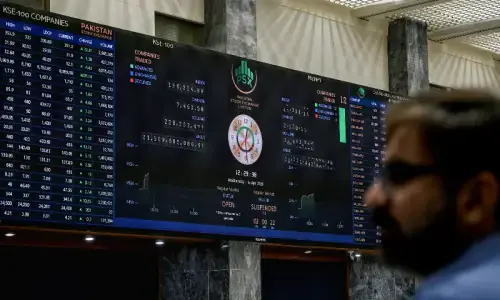
With consumerism thriving, stock prices of listed consumer goods companies have provided investors a juicy return of 42pc in 2014-to-date, outperforming the KSE-100 index’s gains of 22pc by a wide margin.
Last year, the consumer goods stocks did even better, rising 85pc against the benchmark index’s return of 49pc.
“Sales revenue of a sample of 47 consumer goods companies listed on the Karachi Stock Exchange — with a market capitalisation of Rs1.5trn and accounting for 21pc of the bourse’s aggregate market capitalisation — grew by 12.4pc, and their earnings rose by 17.9pc in the first nine-months of 2014,” says Vahaj Ahmed, head of research at Topline Securities.
Food, beverages, pharmaceuticals, tobacco, footwear and personal care products have witnessed growing demand, regardless of the weak economy.
Following the departure of Unilever Pakistan Ltd from the KSE when its parent company bought back its shares, Nestle Pakistan — whose products range from milk to juice, water, baby food and cereal — stands out as the largest fast moving consumer goods (FMCG) company on the bourse, with a market capitalisation of Rs378bn.
The company has posted stellar growth over the past five years, with sales rising from Rs34bn in 2008 to Rs86bn in 2013. This corresponded with an increase in earnings from Rs1.6bn to Rs6bn.
Among the listed FMCGs, food producers are the highest in number. Of the 50 food-manufacturing companies, 32 declared a profit in 2013
The second biggest company, Rafhan Maize, saw sales surge from Rs11bn to Rs24bn and after-tax profit from Rs1.5bn to Rs3bn in the five-year period.
Excluding companies that can be counted on one hand, almost all FMCGs have done equally well. Interestingly, Murree Brewery, which derives its revenue from several lines of products besides its well-known brew, stands out in terms of stock market performance this year, having rallied 151pc year-to-date.
Among the listed FMCGs, food producers are the highest in number. Of the 50 food-manufacturing companies, 32 declared a profit in 2013. Household goods, personal products and pharmaceutical and leisure goods are other segments of FMCG companies that are separately grouped on the KSE. Almost all these sectors have performed well, thanks to higher consumer spending.
Some economists suggest that increased consumerism is stemming from the burgeoning middle class, rising health awareness, falling family size and an improving literacy rate, among other factors.
“With a population nearing 200m, Pakistan is the fifth largest country in the world,” says Professor Hasan Zaidi, who teaches at a business school in Karachi. He asserts that in the last five years, an additional 25m people have joined the middle class, of whom 7m fall in the upper middle class segment.
Answering to a written query, the chairman and CEO of Unilever Pakistan recently explained that sales of most FMCG companies originate 66:34 from urban and rural areas respectively, whereas the population split is the other way round.
“Recognising the potential of rural areas, Unilever stepped up its distribution and sampling efforts, targeted melas, harvest periods and created excitement through sampling activities. Our sales of butter, soap, shampoos, tea and ghee have doubled from Rs31bn in 2008 to Rs61bn in 2013, and profits have jumped from Rs2bn to Rs6bn in five years.”
Muzammil Aslam, managing director of Emerging Economics Research, says higher usage of consumer goods is a healthy sign, as this creates uniformity in prices of products of everyday use. He believes that the recent phenomenal growth in use of packaged goods is due to their low penetration earlier on.
But another economist admitted that the consumption of items that are not produced in the country but merely assembled is a burden on the economy. Lavish consumer habits — like owning several sets of expensive cell phones, apart from non-essential electronic items and luxurious automobiles — are merely fattening the import bill, resulting in a wider current account deficit.
“Besides, when people start to spend more, they mostly do so by compromising their savings,” says a mutual fund manager. Some experts also raised other disconcerting questions.
“The stunted GDP growth rate and the big leap in sales and turnover of FMCGs are in stark contrast to each other,” says one such critic. He posed a pertinent question: “Where does all the wealth spent on the consumer goods come from?” Higher remittance inflow by expatriate workers to their families is one known source of spending on quality goods, particularly by the rural population.
But that is scarcely enough to explain the billions of rupees-worth of sales of consumer good items every year. Many economists suspect that the massive undocumented economy is bankrolling the hefty spending on consumer and durable goods.
The KSE’s Managing Director Nadeem Naqvi subscribes to this view. He observes that while the economic growth is at an anemic 4-4.2pc, the undocumented economy is growing at a much faster pace.
“It provides purchasing power to consumers, which helps consumer goods companies post stunning sales growth, improved margins and glossy bottom lines.”
Published in Dawn, Economic & Business, November 17th, 2014