1
1
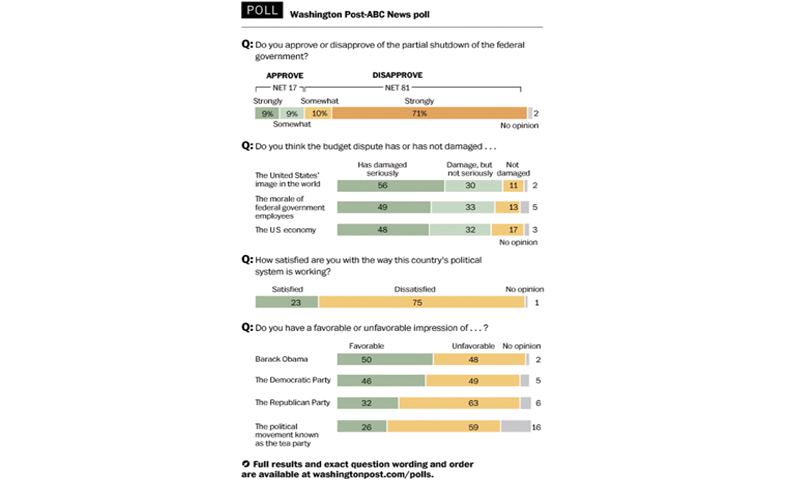
IN a time of political polarisation, one thing still unites left, right and centre: the disdain people have for Washington, their elected leaders and the political system.
Everywhere people look, there are reasons to feel shut out, manipulated or deprived of the whole truth. Big money permeates political campaigns. Political rhetoric is frequently a vehicle for half-truths or pure spin. Members of Congress too often posture rather than legislate.
The impact is all too predictable. Three in four Americans are dissatisfied with the way the political system works, according to a Washington Post-ABC News poll. More than eight in 10 say they trust the government to do the right thing only some of the time, according to a Quinnipiac University poll.
The Pew Research Center recently found that 55 per cent of Americans think the current Congress has accomplished less than recent Congresses — a record high. A survey taken at the end of last year by the National Opinion Research Center and the Associated Press found that six in 10 respondents felt generally pessimistic about how their political leaders are chosen.
Gallup reported last week that only a fifth say members of Congress deserve to be re-elected, which if it holds through November would be lowest percentage in a midterm year since Gallup started asking the question in 1992.
In campaigns, wealthy people with political agendas now speak loudly. The conservative Koch brothers, who will contribute perhaps several hundred million dollars this cycle to try to influence the outcome of elections, have become symbols of the new era. They may be the most prominent practitioners of an accelerating trend, but billionaires large and small, conservative and liberal, all want in on the action.
The Supreme Court’s 2010 ruling in Citizens United versus Federal Election Commission and other legal decisions triggered the explosion in super PAC (political action committee) spending, as well as the darker expenditures by entities that collect individual contributions in the millions of dollars but aren’t required to reveal their donors’ names.
There are serious legal and philosophical arguments about the role of money in politics, as well as real debate about the actual influence all this spending has on election results. But perceptions matter, and many Americans see favouritism and possible corruption lurking behind the dollar signs.
Some politicians say they are outraged by all this money, but they can be selective about their targets. Senate Majority Leader Harry Reid has railed repeatedly against Charles and David Koch on the Senate floor and tried to turn them into the bogeymen of politics. Two months ago, Reid explained his animus toward the brothers, telling NBC’s Chuck Todd, “They are in it to make money.”
That is his right to say. But when it comes to the activities of his fellow Nevadan Sheldon Adelson, Reid has a different view. Adelson, a Las Vegas casino magnate, put about $100 million into the 2012 presidential campaign on behalf of Republican candidates. “I know Sheldon Adelson,” Reid told Todd. “He’s not in this to make money.”
President Barack Obama criticised the Citizens United decision during his 2010 State of the Union address. He was unhappy with that ruling and its implications for the role of money in politics.
Whatever the president thought of the decision in 2010, he has not let his displeasure get in the way of political needs in 2014. On a recent West Coast fund-raising swing, in addition to raising money for Democratic political committees, the president also appeared at events for the Senate Majority Committee and the House Majority Committee, two pro-Democratic super PACs.
Much of the money contributed to candidates and outside groups, whether by billionaires or small donors, goes into television ads by and for candidates. Watchdogs such as The Washington Post’s Glenn Kessler, who writes the Fact Checker column, or Politifact.com and FactCheck.org, do yeoman’s service policing the advertising and the slippery statements from candidates and campaigns.
In this age of fact checkers, ad makers have to be clever. In October 2012, Mitt Romney’s team ran a classic of the genre, an ad that was technically accurate but highly misleading in its overall message.
The ad suggested that Chrysler was going to shift production of Jeeps from Ohio to China. (In fact, the company announced plans last spring to add workers to its Toledo plant.) Ohio news organisations and others roundly denounced the Romney ad as misleading. Some Romney strategists later claimed that the ad had moved numbers in some parts of Ohio. In other words, it was worth all the denunciations.
Most ads in Senate and House campaigns don’t get nearly the scrutiny that the Jeep ad did. When they do, many fail to get a seal of approval for accuracy.
Everyone knows that candidates spend far more time raising money than talking with voters. A leaked campaign planning document written late last year for Michelle Nunn, a Democrat who is running for the Senate in Georgia, offered a breakdown of how she should spend her time. The memo was first published by National Review Online.
Nunn’s advisers recommended that she spend 80 per cent of her time on fund-raising in the first quarter of this year, 75 per cent in the second quarter and 70 per-cent in the current three months. The memo recommended that she still should devote half her time to raising money in the final month of the campaign. That’s the new normal for most candidates.
Meanwhile, important legislation languishes in Congress. To too many Americans, the system appears broken, rigged against them or both.
—By arrangement with The Washington Post
Published in Dawn, August 26th, 2014