3
3
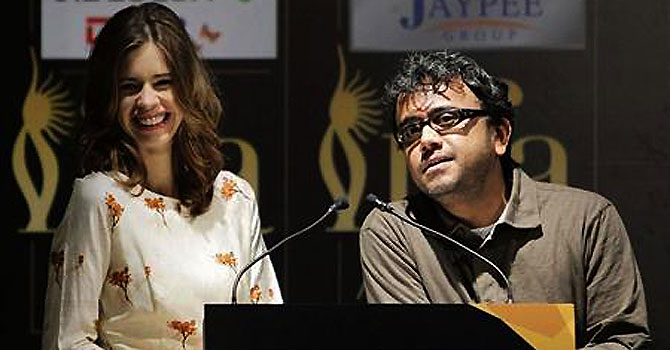
Indian director Dibakar Banerjee is marking 100 years of Indian cinema with a short film inspired by a story written by Bengali film-maker Satyajit Ray.
Ray, who shot to global fame in the 1950s with the coming-of-age narrative "Pather Panchali" (Song of the Little Road) and won a lifetime achievement Oscar in 1992, wrote the short story "Patol Babu, Film Star" - about a middle-aged man who gets his moment of fame playing a bit role in a movie.
Banerjee adapts this story for a short film, one of four in the anthology film "Bombay Talkies", that opens in cinemas on Friday exactly a century after the first Indian feature "Raja Harishchandra" held audiences spellbound in Mumbai and laid the foundation of the world's largest film industry.
"Bombay Talkies", to be screened at the Cannes Film Festival this month, also features short films by well-known directors Dibakar Banerjee, Zoya Akhtar and Karan Johar.
Banerjee, 43, spoke to Reuters about making a short film, cinema being viewed as human history and how Bollywood dominates Indian cinema.
Q: How different is making a short film from making a full-length feature?
A: It's just a different way. I took a short story written by Satyajit Ray, a very interesting story and I adapted it. It is similar and yet different. I have taken the core of the story, and have changed the setting from 1960s Calcutta to 2013 Bombay and given it new elements and dimensions. The story is also about a man defining his own success for himself. That remains the same but the definition has evolved from there. It's about man trying to succeed as a professional and as a man trying to command the respect of his peers.
Q: Is it an emotional film?
A: I haven't tried to move away from any emotion and I hate over-sentimentality and over-emphasis on the same things, as if you are telling the audience to cry or laugh. Having said that, this is the most emotional film I have made to date. This one has a very apparent emotional level and it has a conclusion.
Q: Do you mean to say your other films don't have conclusions?
A: We really go into films to escape. So a few films like mine, which don't give you that crutch to escape, have to survive on the strength of other things, like a visceral attack or the way of telling you a story which commands your attention, and respect for the audience's intelligence, rather than talking down to them.
Q: What are you focusing on in this film?
A: This film is about the presence of Indian cinema in our lives. At another level, it is an universal story. You take that as a means to say something that is bigger and more meaningful.
Q: Has Indian cinema changed over the years?
A: No, it hasn't changed. Cinema is who we are and cinema is who we want to be. When you see a (film-maker) Karan Johar romance or an (film-maker) Aditya Chopra romance, you can see what a young man of 1995 was. He's not there in the film but that's what he wanted to be. Similarly in the 70s or the 40s. Cinema is the history of the subconscious. When you watch films, you get human history from the personal point of view.
Q: Are we forgetting regional cinema in this celebration of Indian cinema? Is it all about Bollywood?
A: If I was a Bengali film-maker, I would have made it in Bengali, but I make films in Bollywood. If you see by sheer numbers and if you go by the sheer number of people who speak Hindi, then yes, it pretty much represents a majority of Indian cinema. I would like regional cinema to prosper and the fact that it hasn't cannot be the fault of Hindi cinema. It is the fault of the people who are making those regional films. Because you are not being relevant, you are not reaching enough people.