SRINAGAR Police arrested a top separatist leader Wednesday for rallying massive anti-India protests that have rocked the Indian-administered Kashmir for months, and supporters reacted by staging fresh demonstrations and hurling stones at troops.
The arrest of Kashmiri separatist leader Syed Ali Shah Geelani, 82, at his residence in Srinagar, the regions main city, came days after he laid out stiff conditions for peace talks with the Indian government.
The mostly Muslim Himalayan region has been roiled by anti-government demonstrations and clashes between protesters and government forces for the past three months. At least 69 people, mostly teenage boys and young men in their 20s, have been killed in the civil unrest against rule by predominantly Hindu India.
Police Inspector-General Shiv Murari Sahai said officers arrested Geelani for causing breach of peace in the region.
The news of his arrest triggered fresh protests as scores of young men defied a curfew in a neighbourhood in Srinagar and threw stones at government forces.
Police and paramilitary soldiers fired tear gas to quell the protesters, said a police officer on condition of anonymity as he was not authorised to speak with media. No injuries were reported.
Anti-India sentiment runs deep in Kashmir, which is divided between India and Pakistan, and claimed by both in its entirety. Protesters reject Indian sovereignty over Kashmir and want independence or a merger with predominantly Muslim Pakistan.
Last week, Geelani demanded that India accept Kashmir as a disputed territory, withdraw hundreds of thousands of troops from the region and release all political prisoners as a precondition for peace talks.
Otherwise, the protests would be intensified, warned Geelani, a key leader of the All Parties Hurriyat Conference, a conglomerate of separatist groups espousing nonviolent means rather than insurgency.
There was no response from the Indian government to Geelanis demand.
India has fought two wars with neighbouring Pakistan over control of the region since the archrivals won independence from Britain in 1947.
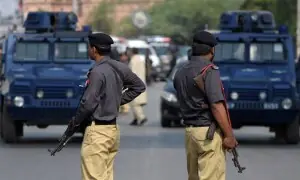
On Wednesday, the streets of Srinagar and other towns were deserted as armed troops in riot gear enforced a rigid curfew for a second straight day.
Armoured vehicles patrolled the streets and government forces used steel and barbed wire barricades to seal off public squares and neighbourhoods in Srinagar.
Security was further tightened after clashes between government forces and protesters in Srinagar and half a dozen towns and villages injured at least 13 people late Tuesday, a police officer said.
The recent unrest in Indian-administered Kashmir is reminiscent of the late 1980s, when protests against New Delhis rule sparked an armed conflict that has so far killed more than 68,000 people, mostly civilians.