Bajwa rejects India’s surgical strike claim


 0
0
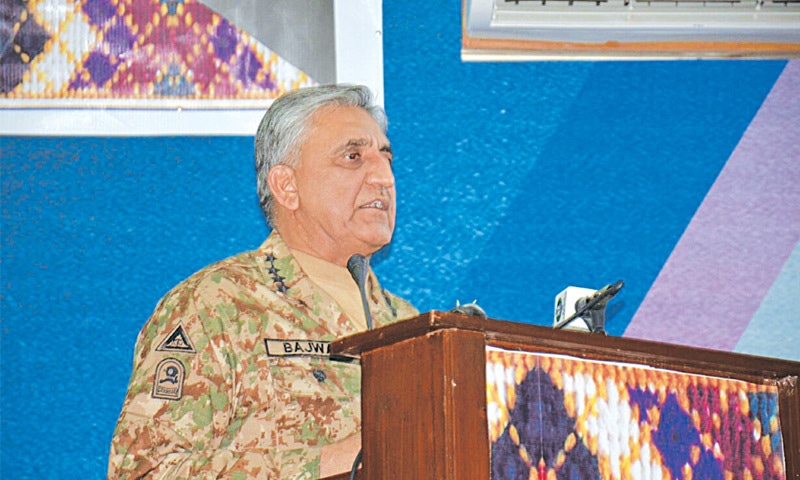
KHUZDAR: Chief of the Army Staff Gen Qamar Javed Bajwa on Thursday rubbished a recent claim by his Indian counterpart about surgical strikes having been carried out against Pakistan.
In an interview to an Indian TV channel earlier this week, Gen Bipin Rawat had said that the surgical strikes against Pakistan were meant to send out a message and that further strikes cannot be ruled out. On Thursday, the director general of Inter-Services Public Relations tweeted, “#COAS Gen Qamar Javed Bajwa rejects self defeating claims by Indian COAS about ‘so called surg[ical] strikes’ and its possible recurrence”.
Another tweet read, “`Pakistan Armed Forces are fully geared to respond to any aggression by India’ COAS”.
Earlier, Gen Bajwa while addressing a seminar organised by the Balochistan University of Engineering and Technology in Khuzdar said that youths of Balochistan are the future of Pakistan. He advised them to spearhead their efforts in all fields to take Pakistan forward and bring the country glory.
“So get ready to face challenges, grab the opportunities and make us all proud,” he asked the audience, largely comprising the youth.
“Our enemies have been trying to keep Balochistan in a state of constant unrest and instability,” he said, adding that “being a resilient nation, we have fought well and have defeated their plans”.
“Today, Balochistan is stronger, integrated and on its way to recovery,” the army chief said. “Development of the Gwadar port, construction of 870km of road infrastructure and the China-Pakistan Economic Corridor (CPEC) is testimony to our national resolve.”
He said that federal and provincial governments as well as the army were trying their best to ensure peace and stability in the province.
“What we need to do is to remain focused on our vision of connecting the whole region and beyond; for economic growth and prosperity,” he said, adding that in order to do this, the prerequisite was to “optimise Balochistan’s geostrategic location and galvanise enormous human and natural resource potential”.
This, he said, would only be possible when the external and internal challenges were dealt with properly.
He said that connectivity is not just about bringing places closer, it’s about binding people through the bond of shared development and prosperity.
Published in Dawn, January 6th, 2017