0
0
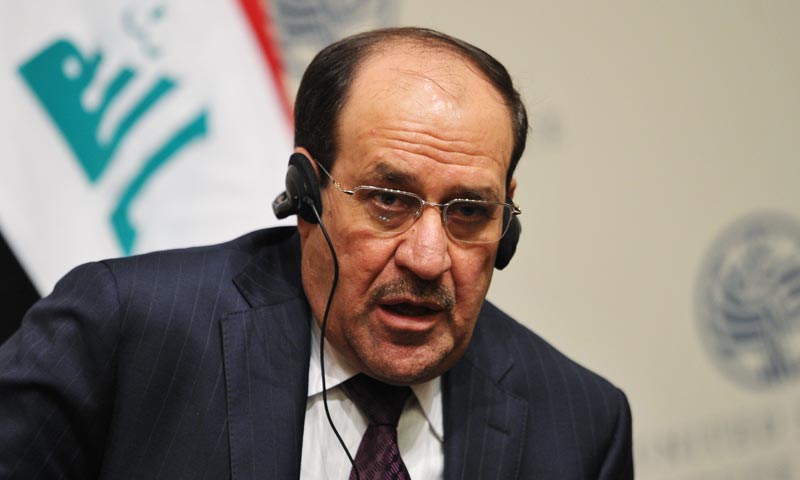
WASHINGTON: Iraqi Prime Minister Nuri al-Maliki on Thursday pleaded for a major international effort to combat Al-Qaeda and terror networks, likening the fight to a third world war.
In Washington for a series of meetings hoping to drum up more support for Iraq, Maliki said that with US help his country had defeated Al-Qaeda.
But now with the vacuum created by the toppling of long-standing regimes during the Arab Spring, “the terrorists found a second chance.”
His visit to the US comes as Iraq witnesses its worst violence since 2008, a surge in bloodshed that has killed more than 5,400 people this year despite several operations and tightened security measures.
“We want an international war against terrorism,” Maliki said in a speech to the United States Institute of Peace, calling Al-Qaeda and its ilk “a virus”which was trying to spread “a dirty wind” around the region.
“If we have had two world wars, we want a third world war against those who are killing people, killing populations, who are calling for bloodshed, for ignorance and do not want logic to govern our daily lives.”
Maliki also called for the convening of an international conference on counterterrorism to be hosted in Iraq.
His government has been criticized for not doing more to address grievances in the Sunni Arab community over alleged ill-treatment at the hands of the Shia-led authorities.
But the Iraqi leader, who has served two terms already, denied his country was plagued by sectarian unrest, pitting Sunni and Shiite Muslims as well as Kurds against each other, saying “all are targeted.”
He blamed the unrest for setting back Iraq's struggles to emerge from the dictatorship of Saddam Hussein and the bloodshed of the US invasion to rebuild its institutions, schools and homes.
Maliki will meet US President Barack Obama on Friday at the White House to press for military equipment and greater cooperation in fighting militants.
The United States vowed Wednesday to help Iraq combat terror groups, but said Baghdad needed a strategy which was not just based on increasing its military arsenal.
“What we don't want the Iraqis to do is to take just a security-centric approach to this. This is an asymmetrical threat and it has to be approached asymmetrically,” a senior US official told reporters, after Maliki met for two-hours with Vice President Joe Biden.
“What that means is making sure they have information in terms of where people are located, where it's coming from, where the funding is coming from, and that's something that we can do pretty effectively.”
”Without terrorism we would have leaped forward in providing services for our people,” Maliki insisted.
“All our efforts should aim at preventing the success of Al-Qaeda and other terror organizations,” the Iraqi premier said, adding that while Baghdad was neutral in the conflict in Syria it was concerned militant groups might win control and gain a platform to wreak havoc across the region.