The Swat carnage
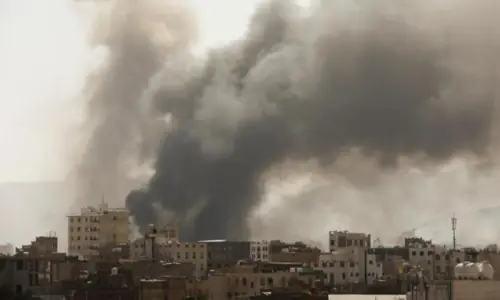
THE anachronistic idea which Fata represents — that the tribal area is beyond the jurisdiction of Pakistani laws — is expanding instead of shrinking. Also expanding with it is the theatre of war. The death and destruction in Swat on Thursday testify to this truth. Blaming ‘religious extremists’ for this carnage is stating the obvious. There are many who share the responsibility for the violence. Thus there are people like Maulana Fazlullah, also known as Maulana Radio because of the illegal FM radio station he runs, who upped the ante in Swat and thus instigated this violence by turning Islam into fitna — public mischief. It is a pity that the government has chosen to procrastinate when it comes to dealing with religious militancy, giving the maulana a free hand. Not surprisingly it has led to the deterioration of the law and order situation in the area. Commanding a well-armed militia, Fazlullah, a semi-literate man with obscurantist views, has terrorised the local people in Swat and the government’s writ has virtually ceased to exist. As the NWFP home secretary and the provincial chief said at a press conference, Fazlullah has set up a 4,500-strong Shaheen Force and his volunteers run courts. In other words a parallel government à la Lal Masjid, but on a larger scale, has come into existence in Swat.
The bombing of the bus carrying FC personnel in Mingora came a day after the provincial government deployed thousands of paramilitary troops and police in the 59 villages where Fazlullah runs his kingdom in the name of religion. The Tehrik-i-Nifaz-i-Shariat-i-Mohammadi, to which Fazlullah belongs, was almost destroyed in the aftermath of the American attack on Afghanistan and the fall of the Taliban regime. The TNSM was also one of the outfits banned by President Musharraf in January 2002. However, Fazlullah got recognition of sorts when the MMA-run government signed with him on May 22 an agreement whereby he agreed to drop his opposition to girls’ education and to polio drops and discontinue arms production in return for the government’s permission to run the FM radio station. This enabled Fazlullah to consolidate his position.
The NWFP government has no choice but to restore its authority to the area and crush what could turn out to be a re-enactment of the Lal Majid drama. The heavy casualties in the Lal Masjid crackdown stemmed from the authorities’ failure to act early. There is no doubt that innocent civilians will get caught in the crossfire when the crackdown is finally launched, and there will be justified protests from the media and the rights groups. That is where the government has to realise that it cannot go it alone. Without a national consensus, the government will have to put up with a character like Amir Siddiqui, deputy imam of the Lal Masjid, who says that the soldiers killed in Thursday’s blast ‘died like infidels’. This is coming from a man who gets paid from government coffers. The answer, in our view, lies in fair and free elections, for a government enjoying a popular mandate is far better equipped to deal with the scourge of extremism than a quasi-civilian set-up whose different elements are pulling in different directions.
Transplanting life
THE newly promulgated Transplantation of Human Organs and Tissues Ordinance 2007 is being hailed by doctors and the civil society as a promising step to give hope of life to end-stage kidney-failure patients. It is also expected to curb the exploitative organ trade that has brought such a bad name to the country and the medical profession. This ordinance may be a result of an arduous 15-year battle but victory is still far from absolute. The most difficult task ahead is to ensure that it gets a permanent status by being adopted as an Act and is implemented fully, which is still in doubt. It prescribes severe penalties for violators and can put out the transplant tourism mafia significantly by making evaluation committees responsible for monitoring transplantation cases and ensuring that no commercialism is taking place. However, there are fears — and not unfounded — that the first violation may have already occurred as 19 hospitals in Karachi, Lahore and Islamabad have been temporarily permitted by the Human Organ Transplant Authority (HOTA) to conduct operations without prior inspection. Apprehensions abound that in doing so, the authority may have also included institutions of dubious repute. These oversights can not only delay the ordinance from becoming a law but also keep it from putting an end to unethical practices. Regional monitoring committees are the most important aspect of the edict to prevent unscrupulous elements from bypassing laws and ensuring that no organ is procured from non-related living donors.
The ordinance also lends official recognition to the fact that some among us are vulnerable to the point of being constrained to sell their organs and sacrifice their physical integrity and well-being. That is because there is a severe shortage of organs and the Sindh Institute of Urology and Transplantation (SIUT) must be lauded for its donor card campaign to combat commercialism and exploitation and to increase the availability of organs from deceased donors. The campaign will create awareness and encourage people to will their organs in case of brain death, which is allowed in Islam and is currently being practised in many Muslim countries. An evaluation mechanism is also required to ascertain brain death, tissue suitability and fitness levels to facilitate the transplantation procedure. The sooner this is set up the easier it will be to implement the ordinance.
Death in custody — again
IT will be a while before doctors can determine the actual cause of the death of a young man said to have been tortured while in the custody of police in Vehari recently. Given the numerous instances of torture of detainees kept in police lock-ups across the country — and quite often with fatal consequences — it would not be surprising if the findings prove the allegations of police brutality correct. In that case, one hopes that the murder charges registered against the erring police officials will be pursued vigorously, and not in the half-hearted manner that is usually the norm when police officials want to cover up the crimes of their colleagues. Fully cognisant of the failings of the law-enforcement department, police laws provide for penalties against erring officers. Moreover, the public safety commissions — although still at a fledgling stage because of official apathy — are also required to address complaints against policemen in order to make the force people-friendly.
What has been disappointing is the lack of public pressure to make these forums fully functional. It seems that enervated by the struggle to cope with daily life, there is little spirit left among civil society members to rally against institutions that are consistently violating human rights. Unless they actively take on issues such as police brutality the government will not feel the need to ensure that laws are followed or to press ahead with the ratification of international obligations such as the Convention Against Torture. Despite elaborate laws seeking to curb arbitrary behaviour on the part of the police, there will be no let-up in cases of torture by security officials. Public and court pressure on the intelligence agencies has helped in the recovery of missing people clandestinely picked up for their ideological beliefs. Similar public pressure on the police department can also yield positive results.
EU plans a ‘blue card’
FORGET hopes of a new era of European harmony and unity following the agreement in Lisbon last week on a new reform treaty to whip unwieldy European Union institutions into shape: the bloc faces years of anxiety on whether the new institutional blueprint will be ratified by all 27 countries.
EU policymakers have also become entangled in a passionate and often acrimonious debate on just who should lead the EU for the coming years.
Most crucially for Asian governments, discussions in Lisbon also revealed deep and damaging fault lines on future EU economic policy and Europe’s response to globalisation. There’s little doubt that EU countries do not see eye to eye on whether globalisation is a threat or opportunity, with some still believing in the virtues of free trade but others voicing fears that global competition will lead to more job losses and the flight of investments to cheaper locations in Asia and elsewhere.
Broadly speaking, while France is leading the battle for more EU protectionism and economic nationalism, Britain and Nordic nations are struggling just as hard to keep Europe’s markets open to foreign exporters and investors.
Divisions over Europe’s economic future have also come to the fore on the sticky issue of immigration and more specifically, over European Commission plans for a so-called ‘blue card’ system to lure skilled foreigners to Europe. Once again, while some EU states believe Europe needs foreign labour to fill crippling shortages of workers in areas such as information technology, others — including Germany — are averse to any plans to import foreign workers, fearing this will further exacerbate wide-ranging xenophobic sentiment in the bloc and trigger even more social tensions.
While these and other divisions — over energy sector liberalisation for instance — are likely to dominate the EU agenda in the coming months, the current focus in Brussels and other EU capitals is on reaching agreement on the identity of the man or woman who could become the European Union’s first-ever president once the new reform treaty enters into force in mid-2009.
Former UK prime minister Tony Blair appears to be a frontrunner for the prestigious and high-profile job. Surprisingly, given the tradition of Franco-British rivalry, among those in favour of such a decision is French President Nicolas Sarkozy.
For all the pomp and ceremony attached to the post, the future EU president will have no executive powers. He will, in fact, preside over bi-annual EU summits, known in the bloc’s jargon as European Councils which bring together EU heads of state and government. The post is a two and a half year term, but it can be held twice. The system replaces the current situation where the post of EU president rotates among member states every six months.
Despite his high-profile career, however, Mr Blair — currently an international envoy for the Middle East — is just as controversial a personality inside the Union as he is outside it. Like many in the Muslim world, EU policymakers point out that Mr Blair’s support of the US-led invasion of Iraq in 2003 caused a deep rift in Europe, with France and Germany opposing the war.
In Brussels, many also believe it would be counterproductive to put Blair in the EU driving seat when Britain does not participate in key common policies, including the euro as well as justice and home affairs.
Other frontrunners for the top job are less controversial. Luxembourg’s Prime Minister Jean-Claude Juncker, currently head of the euro group, is respected by those who remain loyal to the dream of an increasingly integrated EU while others favour Danish prime minister Anders Fogh Rasmussen.
There’s much less uncertainty over who will lead the European Commission, the EU’s executive body, over the next few years. The organisation’s current president, former Portuguese premier Jose Manuel Barroso, is reportedly eyeing a second term from 2009 and is likely to be reconfirmed in his job.
Speculation is mounting, on the other hand, over who will become the first-ever EU foreign minister, a post which will combine the two current jobs of EU foreign policy chief Javier Solana and EU external affairs commissioner Benita Ferrero-Waldner. Although many EU policymakers believe the highly-respected Solana should be asked to stay on, Sweden’s Foreign Minister Carl Bildt has also been cited as a possible candidate for the post.
The new treaty will be formally signed by all European leaders in Lisbon on Dec 13 and subsequently be submitted for ratification next year, with a view to coming into place by mid-2009, ahead of elections to the European Parliament. While Ireland is obliged under its constitution to hold a referendum on the blueprint, Britain’s Gordon Brown is fighting hard to avoid such popular consultation which many fear will result in a public ‘no’ to the treaty. If this happens, the bloc could be plunged into a serious institutional crisis.
For the moment, however, agreement on the treaty allows EU leaders to shift the focus from institutional matters to issues such as globalisation and climate change. A report by the European Commission drawn up for the Lisbon summer argues that the EU should avoid being a passive spectator and start working to ‘shape’ globalisation.
The message is simple: the EU executive argues in favour of reciprocity in global trade and business relations, saying foreign trading partners — including Asian states such as China and India — should open their markets as much as the EU does.
Commission president Barroso suggests that openness is a two-way street and that third countries should offer comparable levels of openness to EU exporters and investors. In addition, foreign companies wishing to do business in EU territory should not be allowed to bypass the rules applied in the Union’s internal market.
Mr Sarkozy has emerged as the strongest advocate of such a principle. ‘Let’s not be naive, we must demand reciprocity,’ he said, complaining that EU firms were obliged to comply with severe environmental and social requirements which were not imposed on their non-European competitors. ‘We have to remind others there are rights as well as obligations,’ Mr Sarkozy added, singling out Russia and China.
One way of meeting the challenge posed by globalisation is for the EU to recruit talented and skilled foreign workers, says the EU Commission. As such, argues Commission chief Barroso, the bloc needs a blue card scheme allowing non-EU nationals to live and work in Europe for a limited amount of time.
‘We are not good enough at attracting highly skilled workers nor are we young enough or numerous enough to keep the wheels of our societies and economies turning on our own,’ Barroso has warned. ‘With the European blue card, we send a clear signal: highly-skilled workers from all over the world are welcome in the European Union,’ Mr Barroso added.
According to commission estimates, labour shortages will peak by 2050 when 25 million Europeans are expected to retire from work and one-third of the population will be over 65 years of age. While in Europe, non-European highly-qualified workers make up only 1.7 per cent of the employed population, they account for nearly 10 per cent in Australia, over seven per cent in Canada and over three per cent in the US.
The writer is Dawn’s correspondent based in Brussels.
OTHER VOICES - Bangladesh Press
Anti-corruption task forces on a roll
IT comes as a great relief that anti-corruption task forces have started working at the Dhaka City Corporation and other public services agencies. Rajuk, the city developer, will also come under the close watch of the task forces. The purpose of the move is not to punish some people who are perceived to be corrupt but to overhaul the public services agencies, which are mired in deep corruption. Other agencies that will also be watched are the Zia International Airport, Chittagong Port and Customs, Dhaka Electric Supply Authority, Benapole Customs and Titas Gas.
Corruption and lack of skills have slowed work to a crawl. People do not get services from the government because the agencies are run by many unskilled people.
The caretaker government is determined to curb corruption by overhauling the services agencies — an act which it deems unavoidable.
In his previous speeches to the nation, chief adviser Fakhruddin Ahmed underscored the need for better public services. With the changes made, the government’s efforts will not only cut the suffering of the people, they will also help boost the economy.
Businesspeople count extra pennies for greater business costs at the ports. The burden is shifted on to consumers as a trickle-down effect. In initial efforts, the government sent an anti-corruption task force to Chittagong Port — a case in point — which quickened the pace of work.— (Oct 25)
Missions miss out on export opportunities
MOST diplomatic missions of Bangladesh have failed to reach export earnings targets. As many as 23 out of the 44 missions have missed the targets set for fiscal 2006-07. Questions abound. Every year, the government spends millions on missions abroad. But there is no clear explanation as to why the missions have failed…to meet the targets.It seems to be a trend for Bangladesh. The ministry of foreign affairs or any other related agency of the government tends to keep mum on the issue.
Every year, the government sets export earnings targets for the missions to reach. Only 21 missions out of the 44 have reached the fiscal 2006-07 targets.
The mission officials do nothing more significant than organising trade fairs and accompanying businessmen when they run errands in foreign countries.
For Bangladesh, knitwear ranks as the biggest export revenue earner, but there are no close connections between knitwear exporters and mission officials. We feel that the government should build a system that holds mission officials largely accountable for the failure to boost exports.
The government should bring transparency to the appointment of officials to its missions and bring dynamism to the export sector. The diplomatic missions have twin roles to play: enhance bilateral ties and shore up trade links. We hope the officials will act a little more responsibly. — (Oct 25)
— Selected and translated by Arun Devnath
| © DAWN Group of Newspapers, 2007 |