In cold storage?
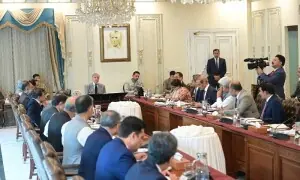
THERE is no doubt that we will continue to hear cheerful promises from the government from time to time, but for all practical purposes the women’s rights bill is now in cold storage. The government must now dispel the impression that the MMA’s rejection of the proposed amendments helped it wriggle out of its commitments on the Hudood laws. What happened on Wednesday was no surprise — the government conceded tacitly that it had lost the battle with the MMA, because for the third time the bill in question was put on the National Assembly’s agenda but was not taken up. In fact, it is a measure of the ruling coalition’s resolve on the issue that neither Prime Minister Shaukat Aziz nor PML President Chaudhry Shujaat came to the House, and an angry Speaker adjourned the session. For the six-party alliance it is a victory. As for the government, it must prove that what has happened over the last few days is not an unmitigated disaster and that it still has the will and political acumen to push the legislation through. Besides facing stubborn opposition from the MMA, the government position was also weakened by the split within its ranks. The MQM, a key government ally, made it clear that it would not support the bill if it included amendments made through “the back door”. The apprehension that the bill is in cold storage stems from the refusal by Information Minister Muhammad Ali Durrani at a press conference on Wednesday to give a date for taking up the bill again. He said the government was under no pressure for “a time frame” for the bill, that its aim was consensus, and that its priority was “soundness” rather than speed.
The MMA’s refusal to support the revised bill is astonishing, because the ulema on the government side included some respected personalities, including Maulana Taqi Usmani. As claimed by Chaudhry Shujaat in a written statement, all the ulema on their side had found the revised bill in keeping with the Quran and Sunnah. Yet MMA leaders Maulana Asadullah Bhutto and Maulana Syed Nasib Ali Shah said on Thursday that several points agreed upon earlier with the ulema on the government side had not been included in the revised bill. The proposed amendments, they said, were not enough for the MMA to withdraw its threat to quit the National Assembly and the Balochistan Assembly if the ruling party insisted on having its way. Apparently, nothing is going to satisfy the MMA.
The Hudood ordinances were enacted by a dictator who enjoyed the unqualified support of a section of the ulema for political reasons. The MMA is a continuation of that group, and for that reason it has made it a prestige point not to compromise on a law enacted by a general who did them the ultimate favour by doing their job for them — overthrowing the Bhutto government. Whether the original Hudood ordinances and the proposed changes are in conformity with the Islamic principles of jurisprudence and equity do not seem to matter any more, for the issue has been thoroughly politicised. As over the Qadiani issue during the Bhutto period, so over the Hudood laws now, the ulema lobby has discovered its strength. In the given context, the government seems to believe that it has no choice but to go on kowtowing. The ruling coalition must prove that this impression is wrong and that it is quite capable of holding its ground.
Civic failure in Hyderabad
CONTRARY to what the Hyderabad nazim would have us believe, nature alone is not responsible for turning his city into a disaster zone. Karachi’s rain-related misfortunes, bad as they were, seem trifling now compared to what Hyderabad is experiencing, but one common thread runs through both sorry sagas. Like his counterpart in Karachi, who was quick to pin the blame for the civic collapse on anyone but his own administration, Mr Kanwar Naveed has also chosen to ignore the truth. In his view, “no amount of planning” could have prepared the city for “a natural disaster of this scale”. True, Hyderabad is not accustomed to being battered by ten inches of rain in less than twenty-four hours. The scale of the disaster, however, is a human creation. Civic apathy and failure are the primary reasons why large swathes of Hyderabad now resemble a swamp.
Hyderabad’s drainage system is dependent on a network of pumping units, many of which are understandably located in low-lying areas. But in an amazing display of incompetence, the city planners failed to realise that these pumps ought to be placed on raised platforms. During the recent downpour, the pumps promptly disappeared under water and were thus rendered useless — along with the standby generators recently installed by the local government. Another case of major mismanagement involved the administration’s failure to clear choked sewerage lines prior to the onset of the monsoon. To be effective, cleaning of lines must be a year-round activity, not just the occasional ‘campaign’. Even when it tried to tackle a problem, the local government failed miserably. A trench dug up earlier to lay new sewerage lines was left unmarked following the rains, and at least two people drowned when they suddenly plunged some six feet while wading across the road through chest-high water. After the deluge, all that can be done now is damage control. Besides somehow pumping out the standing water, rations and medicines must be delivered to those marooned on the upper storeys or roofs of their houses. People willing to leave their flooded homes should be evacuated forthwith. The Hyderabad administration has made enough excuses and must now get down to real work.
Checking mobile phone theft
GIVEN the alarming increase in mobile phone theft, particularly in Karachi, the Pakistan Telecommunication Authority must now wake up and implement the anti-mobile phone theft system by the September 30 deadline. Two prior attempts to implement the scheme proved unsuccessful but that cannot be allowed to happen again. That 29,410 phones have been stolen in the first eight months of this year in Karachi should prompt the PTA into taking action immediately. If the anti-mobile phone theft system is put into effect, both the SIM card and the phone set will be deactivated, rendering it useless and thus reducing the demand for stolen phones. The CPLC has been pressing for this system for over a year now but it is being met with resistance from mobile phone operators as well as electronics market associations — both of whom stand to lose financially if the system is put into effect. But the PTA has a responsibility to consumers and cannot be bullied by mobile phone networks into acceding to their unfair demands.
The PTA must go ahead and ensure that the scheme is implemented by September 30. If need be, companies that refuse to comply on one pretext or another must be fined. The PTA should also ensure that its rule of allowing one person to have up to 10 connections in his or her name is strictly followed. One phone company had issued as many as 5,000 connections to one subscriber, which is a blatant violation of rules. The CPLC associates this problem with the rise in criminal activities and it must be thoroughly investigated so as to check irregularities of all kinds.
How to ensure Justice for all
JUDGES and legal luminaries of 42 countries came to Islamabad on the eve of the golden jubilee of the Supreme Court of Pakistan and held a meeting. If such conferences were held on any other continent, “justice for all” would not necessarily have been the topic as it appropriately was in the case of Pakistan and the Asian continent where socio-political realities make justice hard to get.
This is apparent from the fact that despite constitutional guarantees for it, the scales of justice invariably tilt in favour of the state when a dispute is between the state and a common citizen.
Executive excesses have led to chaotic conditions and the man in the street has lost faith in judicial institutions. According to the latest Amnesty International Report, corruption is rampant in the judiciary. Let there be a candid admission of the fact that Pakistan, despite a written Constitution, has never had an independent and fearless judiciary to enforce the fundamental rights of the citizens enshrined in the Constitution of 1973.
The guardian of the Constitution had left the Basic Law unguarded when it was being mutilated and disfigured. Justice continues to be elusive for the common man despite the best and sincere efforts of the present chief justice of the apex court of Pakistan through suo motu actions to redress the grievances of the people.
Earlier, Mr Nasir Aslam Zahid, who is now a retired judge of the Supreme Court, while he was chief justice of the High Court of Sindh, used to convert into petitions numerous complaints of aggrieved persons addressed to the chief justice from various parts of Sindh. Some of these petitions spoke of heart-rending tales of tyrannies perpetrated on oppressed and suppressed men, women and children by tyrants of an exploitative system in league with a corrupt bureaucracy.
The long hands of the law could reach the dark dungeons of remote jails in Sindh to liberate those languishing there without any hope for release. Woeful tales of this forgotten and neglected class of society defy description. Unfortunately, this period of ‘justice for all’ did not last very long.
The Basic Law of the land is the Constitution of 1973. It is an ideal document if constitutional governance is ensured and any deviation from it is not allowed or condoned by the guardian of the Constitution, the Supreme Court of Pakistan. But the executive organ of the state never felt accountable to the judiciary, the third important pillar of the state while going beyond the limits of the law and the Constitution.
The people of Pakistan have suffered and continue to suffer as the judiciary does not always play its constitutional role and does not take suo motu notice of the unconstitutional policies pursued or actions taken by civil and military governments over the last 50 years. Governments have always desired to have a docile and submissive judiciary.
Eminent legal brains offered their services to totalitarian regimes to subdue the judiciary causing incalculable damage to the polity of Pakistan. Political and democratic institutions could not develop and take roots and the lack of accountability has led to countless political evils in the country. It is a sad commentary on the state of Pakistan. The fundamental rights defined in Article 8 to 28 under Chapter 1 of, Part-II of The Constitution, can be enforced only by an independent judiciary to ensure ‘justice for all’.
Effective enforcement and protection of these rights by the superior judiciary can mitigate the sufferings of the people and can lead to the protection of life, liberty, honour and property of the citizens for a peaceful and civilised life.
Why are our courts flooded with cases? People remain locked in litigation and in some cases their generations also inherit the disputes pending in the courts. The following are the major causes of massive litigation in our law courts from the lowest to the apex court of the country:
* False and frivolous litigation.
* Dishonest and corrupt state functionaries generate litigation because of their ulterior designs.
* Investigating agencies indulge in massive corruption and thus provide causes for multiplicity of litigation.
* Abuse of discretionary powers and denial of administrative justice compel aggrieved persons to seek the intervention of the courts.
* All citizens are not equal before the law and this discrimination breeds litigation.
The object of justice for all can be achieved if these causes are seriously addressed. The cure for these causes also lies with the judiciary. It can win over the support of the people by infusing confidence in the minds of the people that any wrong done to anyone will be redressed by a competent judicial forum. The solution to all our social, political and economic problems in society is constitutional governance.
Does the 1973 Constitution allow military intervention to run the affairs of the state? It does not. The Constitution also requires political governments to carry out the mandate laid down in the Constitution. The function of the superior judiciary is to guard against any violation of the Constitution.
Justice Wallance, who attended the recent international juridical conference in Islamabad said that recently “the US government produced in his court a suspect from the Middle East without charging him. The government pleaded that by charging the suspect the source of information through which they were trailing the terrorist organisation would be disclosed.
But the court held that the government had either to charge or let the man go because that is what the US Constitution said. He further observed that courts have a great responsibility towards the constitution but not towards the government. “The key is to keep alive the values of the constitution all the time no matter what it takes.”
The judges of the superior judiciary in our country can ensure justice for all if they do not violate the oath administered to them and uphold the Constitution. To validate constitutional deviation on the ground of the ‘doctrine of necessity’ is a violation of this solemn oath. The judges must realise that they occupy a unique position in society and the destiny of the nation depends on their decisions.
The writer is Deputy Attorney-General of Pakistan.
Thinking beyond reinforcements
NOT many people at Nato’s Brussels HQ are likely to laugh these days at the old joke that the acronym for the North Atlantic Treaty Organisation actually stands for Now Almost Totally Obsolete. The concern that the alliance badly needed a new raison d’etre after the cold war was briefly assuaged by the 1999 Kosovo campaign.
But Nato floundered after 9/11, rebuffed by the US when it decided to fight Al Qaeda and their Taliban hosts with an ad hoc “coalition of the willing.” Nothing in its history had equipped Nato to combat terrorism or operate beyond Europe. Still, after its “near death experience” over Iraq — when France and Germany lined up against the US, Britain and Spain — helping bring peace and stability to Afghanistan (and helpfully taking up the slack left by overstretched US forces), was an appealing if very challenging option.
Jaap de Hoop Scheffer, Nato’s secretary-general, sees Afghanistan as a test of the alliance’s credibility. Thus his anxious efforts to raise more troops to share the burden being borne by British forces in Helmand province, where fierce resistance from Taliban fighters has exposed failures of intelligence, planning and tactics.
Public opinion in Britain, originally supportive of the intervention in Afghanistan in a way it never was over Iraq, is starting to turn: a BBC poll this week showed 52% backing withdrawal. The 14 coffins of the men killed in last week’s RAF Nimrod crash arrived home to a loud chorus of troubling questions. After all, what was billed as an operation to foster stability and reconstruction has suddenly become a fully-fledged guerrilla war. The Canadians and Dutch, with smaller contingents in other dangerous areas, also have qualms.
But the criterion for judging Nato’s mission should not be the alliance’s institutional credibility. The only thing that matters is whether it can help extend the reach of the central government in Kabul by providing security — a precondition for normal life and economic prosperity — and at what price. No progress was made on Wednesday in finding 2,500 extra troops to fight the Taliban before they slip back to the mountains for the winter.
Yet if more forces are simply reinforcing failure, if Afghanistan is doomed to become a latter-day Vietnam, then there is little point. British commanders who claim to have the upper hand will need to convince sceptics they can improve on the disastrous US performance in Iraq and Israel’s cack-handed war against Hezbollah. The lesson is that in “asymmetrical” conflicts it is the nimbler side with local knowledge which will prevail.
The degree of support for the Taliban, notorious for beheading teachers and government officials, is unclear. But talk about winning “hearts and minds” as soldiers in berets hand out sweets to children sounds ridiculous when the enemy is using suicide bombings, and Nato is deploying massive firepower and measuring its success in dead Taliban — a label which very likely masks many innocent casualties.
—The Guardian, London