0
0

Vision for peace
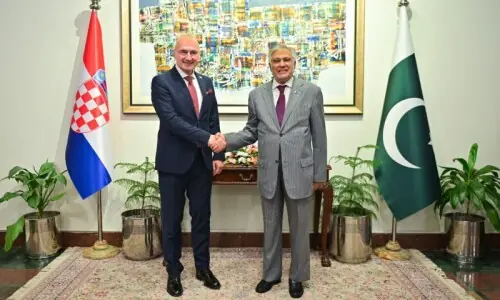
Hopes are riding high on the first formal round of talks in over three decades between the foreign ministers of Pakistan and India in New Delhi. The talks are due to conclude today, and there will probably be some kind of a joint statement.
Many confidence-building measures are on the table, but there are also more contentious issues that are likely to take time to be sorted out. The Gordian knot of Kashmir will prove even more difficult to approach when and if the two sides finally decide to tackle the task in earnest.
Future progress depends on whether or not the two countries have made up their minds to live in peace and as states with normal relations. If this basic requirement is fudged, what we are likely to see is halting progress on the peripherial matters and the usual exchange of cutting remarks from the foreign offices in Islamabad and New Delhi.
The former is not unimportant and carries with it the promise of creating a generally more condusive atmosphere. But the latter course will make sure that the people of both India and Pakistan are denied the opportunity to work together to change the face of this wretchedly poor, underdeveloped and overpopulated region of the world.
A fundamental change in thinking is required on both sides. It was the accepted gospel 30, 40 years ago that once the older generation, with its experiences of partition and separation, faded out, the new generations would find it easier to make up.
This has not happened because we have made sure in the interim to indoctrinate the minds of younger people with mutual hate, distrust and ignorance of one another. In fact, one may perhaps find a greater residue of sentimentality over vanished ties now among the older people.
A determined effort has to be made to adopt a more accommodative and understanding attitude. We have to realize each other's difficulties in trying to break away from the shackles of the past and, by our words and actions, help each other to do so.
For instance, if Pakistan has a problem in trying to prepare itself for a compromise on Kashmir, India should be willing to see the problem and consider how Pakistani leaders can be helped.
What has actually happened is that most of what India has said and done over the past five decades has undercut the peace lobby in Pakistan and both further strengthened the entrenched hawks in the establishment and negatively influenced the public mind.
Similarly, Ziaul Haq's crusade to lend a religious justification to Pakistan's role in Afghanistan could only have confirmed the image of the country among the Indians as an interventionist power in the region. This is besides the war hysteria generated on both sides of the border by the 1965 and 1971 conflicts and recently by Kargil.
At some point we have to realize that both of us are strong, independent nations capable of looking after our interests without necessarily being at loggerheads. India needs vision, to see that it has to make concessions to accommodate Pakistani concerns.
Even token gestures like a scaling down of its military presence in Kashmir and respecting the human rights and civil liberties of the people of Kashmir will help. Pakistan needs to be confident of its own identity and realize that it no longer requires an external threat to justify its existence.
We don't have to be in a state of perpetual conflict at home and abroad to establish that we are somehow more righteous than other people. It is a whole change in outlook that has to be encouraged in both countries to give substance to what Mr Khurshid Kasuri and Mr Natwar Singh are discussing.
Why the educational failure?
Participants in a workshop organized by Unesco in Islamabad have said that Pakistan was unlikely to attain its literacy goals. The UN Millennium Development Goals seek to provide education for all by the year 2015.
The figures quoted for the children out of school - 50 per cent - and adult illiterates in the country - 50 million - make it unlikely that all of them would be enrolled in literacy classes or schools in the next ten or so years. Besides, there will be another 30 million to be educated in the next decade.
It is strange that the organizers of the workshop focussed their energy and attention on extolling the virtues of education and how it can help in the social and economic development of the people. As if people in Pakistan - even the illiterate ones - do not know this.
If there is someone who needs to be educated on the issue, it is the government. If our policymakers were really convinced about the utility of education for society and were committed to the cause, the country would not be trailing behind in this field. There are only 13 countries with an adult literacy rate less than that of Pakistan.
The question that needs to be posed by all those concerned with education policies and planning is: why are so many people still illiterate in Pakistan? No one will deny that good education gives an advantage to the person who manages to acquire it.
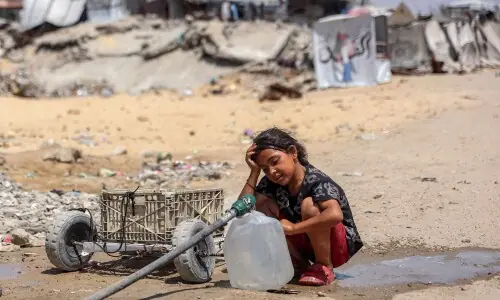
But the problem is that the poor, who also happen to be the one lacking in literacy, feel that the education available to them does not give them any benefit. Given the state of the schools in the public sector and the dismal pedagogy there, it is not at all surprising that many children are so put off by school that they either play truant or just drop out to swell the number of the illiterates.
Their parents are also dissatisfied since they soon discover, after enrolling their children in schools, that they are not learning anything worthwhile. With education so unrelated to and out of sync with the social and economic life of the people living in a particular area, it is not surprising that the people really do not benefit from spending a good part of their lives in the classroom for quite a few years.
It is this aspect - the quality and relevance of education - that needs to be addressed. The problem is that the education which is affordable for a majority of the people is the one which the government provides. But unfortunately the government has not been expanding the school system as fast as it should have been doing. Besides, many of the schools are not physically accessible, especially for girls in the rural areas who do not like to go far from their homes, and that denies children the fruits of education.
In many cases the school buildings are there but there are no teachers. Where a school is functioning, education is of such a low standard and the curricula is so irrelevant that the students gain very little knowledge.
The media can certainly play a useful role in sensitizing the policymakers about the flaws and drawbacks in the system. This calls for some serious investigative reporting into the state of the schools and what has gone wrong. Unesco has done well to involve the media in this exercise.
If journalists can be persuaded that the education beat may not have the glamour of politics but is certainly equally vital, they may think it worthwhile to probe into the weaknesses of this largely neglected sector.