0
0

LAHORE, May 30: Participants in the 4th DAWN In Education Spelling Bee Phonetics Workshop, 2012, say the workshop has opened new avenues of phonetics – the science of human speech – on them.
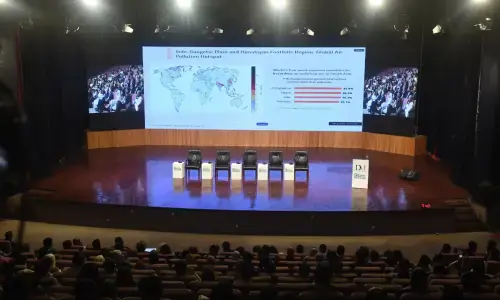
Fifty schoolteachers attended the workshop organised by Dawn Newspaper with the Oxford University Press at the OUP Auditorium on Wednesday.
Azka Khan, Masters in Linguistics from the NUML University, conducted two sessions on phonetics with teachers of private schools participating in Dawn Spelling Bee competitions.
Another 50 participants will attend a two-and-a-half- hour workshop on Thursday (today).
Bazila Tariq from Beaconhouse School, Wapda Town Campus, Gujranwala, said the workshop helped her learn many new concepts.
“Maybe, I was making some errors earlier. Now, I exactly know the correct pronunciation of different words,” she said.
Though this stand alone workshop cannot help her fully grasp phonetics, Ms Tariq said, she still felt confident enough to train her students for the Dawn in Spelling Bee competition in a better manner.
Rabia Munawar from Beaconhouse School, Palm Tree Campus, Gujranwala, said the workshop was very beneficial and could be more advantageous, if more and more such workshops be organised.
“People are weak in linguistics as everybody does not have the opportunity to learn phonetics,” she added.
Wajeha Bilal from Beaconhouse School, Canal side Campus for Boys, Lahore, said the learning from this workshop would be productive and make a difference in her classroom teaching, at home and her career in the long run.
She was all praise for the trainer.
“The whole management of the workshop as well as Ms Khan made me felt that I’m attending a training workshop session abroad,” said Ms Bilal. She said that other organisations including chain schools should also organise such workshops for English language teachers.
Talking to Dawn, trainer Ms Khan said this workshop had at least motivated the participants to take phonetics as a part of their studies to meet the modern world challenges. Though, those graduated a decade or so ago had no opportunity to learn phonetics, she said, now children were learning phonics and phonetics from the very beginning of their academic careers.
She admitted that those, who had not formally studied phonetics, needed to undergo extensive training and overcome the shortcomings with regard to pronunciation. “It is easier to teach phonics and phonetics to younger children,” she said.
Ms Khan said the workshop participants had learnt to transcribe the symbols, which otherwise continue to frighten the learners. “There is no shortcut in language. One has to listen and read more and more to speak and write correctly,” she added.