RAWALPINDI, Jan 9: Neither the military nor the politicians could bring a democratic movement in Pakistan, where there is no democracy and power and resources are concentrated in a few hands, the participants of a discussion observed here on Friday.
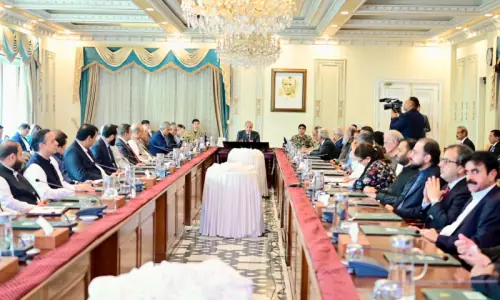
The discussion on "The New Progressive Politics for Pakistan" had been organised by Awami Jamhoori Forum (AJF) and People's Rights Movement (PRM) at the press club here.
A constructive and progressive debate between more than 70 participants, most of them intellectuals and leaders of labour unions, also took place during the discussion that lasted undisturbed for almost three hours.
Presenting his paper on the topic, Jamil Umar of AJF said the country badly needed a democratic movement, comprising three ingredients: true democracy, secularism and fair representation of the exploited and downtrodden classes. However, at the same time he ruled out the chances of repeat of the 19th Century revolution in Pakistan, as some unprecedented changes had taken place in the global politics and even in the very style of capitalism during the last few decades.
Though Marxism and Socialism, he said, were unable, at this stage, to present total solutions to the problems of the peasants and the proletariat here, both the systems still possessed inspiration for the neglected factions to thoroughly analyse their problems and come up with such solutions that could at least minimise and finally root out the unjust division of resources, wealth and political powers in the society.
He also presented a bird's eye view of the leftist movements in Pakistan that had faced a stiff resistance from both the civil and military bureaucracy. He also criticised the Hudood Ordinance and Blasphemy Law and termed them a big hurdle in the strengthening of progressive forces in the society. Such laws, he said, were the products of a society, where there was respect for the rights of the others.
Asim Sajjad from the PRM also thoroughly discussed the financial capitalism and its impact on the Third World countries, particularly Pakistan. No policy-making was done here without the influence of the outer forces that damaged the sovereignty of the country, he said.
About 25 to 30 per cent of our GDP is in the hands of military officers, Mr Sajjad said, after elaborating the negative role of institutions like Army Welfare Trust and Fauji Foundation in our society besides the military control over big chunks of agriculture land.
He said about 30 million people, previously peasants, had no land in their control in the rural areas of the country owing to the changing status of relationships between the landowners and the peasants. The latter, he said, were now becoming mere "agricultural labourers" with no social security, he added.
He also asserted that Pakistan had reached a stage where no election could bring any positive and democratic change in the society. He also discussed the realities produced by globalisation and asked for intellectual labour in order to bring harmony in the Classical theories and "practical realities" for sorting out solutions to our issues.
Dr A H Nayyar, professor of physics at the Quaid-e-Azam University (QAU), was the resource person. He also heard the viewpoints of those who challenged the hopes of occurrence of any fruitful revolution here.
He also tried to differentiate between the concepts of the civil and human societies and added that such kind of discussion would be organised at the same venue after every two weeks.