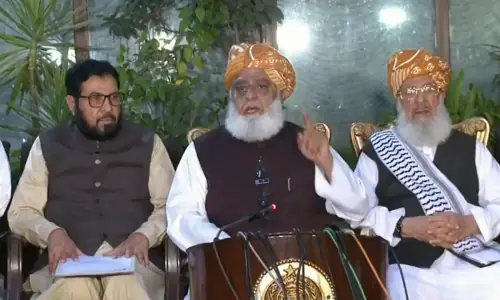
HYDERABAD, Dec 14: Speakers at a seminar on bonded labour have stressed the need for developing harmonious relations between the employer and the employee to help end forced labour.
Dr Ghulam Haider of Green Rural Development Organisation said at the seminar organised by the Employees Federation of Pakistan in collaboration with ILO on Saturday that 20,000 workers were employed in 108 brick kilns in the district and 1.7 million people were working as bonded labour in the country.
He said that mostly the children of bonded labourers did not attend schools.
The ILO, ACTIONAID and a number of other NGOs had set up medical camps and schools but they were closed after running for a brief period, he said.
He said that the district administration had appointed a vigilance committee on bonded labour but it had not met over past many months.
ILO representative Saifullah Chaudhry urged harmonious relations between the employer and the employee to end forced labour.
The president of Hyderabad Chamber of Commerce and Industry, Shafique Qureshi, said that the bonded labour was an outcome of economic disparity and absence of education.
He said that mostly bonded labourers were employed in agriculture sector, brick kiln industry, domestic industry and bangle and carpet industry in the province. The menace could be eliminated through concerted efforts by the district government, he said.
He suggested that the entire labour force should be registered with the labour department and new technology should be introduced in the bonded labour prone industry.
HCCI: The president of Hyderabad Chamber of Commerce and Industry, Shafique Ahmed Qureshi, on Sunday demanded that the State Bank bring down mark-up rates to save industrial sector from total collapse.
He said in a press statement that cost of production had skyrocketed after rise in the mark-up, depriving Pakistani goods of competitiveness in the international market.
The industrialists were facing multiple problems and many industrial units had already closed down, Mr Qureshi said, adding that the rise in mark-up had made it difficult for the industrialists to repay loans.
He pointed out that all banks in the country were charging mark-up on industrial loans between 18 to 20 per cent whereas the mark-up in China was only between 9.50 to 11.50 per cent.
He said that short-term loan policy was dangerous and demanded a long-term policy for industrial and commercial loans to be evolved in consultation with the chambers of commerce of the country.