DURING the darkest years of the Second World War, with German U-boats choking off Britain’s supply lines and making every ship at sea a target, the government did not ask people to march or to grieve. It asked them to dig. The Dig for Victory campaign turned front lawns into potato beds and public parks into allotments, and it worked because it explained something older than war itself: one cannot starve a nation that can feed itself. People gave up ornamental grass for cabbages and found, in the process, that the ground under their feet was worth more than any gold reserve.
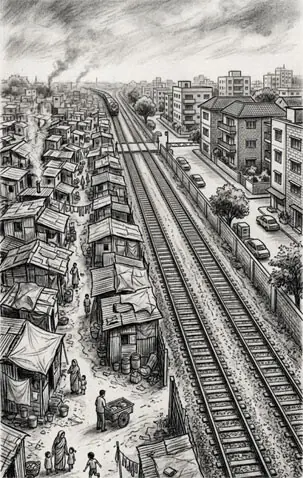
Pakistan faces no U-boats today, but it is losing the same war anyway; slowly and by choice. Drive along the outskirts of almost any Pakistani city and the same scene repeats itself with numbing regularity: fertile land that once housed orchards and farms turning into housing societies that sell a lifestyle their own investors rarely stick around to enjoy.
Most buyers live abroad, pouring remittances into brick and mortar they will visit maybe twice a decade, while the people who stay behind become caretakers of empty mansions. And still the herd runs. Every family that can scrape together the money chases the same fantasy of a boundary wall and a marble facade, pouring its savings and its best years into that dream, while the soil that used to feed the country vanishes under concrete.
This is not just an aesthetic loss. Trees that held the water table in place are cut down by the acres. Birdsong that once marked the changing seasons has fallen silent across entire districts. The small farmer, who once made an honest living from that land, gets pushed into a city that has nothing to offer him for work. What is disappearing is not scenery; it is survival infrastructure.
The trend cannot simply be turned around at this point; the hunger for concrete has become part of society. But it can be contained, and other countries have already shown how. New Jersey, one of the most densely built states in the United States, has run its Green Acres Programme since 1961: a legally binding system where the state buys up land and keeps it permanently off-limits to development, funded by a dedicated tax.
Pakistan surely needs the same kind of discipline. The government has to start acquiring land and declaring it permanently open: no construction, trees planted, and recharge wells dug to refill the water table. Call them what they will eventually become: breathing stations. Because the day is coming when the concrete jungle we are building with such pride finally closes over our heads, and it will be these deliberately unbuilt acres, not our marble facades, that will hand us back our breath.
Sqn-Ldr (retd) Uzma Syed
Rawalpindi
Published in Dawn, October 19th, 2026