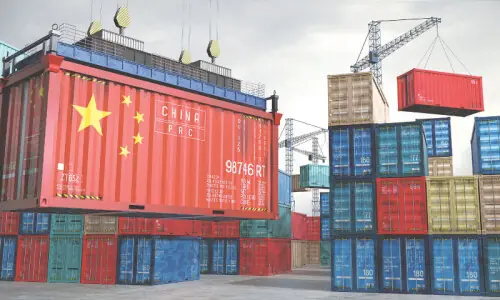
Pakistan earned $30.14 billion from goods exports in the year to June 2026. That was 5.9 per cent less than the $32.04bn of the year before. Over the same twelve months, imports rose 8.1pc to $69.76bn, so exports paid for only 43pc of what the country bought abroad. The trade deficit came to $39.6bn.
This is not a one-year slump. The first quarter of this fiscal year shows the same thing. Exports rose 10.8pc to $8.42bn, which is good news. Imports rose 13.2pc to $19.22bn, and the trade deficit grew 15pc to $10.79bn. Exports have stayed in a band of roughly $25bn to $30bn for almost two decades. Bangladesh has crossed $50bn and Vietnam is above $350bn. With a GDP of about $452bn, Pakistan’s goods exports amount to under 7pc of output.
Pakistan’s export crisis is no longer just a trade problem. It is a constraint on economic growth, employment, investment and financial stability. The country entered the current fiscal year with a narrow margin for error: any increase in the import bill without a corresponding rise in export earnings threatens to reopen external financing pressures.
Weak exports leave the country dependent on remittances, foreign borrowing and periodic assistance from international lenders to finance imports and meet external debt obligations. Every time these inflows fall short, pressure builds on foreign exchange reserves, the rupee and domestic liquidity. The government then has little choice but to tighten imports, raise interest rates, compress demand or seek more loans.
Sustained incentives should reward sustained expansion, not just volume
Whatever exports do not cover has to be borrowed or rolled over. Early in September, the finance ministry raised $3bn through a two-part Eurobond, the largest single international bond issue in Pakistan’s history. The $1.75bn tranche, maturing in five and a half years, carries a 7.5pc coupon. The $1.25bn ten-year tranche carries 7.9pc. Orders came in at nearly $6bn.
The proceeds helped lift the State Bank’s reserves to $21.4bn by September 11, with import cover above three months for the first time since 2020. That is a real improvement. But reserves built on borrowing, rollovers and remittances are a cushion, not income. A sharp rise in oil prices, which the Middle East conflict has already caused, could wear it down quickly. Dollar liquidity stays tight because the country does not earn enough of them.
Textiles and apparel remain central to the challenge. The sector brought in $18bn in FY26, about 60pc of all exports. They grew 0.3pc in a year when everything else fell. The sector’s own figures show 83pc of it is finished goods, up from 77pc in FY22. That sounds like progress, but most of it is basic: knitwear, bedwear and made-up articles, and plain garments.
These are crowded, low-margin segments where buyers shift orders for a few cents. Three markets, the EU, the US and the UK, take about three-quarters of textile exports. The US alone accounts for roughly a fifth of all Pakistani exports.
Why cannot Pakistani exporters compete? The causes are well known and slow to change. Export competitiveness is undermined by high energy and financing costs, a tax system that ties up working capital through advance payments and delayed refunds, and tariffs that make imported raw materials expensive.
Frequent import restrictions and abrupt policy reversals add uncertainty. Beyond these immediate costs, weak productivity, inadequate testing and certification, and limited investment in technology, product development and branding prevent firms from moving into higher-value segments. The result is an industry struggling to compete on price while failing to build the capabilities needed to compete on quality, innovation and value addition.
A proposal recently put forward by a prominent business leader from Lahore deserves serious consideration. As reported in the media, it calls for exporters to receive a rebate of up to 8pc against eligible domestic taxes if they increase their manufactured merchandise shipments by at least 10pc annually. The attraction is straightforward: rather than offering blanket subsidies to exporters regardless of their performance, the government would reward those who demonstrate measurable growth in foreign sales.
The numbers are compelling. For example, starting from textile exports of $18bn, a 10pc annual increase would take them to about $19.8bn in the first year and $20.7bn in the second. By the third year, exports would reach approximately $23.4bn. That would add roughly $5.4bn to annual textile export earnings compared with the FY26 baseline. These are projections, not guaranteed outcomes, but they show the potential scale of the prize.
The logic has appeal. Pakistan has just paid about 7.7pc on average to borrow $3bn. Why not pay a similar price to those who bring dollars in? There is also a difference that matters. The bond has to be repaid with interest. A rebate is a one-time cost on earnings that stay in the country. And unlike past schemes, it would reward only those who actually grow instead of handing every exporter a subsidy for standing still.
A carefully designed export incentive could help generate recurring foreign exchange earnings without creating a corresponding external debt liability. The comparison is not exact: a domestic tax rebate costs revenue, while bond interest is a financing expense. Nevertheless, it highlights the economic value of encouraging exporters to earn dollars rather than repeatedly borrowing them.
The proposal’s strongest feature is its performance condition. Past export incentives have often been criticised for rewarding established exporters without requiring commensurate gains in productivity, investment or foreign sales. A scheme tied to annual export growth would create a clearer incentive to find new customers, increase capacity, improve quality and move towards higher-value products. It could also encourage businesses that have remained content with existing markets to seek new opportunities.
However, the scheme must be designed carefully. An 8pc rebate should not become another open-ended subsidy on existing exports. Eligibility should be based on verified export receipts, with a transparent baseline and safeguards against inflated invoices, related-party transactions, artificial price increases and the shifting of shipments between companies.
Rebates should be capped by eligible domestic taxes actually paid, and their fiscal cost should be disclosed. Government must also distinguish genuine additional exports from shipments brought forward from the following year or gains caused solely by higher international prices.
The incentive should reward sustained expansion, not just volume. Exporters investing in higher-value products, new markets, technology, worker skills, energy efficiency and compliance with international standards should be well placed to benefit. Small and medium-sized firms should not be excluded by cumbersome procedures or an inability to navigate the tax system. Independent evaluation should establish whether the scheme generates additional exports and jobs at a reasonable fiscal cost.
That said, the proposal does not fix the underlying costs. A rebate is a bandage on power tariffs, interest rates and refund delays. If the energy and tax burdens that made Pakistani goods expensive remain, the rebate becomes a permanent crutch, and the government will find it hard to withdraw.
The writer is a Dawn staffer
Published in Dawn, The Business and Finance Weekly, October 12th, 2026