Agriculture: Opting for sustainable farming
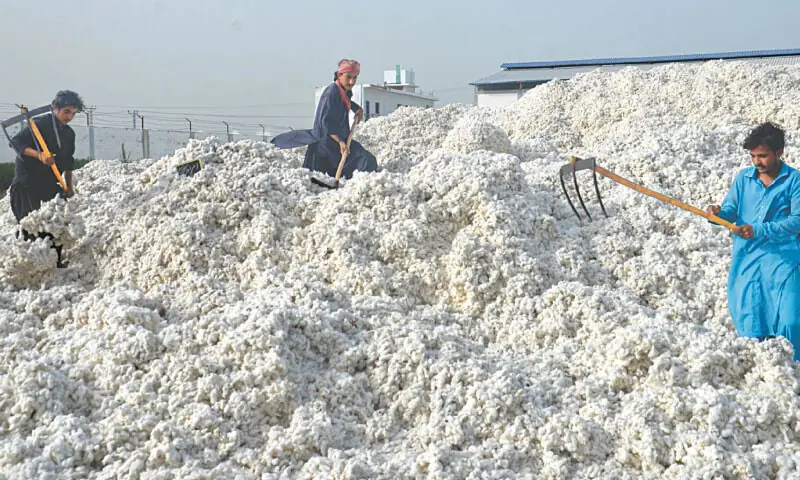
A small farmer, Mohammad Siddique Channa from Balochistan’s Lasbela district, seems contented since switching to organic cotton cultivation under organic agriculture (OA) practices. He now grows cotton on 15 acres of his land, making him one of many organic-certified cotton growers in Balochistan.
He explains that OA practices in cotton cultivation reduced the expenses he used to incur on farm inputs, including urea and DAP, pesticides, non-genetically modified organism (GMO) seed, and insecticides, when he was associated with conventional agriculture methods. After starting organic cotton cultivation on two acres seven to eight years ago, he increased it to 15 acres with support from the Balochistan government and textile millers, who provided seed and other inputs.
“I think we can bring considerable acreage in Balochistan for vegetables, fruits and other major crops under OA. Our land is still virgin while soil in Sindh and Punjab face degradation, but we do depend mostly on rain-fed irrigation, “ he said. His friend, Munir Roonjho, in the district’s Bela taluka, shared the same story, saying organic cotton cultivation has reduced his input costs from Rs50,000 to Rs60,000 an acre, as OA does not use fertilisers, pesticides, and GMO seeds.
Farm input costs have been rising rapidly. Barring large landholders, smaller farmers fall into debt, creating a vicious circle. They commonly borrow cash from private lenders in rural areas to keep their economic cycle going, then sell the harvest at a lower price to repay loans against inputs, with urea and DAP as major components.
About $1.9 per kg was earned as foreign exchange, and $0.9m as carbon credits between 2016 and 2024 in the organic cotton project
The Economic Survey of Pakistan 2025-26 puts fertiliser’s share in the cost of production of major crops at 10-15 per cent. Farmers spend Rs1.2 trillion annually to buy fertiliser. A Rs100 increase in the price of a 50kg bag adds Rs20 billion in financial burden to farmers’ pockets nationally.
OA has emerged as a viable option for lessening the burden of synthetic fertiliser use worldwide, and it is being pursued as a global movement. In Pakistan, Balochistan province seems to be leading OA practices, primarily in cotton. The provincial government passed its Balochistan Organic Policy in Nov 2024 to promote OA by involving 12,000 farmers in collaboration with WWF-Pakistan under a project.
OA helps achieve sustainable agricultural practices that support biodiversity, reduce reliance on fertilisers, pesticides, and imported seeds, and ensure economic growth. Under global OA practices, growers were encouraged to use natural inputs to produce nutritious organic food while protecting the environment.
As Pakistan’s largest but least developed province, Balochistan accounts for 44pc of Pakistan’s landmass.“We initially started with 219 acres under a foreign-funded project in Lasbela, Sibi and Barkhan districts in 2016,” said Dr Syed Habibullah Shah, Director Balochistan Agriculture Extension and recipient of Sitara-e-Imtiaz. He deals with OA practices in specific districts of the province.
In 2019, Pakistan produced its first organic cotton bale in Balochistan, a turning point that propelled the province into the global organic cotton cultivation arena. Experts like Dr Yusuf Zafar, former chairman of the Pakistan Agricultural Research Council, noted that although organic cotton holds a marginal 1.5pc share of global cotton production, demand is on an upward trajectory. The global organic cotton market was valued at approximately $3.25bn in 2026 and was projected to expand to $50.78bn by 2034. Among 28 organic cotton-producing countries, he explained, India alone accounts for a huge 51% of global organic cotton production.
Organic cotton acreage in Balochistan has now reached nearly 133,257 acres across Kohlu, Barkhan, Khuzdar, and Lasbela districts. Balochistan produced the first regenerative cotton bale in 2024. Now, Washuk, Kharan, and Dera Bugti districts are being selected for organic cotton production.
Different textile/ginners groups now sponsor organic farmers in organic cotton cultivation there. They provide non-GMO seed and other necessary inputs and pay a quality premium to producers, over and above the per-40 kg seed cotton price, after a duly verified process involving third-party validation by an international certification body, i.e., Control Union.
“About 159,000 organic cotton bales are produced and marketed in Balochistan from an organic 89,000 acres that are globally certified in 2025. The registered organic area reached 133,257 acres. The differential certified area between 133,257 and 89,000 is undergoing the certification process,” Dr Habib said, quoting the summary of organic cotton in FY26. He claimed that since Balochistan doesn’t have many ginning units, cotton bale numbers from Balochistan were usually reflected in other provinces, including Punjab and Sindh.
He explained that Rs1.21bn (as per the project’s calculations) was paid to farmers as a quality premium in cash and kind. At the same time, $1.9 per kg was earned as foreign exchange and $0.9m towards carbon credit value between 2016-2024 in the organic cotton project.
Farmers are told how to collect animal dung and urine under a protocol. When it turns into compost, they apply it to the soil along with recommended tillage. This bio-fertiliser, with more nutrients, improves water-holding capacity and soil OM, according to Mashood Siddiqui, a private company official working with Balochistan farmers.
Textile millers find considerable potential for domestic organic cotton production, which was 2pc-3pc of total cotton. They argued that overall cotton crop production must reach 15m bales, up from the current 7m. It could potentially take textile exports from $19bn to $35bn annually.
The writer is a Dawn staffer
Published in Dawn, The Business and Finance Weekly, October 12th, 2026