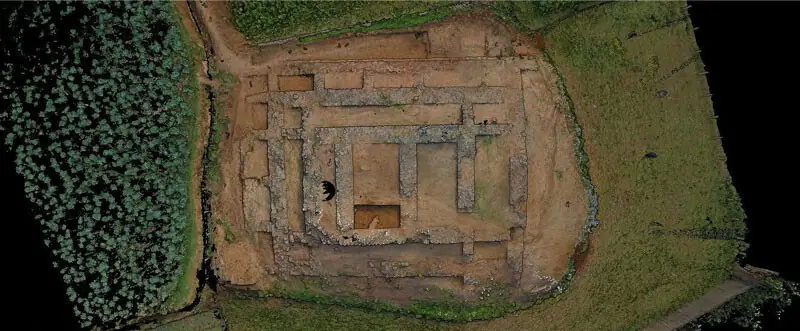
TAXILA: Archaeologists led by Italian experts have unearthed a massive ancient structure measuring nearly 100 metres in length and 50 metres in width at Jandial, adjacent to the University of Engineering and Technology, Taxila.
The discovery could open a new chapter in understanding the ancient urban landscape of Gandhara and the cultural interactions that shaped one of South Asia’s most important archaeological regions.
Located north of the ancient city of Sirkap, the historic Jandial temple stands on an artificial mound and is generally dated to the first century BC, during the Scytho-Parthian period.
Its architecture is strikingly reminiscent of classical Greek temples, distinguishing it from many other surviving religious structures in the region and providing important evidence of the diverse architectural traditions that reached ancient Taxila. The site was inscribed on Unesco’s World Heritage List in the 1980s.
Discovery expected to shed new light on Gandhara’s ancient urban landscape
The monument is believed by some scholars to have served as a place of worship for communities practising religious traditions other than Buddhism, although its precise original religious affiliation remains a matter of scholarly interpretation.
The temple was constructed primarily from limestone and kanjur, a porous sedimentary stone widely used in Gandharan architecture, while plaster was applied to parts of its façade.
Patches of plaster reportedly survive, offering clues to its original appearance, while some of its large columns and pillars were built from massive sandstone blocks.
These features, together with its distinctive architectural arrangement, make the monument an important source of evidence for studying construction techniques and cultural influences in ancient Gandhara.
According to the Director General of Archaeology and Museums Khyber Pakhtunkhwa, Dr Abdul Samad, the discovery was made during excavations directed by Italian archaeologist Dr Luca M. Olivieri and funded by the Italian Agency for Development Cooperation (AICS).
The find has renewed attention on the historical importance of Jandial, where the first-century-BC temple stands as a reminder that ancient Taxila’s religious and architectural heritage extended beyond the Buddhist monasteries and stupas for which Gandhara is widely known.
He said the newly discovered structure’s sheer dimensions made it a noteworthy archaeological find, although its precise age, function and relationship with the existing Jandial temple complex had yet to be established.
“Everyone is familiar with the Ionic temple at present remains of Jandial, but few realise that the hill on the other side of the road concealed an even more colossal and enigmatic monument. First noted in 1864 by Alexander Cunningham, it was regarded by Sir John Marshall in 1911 as an insignificant heap of ruins. Never published, never described, never studied,” Dr Samad said.
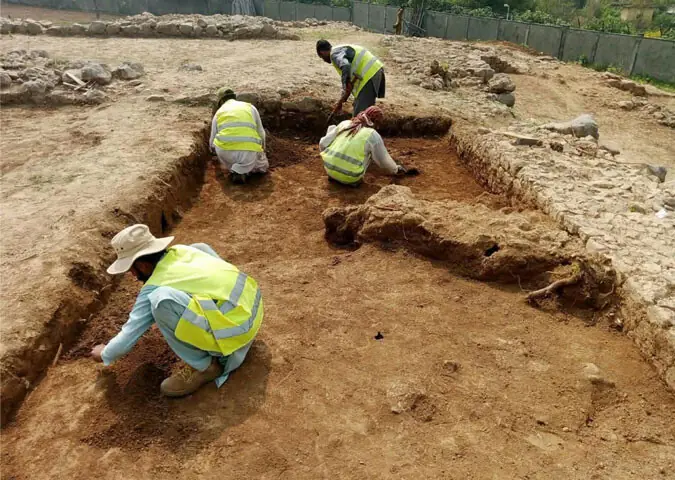
He added that despite Sir John Marshall’s lack of interest, the hill had nevertheless been purchased by the government. Excavations, which began in mid-August this year, have revealed an imposing, isolated monument, either public or religious, nearly 100 metres long and more than 50 metres wide, with walls standing at least one metre high.
DG KP Archaeology and Museums Dr Samad emphasised the discovery was important because it revealed a large monument outside the walls of Sirkap, alongside the Ionic temple, on either side of the ancient road leading from the city’s northern gate towards Gandhara.
“Further scientific investigation will be required to determine whether it formed part of an extensive religious, civic or other architectural complex and how it fitted into the wider settlement pattern of ancient Taxila,” he added.
He added that the discovery highlighted the rich archaeological potential of the Khanpur-Taxila region. He reaffirmed the directorate’s commitment to supporting scientific research, strengthening international partnerships and protecting irreplaceable archaeological heritage.
Another official of the archaeology department, Niaz Ali Shah, said the discovery was particularly significant because Jandial occupies an important place in the archaeological landscape surrounding Taxila, an ancient centre of learning, trade and cultural exchange. Its surviving monuments document interactions between the Indian subcontinent, Central Asia, Persia and the Hellenistic world.
Veteran scholar and historian A.H. Dani, in his book History of Civilisations of Central Asia, noted that remains identified as those of a Zoroastrian fire temple had been reported at Jandial and were believed to date to the Indo-Parthian period.
As research continues, Jandial remains a reminder that the story of ancient Gandhara is far from complete.
Its archaeological landscape may hold further evidence of a world in which South Asian, Iranian, Central Asian and Hellenistic traditions intersected, leaving behind a cultural legacy whose full dimensions are still waiting to be understood.
Published in Dawn, October 12th, 2026