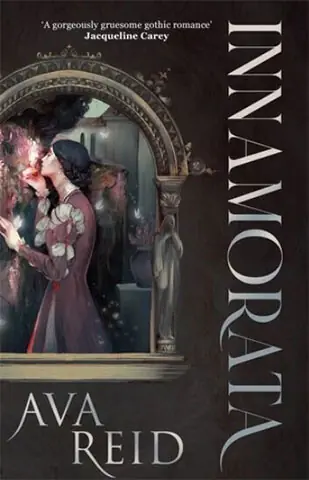
Innamorata
By Ava Reid
Penguin
ISBN: 978-1529910667
560pp.
Ava Reid has already established herself as a notable writer of fantasy fiction. I enjoyed her feminist take on Shakespeare’s Macbeth, and her novel Lady Macbeth recounts the story from the perspective of the doomed Scottish queen. Reid’s latest endeavour, Innamorata, is a bold foray into creating a text in the mode of the Gothic.
Contrary to popular belief, the Gothic is an incredibly difficult genre of writing to master. While a respected tradition of Gothic writers, ranging from Ann Radcliffe to Isak Dinesen, have produced texts that are genuinely entertaining mixtures of horror and romance (the two major linchpins of the genre), plenty of charlatans (both in the Subcontinent as well as overseas) have attempted to create Gothic pieces, with results that are laughable at best and ghastly at worst. Ava Reid succeeds in creating a mixture of grotesque horror and surprisingly plausible romance.
The heroine, Agnes, hails from a period in a fantastical universe where necromancy, though formerly rampant, has been severely suppressed by the efforts of a conqueror named Berengar. Agnes belongs to one of seven major houses, all named after parts of the body — the House of Teeth, the House of Blood, the House of Eyes etc. One does not need to look very closely in order to perceive the parallels between Agnes’ grim world and that of Westeros in Game of Thrones. However, the psychosis and gore underlying Reid’s universe give even the hit show a run for its money!
The author pulls out all the stops in Innamorata when it comes to underscoring the most evil of human instincts — lust, gluttony, cruelty, sadism and violence, to name just a few. While her writing is elegant and clear, Reid makes an undeniable impact on her readers by means of her vocabulary and nomenclature — medics, for example, are called ‘leeches’ in the book. The writing is visually striking throughout, and uncompromisingly graphic at times. The love scenes are sensual without being obscene. However, the violent episodes are very disturbing, and more sensitive readers may benefit from perusing trigger warnings prior to engaging with the novel.
A richly imagined gothic fantasy novel blends necromancy, court intrigue, forbidden love and visceral violence into an unsettling tale
When the reader first encounters Agnes, one finds that the heroine is mute, although that is by choice rather than because of a speech defect. She is portrayed as being especially close to her cousin Marozia. On the passing of their grandmother Adele-Blanche (whose remains, per custom, are brutally desecrated in order to prevent her being resurrected by means of necromancy), Marozia becomes the head of the matriarchal House of Teeth.
She is wed to Prince Liuprand, the son of King Nicephorus. Liuprand’s father, a thoroughly detestable character who delights in the pain and misery of others, rules over all the seven kingdoms in the city of Drepane. The name of Nicephorus’s late wife, Philomel, conjures up images of the ravaged wife of King Tereus in Greek mythology, who was left mute and mutilated by her fiend-like husband.
We are told that Liuprand’s mother was driven to insanity by Nicephorus’s machinations. While Liuprand is a much kinder and far more ethical individual than his cruel progenitor, his marriage to Marozia is doomed from the outset. Agnes and the prince fall hopelessly in love with each other. Although, unlike the mythological Queen Philomel, Agnes eventually regains her ability to speak, it is only after undergoing great trauma — first at the hands of Nicephorus, and later due to other despicable individuals in the tale.
Marozia is no fool and catches on to the fact that her husband has little to no interest in her romantically or sexually. The book repeatedly underscores that the very highest echelons of power mandate that royalty and nobility marry for considerations other than love or passion. Agnes herself is married off to the ruler of another of the noble houses, but her marriage, too, is doomed from the very outset.
Moreover, unlike Marozia and Liuprand’s union, it is short-lived, since her spouse is murdered on their wedding night by an insanely jealous member of his family. Despite Liuprand and Agnes sharing several gentle, sensitive and beautiful moments, these simply serve as fleeting glimmers in what is a very dark and bleak novelistic landscape. Reid does an especially fine job of enabling the reader to access Agnes’s thoughts, a point that is especially important given that she is silent for about a third of the novel.
Despite being over 500 pages, the book is a fast-paced and engaging read. While there are many ugly scenes, including torture and bloody brawls, there is never a dull moment in the novel per se. The chapters are short, ranging from about three to 10 pages each, and Reid’s pace never flags as she leads the action towards a breathless cliff-hanger.
The reason for this ending is that Innamorata is the first part of a duology and, while I will not spoil the reader’s experience by spelling out what happens to the unfortunate Agnes, those readers who appreciate that the violence of the first book is not gratuitous will be left hungering for more.
What is most disturbing to me about the plot of the book is not that Agnes simply suffers trauma due to the actions of depraved strangers. Her own grandmother, Adele-Blanche, who was a very powerful and formidable queen in her own right, subjected Agnes to intense trauma, in order to train her in the dark arts of sorcery and necromancy. But unlike the old queen, Agnes is a fundamentally decent and gentle young woman who chooses the path of love over and above that of power and self-aggrandisement.
Therein, however, lies Agnes’s tragedy. Her love for Liuprand, while fully reciprocated, cannot shield either character from the strictures and demands of royal life, which tend to twist, distort and often destroy those who come between those who are power-hungry and their nefarious goals.
Be that as it may, Reid is to be commended for being able to describe the vicious and the virtuous with an equal degree of skill. Some of her other (more minor) characters, such as a nonagenarian wet-nurse named Waltrude and a wise leech named Pliny, act as rare, calm voices of sense in an otherwise chaotic and cacophonous world. Only those with no capacity for empathy would refrain from sympathising with Lady Agnes’ predicaments.
However, let us hope that the second book will enable one to see whether she manages to triumph against all odds. I’ll settle for a pyrrhic victory for Agnes, if nothing else, simply because I am aware that hardcore Gothic novels tend to add layer upon layer of terror and despair — rather like Pandora’s box in Greek mythology.
Nevertheless, the spirit of hope did emerge from the box once all its evils escaped into the world. Let us hope, therefore, that Reid has a couple of optimistic tricks in mind when it comes to the sequel to Innamorata.
The reviewer is Associate Professor of Social Sciences and Liberal Arts at the Institute of Business Administration. She has authored two collections of short stories, Timeless College Tales and Perennial College Tales and a play, The Political Chess King
Published in Dawn, Books & Authors, August 2nd, 2026