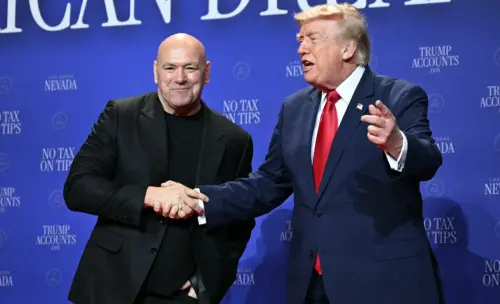
On March 31, 2026, President Donald Trump was asked about plans for his presidential library, the archive that presidents build to house their administration’s records. His was most likely going to be a hotel, he said, with “a beautiful building underneath and a 747 Air Force One in the lobby.”
“I don’t believe in building libraries or museums,” he told reporters.
Trump’s comments reflect how he has diverged from the customary and expected presidential attitude toward libraries of all types. As an information science professor, I have analysed statements by 17 presidents, beginning with Calvin Coolidge.
Combing their speeches, proclamations, messages and letters in the Public Papers of the Presidents, the American Presidency Project, the Federal Register and the American Library Association’s archives and publications, I have found that Trump has broken with a century-old tradition. Nearly all presidents of both parties since 1923 have described libraries, whether public, academic or presidential, as a prerequisite to a healthy democracy and as crucial to sustaining an informed citizenry.
US presidents of all persuasions defended libraries as allies of democracy for a century — until Trump
Trump, however, has rarely spoken of libraries at all. When he has, he has dismissed them.
LIBRARIES AND DEMOCRACY
In the 1920s, Republican Calvin Coolidge said that public libraries were “within the reach of almost everyone” and contained “the best books and authorities on any subject.” By using these institutions, he said, citizens could evaluate “current proposals for political improvement.”
Democrat Franklin D. Roosevelt (FDR) took up that theme as the US edged toward World War II. In 1941, he opened his own presidential library, the first in what would become the National Archives’ system. At the dedication, FDR argued that libraries proliferated in democracies where citizens refuse to accept “so-called information as may be handed out to them by certain types of self-constituted leaders who decide what is best for them.”
The Cold War reinforced the emphasis on libraries as foundational to self-government. Republican Dwight D. Eisenhower feared censorship during the Red Scare and urged a 1953 audience, “Don’t join the book burners.” He also set a precedent for federal library aid, by signing the Library Services Act of 1956, which authorised up to US$7.5 million a year for developing public library services for rural Americans.
Eisenhower’s successor, Democrat John F. Kennedy, likewise believed that “libraries should be open to all — except the censor.” Kennedy’s budgets continued funding public libraries. In 1976, Democrat Jimmy Carter said libraries were fundamental to democracy and, in 1980, he said they strengthened the First Amendment, which protects free speech, a free press and the free exercise of religion. Eight years later, Republican Ronald Reagan said that a free society “must prize its libraries just as it values its liberties.”
That view outlasted the Cold War, which ended in 1991. In 1992, Republican George H.W. Bush said libraries provided the lifelong education each American needed “to remain a fully productive and fully participating citizen.” Campaigning for the Democratic Party’s nomination for president that same year, Arkansas governor Bill Clinton argued that libraries’ provision of equal access to information helped safeguard democracy.
As president, Democrat Barack Obama said in 2009 that “an informed and educated citizenry is essential to the functioning of our modern democratic society” and said libraries “can help separate truth from fiction and signal from noise.” Democrat Joe Biden subsequently called library services “essential to the well-being, health, vitality and democracy of our nation” in a 2022 executive order.
While presidents from Eisenhower onward had tied libraries to the freedom to read, Obama and Biden carried that tradition into the fight over banning books, often by or about people of colour or LGBTQ people, especially in school and public libraries.
“Freedom begins with our capacity to share and access ideas, even ideas we may disagree with or find deeply offensive,” former President Obama wrote during 2022’s Banned Books Week. During National Library Week in 2023, Biden thanked librarians and vowed to “stand with teachers and parents against politicians who try to score political points by banning books.”
“In America, we do not ban books,” he declared in 2024.
THE BREAK
One of Trump’s rare public comments on libraries came during his first term, at a January 2019 Cabinet meeting. Complaining about U.S. allies’ contributions in Afghanistan, he ridiculed Indian Prime Minister Narendra Modi for “constantly telling [him] he built a library in Afghanistan.”
“A library! That’s like five hours of what we spend,” Trump said. “Don’t know who’s using [a library] in Afghanistan.”
Since returning to office, Trump has taken a series of actions affecting libraries. Just days after his second inauguration, in 2025, the Department of Education eliminated its so-called “book ban coordinator” position. The Biden administration had appointed that coordinator in the Office for Civil Rights in 2023 to address book bans in schools and provide guidance on when removing books from school libraries might violate civil rights. The Trump administration rescinded that guidance, ending what it called “Biden’s book ban hoax.”
Like fellow Republicans Richard Nixon and Reagan, Trump asked Congress every year in his first term to eliminate federal library aid. Congress rejected each president’s requests. In March 2025, however, Trump took an unprecedented step: he bypassed Congress altogether, signing an executive order to dismantle the Institute of Museum and Library Services, the chief federal funder of libraries and museums. Since 1996, the institute has run the library grant programme that descended from the legislation that Eisenhower signed into law. A federal court blocked the order to dismantle the institute.
Two months later, Trump fired Librarian of Congress Carla Hayden, the first woman and first African American to hold the position. Asked why Hayden was fired, then-White House press secretary Karoline Leavitt pointed to “quite concerning things she had done at the Library of Congress in the pursuit of DEI [Diversity, Equity and Inclusion] and putting inappropriate books in the library for children.”
Hayden, for her part, had made the Library of Congress into what she called “a library for everyone”, winning a $15 million Mellon Foundation grant to bring underrepresented communities into its collections. “We like to say as librarians, ‘Free people read freely,’” Hayden said after her dismissal. “There’s been an effort recently to quelch that.”
At the September 2026 Republican midterm convention, Trump again mentioned libraries, this time alleging that some Democratic candidates want “to put the books of Lenin… and Stalin in every library for all our young children to read and study.”
The writer is Associate Professor of Information Science at Drexel University in Philadelphia, Pennsylvania, USA
Published in Dawn, Books & Authors, November 8th, 2026