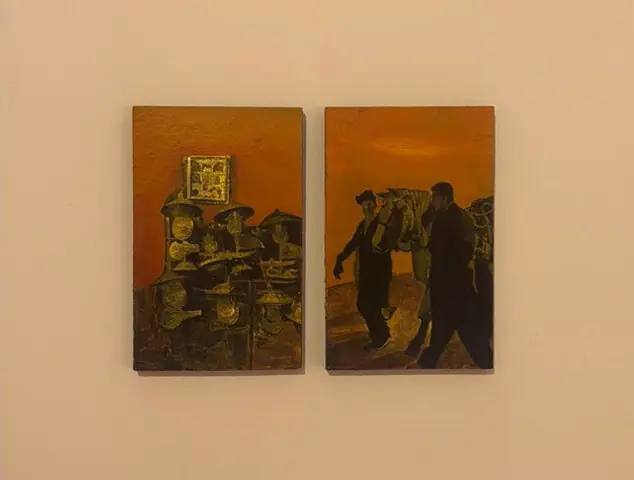
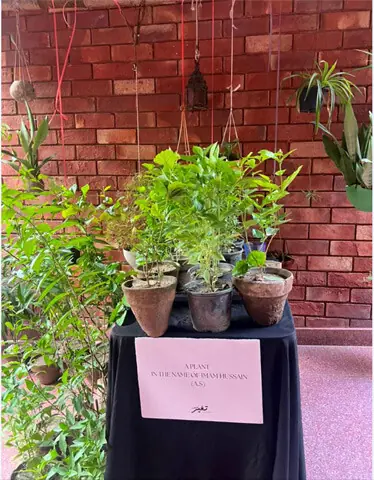
LAHORE: A unique exhibition of artworks related to Muharram and Imam Hussain (RA) is being held at Tagheer Art Gallery, Upper Mall. This uniqueness comes from the “plants sabeel” also that was a part of the exhibition, titled Witnessing Lament, on its opening day. Filmmaker Mahnoor Zaidi and actor and activist Abuzar Madhu hold these “plant sabeels” every year during Muharram.
The exhibition showcases artworks by seven artists, representing one or the other aspect of Karbala and Muharram. It is being curated by Momina Javed and Saleena Shahid.
Speaking about the plants sabeel, Mahnoor said: “In our point of view, this tree sabeel is also a way of protest in the name of Imam Hussain (RA) that has been going on for the last 1,400 years. Azadari and Majalis for the Imam are also protest against the Karbala tragedy. This sabeel is also our protest against climate injustice.”
She said her mother used to hold Majlis every year at home but she herself had the idea to do something for her friends four years ago. She had the idea that food (tabaruk) was okay but from her side, these plants would be the tabaruk.
“It started from there and then I asked Abuzar Madhu to join me to hold this plant sabeels. It is our own method of protest in the name of the Imam because if we manage to plant 1,000 to 1,500 trees every year, and even if 500 of them survive, it would be a great contribution.”
This year, Mahnoor and Madhu have so far distributed more than 1,000 to 1,500 plants since start of Muharram. These plants are donated by people. When they set up a sabeel, they make an announcement a day before and if anybody wants to donate plants they contact them. All the plants are indigenous. In the last three years they have distributed about 5000 plants.
“It was my initiative but how Abuzar would explain each plant to the people, telling them how and where they should be planted to those is amazing. Every plant can’t be planted in a pot and if somebody does not have space but they take the plant, it gets wasted.”
Mahnoor gave credit to Madhu, saying he had a big contribution to it as he was already involved in environmental activism under the Ravi Bachao Tehreek.
Ms Zaidi said the children who take these plants were coming back next year and showing the pictures of their plants or trees. “Because these plants are planted in the name of Imam Hussain, people tend to take more care of them more.”
Manhnoor Zaidi is a filmmaker by profession and has been a part of the team of Kamli, Gunjal and Wakhri as the script supervisor.
Momina Javed, the curator, said she wanted people to know more about plants and take something from the exhibition. Speaking about the exhibition, she said it was about the idea that how the narratives of Karbala had survived through centuries.
“Some artists made their artworks related to Muharram, Karbala and Imam Hussain and some others had already done some work. We added sculpture and 3D works too besides paintings,” she said while speaking to Dawn.
Murtaza Zaidi had displayed his work, Astable (Stable), depicting Zuljanah, the Arabian stallion of Imam Hussain, one of very important parts of Muharram processions. In his painting, he had shown Zuljanah after his disappearance. He said Azadari and Sozkhani in the subcontinent had been happening in different ways.
“My work is inspired by poetry in Sozkhani and Azadari,” he said and added that subcontinent had rich ritual history and its presentation and use of colours was different from the rest of the world.
Maham Qayyum Malik displayed seven wooden panels, showing roses in various stages of withering and decay. These panels were shaped like tombstones. She said each colour depicted different emotion; love, bloodshed and pain, all emotions related to Karbala while tombstone represented loss and memory.
Faariha Kazmi’s artwork was inspired by the huge collection of pictures of processions in Lahore and she used them for her art that was shaped in the form of alams used in processions. “Instead of using text I am using the visual of a procession, showing how the memory is taken forward”. The other artists featuring in the exhibition are Muhammad Anas Aamer, Kinza Fatima, Shafia Batool, and Syed Shehryar Hussain. The exhibition will continue until July 31.
Published in Dawn, July 19th, 2026