0
0

• US says attacks aimed at degrading Iran’s ability to target commercial shipping
• Trump threatens to target Iranian power plants, bridges
• Insists he doesn’t like deadlines; says Iran ‘better behave’
• Ghalibaf vows definitive response to US ‘crimes’
• Iran strikes US military targets in Kuwait, Jordan, Fifth Fleet in Bahrain
• Says it will not meet ceasefire obligations while US breaches deal
• IRGC threatens closure of more energy corridors
TEHRAN: The US struck Iran’s coastal defences and missile sites on Wednesday after reimposing a naval blockade of its ports, while Iran threatened to shut off more regional energy exports, saying it was engaged in an “existential war” with America.
The daytime strikes mark the latest escalation of attacks and counterattacks launched by the two sides as they vie for control of the Strait of Hormuz, which carried about a fifth of global oil and gas shipments before the war.
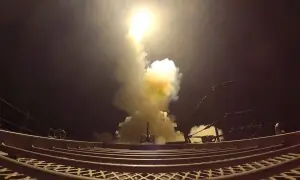
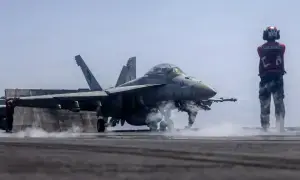
“At 6 am ET (1100 GMT) today, US Central Command forces began launching a wave of strikes against Iran,” the US military said. “The strikes are designed to further degrade military capabilities Iranian forces have used to attack commercial shipping in the Strait of Hormuz.”
In a statement issued hours after Iran’s Mehr news agency reported that US projectiles had hit a location on Iran’s Hengam Island in the Strait of Hormuz, Tehran’s top negotiator Mohammad Bagher Ghalibaf said Iranian security depended on maintaining what he called “Iranian arrangements” in the strait. “We are in an essential and existential war with America,” he said in a statement.
He also vowed that the country would give a “definitive response” to the US for their “crimes”, according to the Tasnim news agency. “We have pledged our jugular vein for the defence of this homeland.”
US President Donald Trump, meanwhile, threatened to widen strikes next week to hit power plants and bridges unless Tehran returns to the negotiating table. “Next week it gets really bad for them,” he told Fox News.
Trump later said he does not like giving deadlines when asked by reporters on Wednesday if Iran had a deadline before the US starts attacking Iranian bridges. “I don’t like giving deadlines, but they pretty much know, they know the story ... they better behave,” he said.
Iran’s Mehr news agency reported that US projectiles had hit a location on Iran’s Hengam Island in the Strait of Hormuz.
US Central Command said the military had attacked coastal defence systems and cruise missile storage and launch sites on Iran’s Greater Tunb Island and had completed the wave of strikes within around 90 minutes.
That followed seven hours of strikes on Tuesday in which the US said it had hit dozens of military targets near the Strait of Hormuz and Iranian coastal areas.
In response, Iran’s Islamic Revolutionary Guard Corps said on Wednesday it had struck US military targets in the region, including in Bahrain, Kuwait and Jordan.
Iran’s Guards said they targeted the US Fifth Fleet in Bahrain, where the military said it had intercepted attacks against civilian targets, while Jordan’s armed forces said they had downed three missiles from the Islamic republic.
The Guards also threatened on Wednesday to shut off more regional energy exports, saying the US “must brace for the closure of all other export corridors that benefit the US and its allies”.
An interim ceasefire deal in the conflict signed last month was meant to lead to further negotiations including on Iran’s nuclear programme, and to a permanent truce, but a return to talks has faltered.
“We have no plans for negotiations at the moment and are focused on defence,” Tasnim news agency quoted Iranian Foreign Ministry spokesperson Esmaeil Baghaei as saying.
He said the interim ceasefire was a set of mutual obligations, and as long as the US breached its commitments under the deal, Iran would refrain from fulfilling its own.
‘End of America’s evil’
Despite renewed hostilities, mediated talks between the two sides have not formally ended.
At the heart of the resumption of hostilities has been the dispute over the Strait of Hormuz, a waterway that is crucial for global oil and gas flows.
The IRGC said on Wednesday the Hormuz Strait would stay closed until what it described as “the end of America’s evils”.
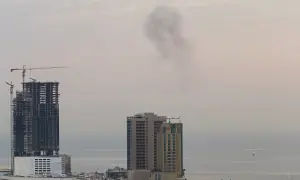
Shipping data showed an uptick in Iran-linked ships passing through the strait before a new US blockade on Iranian ports took effect. The US said on Wednesday it had redirected two commercial vessels attempting to breach the blockade. Iranian state media reported explosions near the port city of Bandar Abbas, on the island of Qeshm and on Bandar Imam Khomeini. It later said fresh US strikes hit the sou thern port city of Bushehr, home to the country’s only civilian nuclear plant.
In Tehran, there was no sign of a return to conflict, with ordinary Iranians thronging cafes to watch the France-Spain World Cup semi-final in huge crowds, AFP journalists saw.
But elsewhere in the country, anxieties ran high.
Khadijeh, 31, an artisan from Qasr-i-Shirin in the southeast, said: “The little children are so frightened by the sound of explosions that they don’t sleep until morning. “The effects of war will stay in our lives and minds and mental health for a long time. If, God forbid, the war becomes more intense, then perhaps it will take several generations before we can get back on our feet.”
Fears similarly abounded in Gulf countries hit repeatedly by Iranian strikes.
“Every day, I wake up wondering whether the situation will de-escalate or worsen,” said Mustafa Mohamed, a 39-year-old Sudanese accountant living in Kuwait.
Blasts near US consulate in Erbil
Separately, several explosions were heard on Wednesday near the US consulate in Erbil, the capital of Iraq’s northern Kurdistan region.
Air defences were activated near the consulate, which was a target of repeated drone and rocket attacks during the Middle East war.
AFP journalists reported seeing several drones hovering over Erbil, before they were hit by the air defence system, followed by explosions and visible smoke.
Published in Dawn, July 16th, 2026