US asylum approval rate falls to lowest in a decade


 0
0
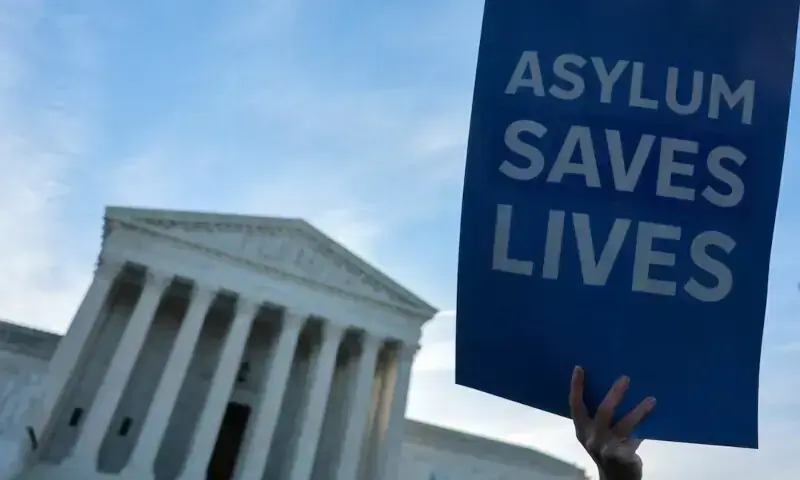

WASHINGTON: The rate at which asylum seekers are winning protection in the United States has fallen to its lowest level in at least a decade, according to immigration court data, as the Trump administration’s tougher enforcement policies reshape the country’s asylum system.
Data from the US Department of Justice’s Executive Office for Immigration Review (EOIR) show that immigration judges decided more than 150,500 asylum cases during the first half of fiscal year 2026 but approved only 5,086 applications.
Asylum grants accounted for just 3.4 per cent of all possible case outcomes. When only cases resulting in either approval or denial of asylum are counted, the approval rate stood at 8.8pc
The decline represents a sharp reversal from previous years. The asylum approval rate was 24.4pc in fiscal year 2025, 45.7pc in fiscal year 2024 and 48.1pc in fiscal year 2023.
Only 3.4pc of applications approved, compared to 24.4pc in 2025
The figures point to a major shift in how US immigration courts are handling asylum claims.
Immigration advocates and policy analysts attribute the decline to stricter interpretations of asylum law, tighter court procedures and broader immigration enforcement priorities under President Donald Trump’s administration.
Claims based on gang violence or domestic violence have become more difficult to win, while immigration judges have been given greater authority to dismiss incomplete applications more quickly.
Many cases now reaching decisions involve migrants who entered the United States during the administration of former President Joe Biden and have only recently moved through the immigration court backlog.
An analysis of EOIR court records by the Transactional Records Access Clearinghouse (TRAC), an independent research organisation at Syracuse University, found that removal orders accounted for roughly four-fifths of completed immigration court cases in fiscal year 2026. TRAC’s analysis also found a significant increase in asylum denials, with more than 59,000 asylum claims denied over a 12-month period, while the number of successful asylum applications fell to a small fraction of previous levels.
The tougher court outcomes have coincided with a broader immigration enforcement campaign.
The Department of Homeland Security (DHS) reports more than 605,000 removals and deportations since January 2025, while immigration monitoring groups and analysts have estimated the total number of migrants deported or returned during this period at between 600,000 and 675,000. According to watchdog organisations and immigration advocacy groups, the administration’s expanded enforcement drive has also been accompanied by an estimated 1.9 million additional undocumented immigrants leaving the United States voluntarily.
US officials say about 38pc to 40pc of those removed had criminal records. Immigration advocacy groups, however, argue that the broader enforcement campaign has also affected long-term undocumented residents and, in some disputed cases, US citizens.
The American Civil Liberties Union has criticised expanded deportation measures, describing the administration’s fast-track deportation policy as “chaotic, unfair, and inhumane”.
America’s Voice, an immigration advocacy organisation, has warned that “mass deportation is making America poorer, weaker, and less safe”.
Published in Dawn, July 13th, 2026