0
0

KARACHI: The Karachi Khichri exhibition, which opens at The Dawood Foundation (TDF) Ghar from Friday, is more than celebrating our traditional food and culture.
While arising a sense of belonging to our roots, it also takes down memory lane to the kitchens and markets of the past.
At the heart of the exhibition lies the story of migration and everyday life which shaped Karachi into one of the world’s most diverse cities. Like khichri is cooked using a mix of different ingredients, the idea behind the exhibition too is a mix of different communities, languages, customs and traditions that gives Karachi its shared urban identity.
At the exhibition galleries you find spices such as turmeric, coriander, cumin, chillies and pepper as well as other raw ingredients such as rice, pulses and flour in buckets or open sacks like they used to be sold at shops before their weighed and packaged form became so conveniently available at supermarket racks.
Karachi Khichri exhibition opens at TDF Ghar
There is a bus stop and a bus, well a portion of it, decorated in traditional truck art, to remind how one would take the bus to get to the markets to shop for groceries. The tradition has still been kept alive thanks to the Empress Market, or whatever is left of it.
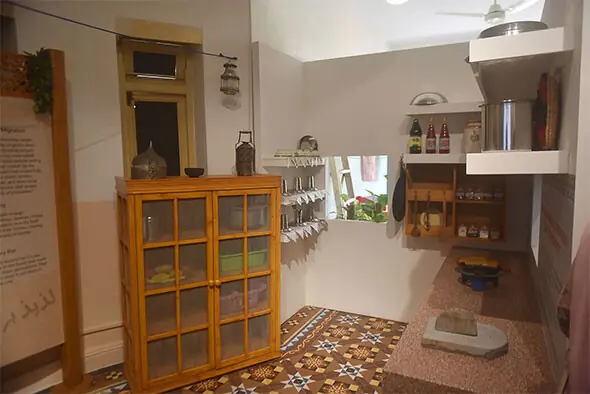
A replica of a traditional kitchen has tamchini (South Asian enamelware), silver and stainless steel utensils, shelfs instead of cabinets for placing the jars of rice, pulses, flour, ghee, oil, tea, sugar, and spices, etc. There are also the mortar and pestle, earthen pots or matka to keep drinking water cool.
Nearby are the charpoy (woven rope bed), takht (low-height wooden day bed), the moora (handwoven chair made from bamboo, reeds and jute) and a chowki (low-sitting stool) to sit on. The chowki was required in every traditional kitchen to sit on while grounding spices, churning butter or cooking as everything, including the stove, was placed on the floor.
Other household objects in the exhibition include the naimat khana, a kind of cupboard with mesh on all sides to allow air circulation while keeping out insects and rodents, is also included in the exhibition to remind how food was stored before refrigerators. There is also a live chicken happily feeding itself on grain and a green parrot in its cage to complete picture from the past.
The various traditional dishes of different communities which arrived to settle down in the city such as biryani, nihari, khaosuey, shawarma, Chinese cuisine, etc, have not been forgotten either.
While speaking at preview of the exhibition on Thursday, Sabrina Dawood, Vice Chair, The Dawood Foundation, said that Karachi is a blend of communities and traditions that come together as something uniquely its own. “In khichri, every ingredient retains its distinct character while contributing to the whole. That’s precisely how Karachi came to be: countless communities, one shared identity,” she pointed out.
The ‘Karachi Khichri’ exhibition at TDF Ghar opens to the public from Friday, running from 2pm to 10pm.
Published in Dawn, July 10th, 2026