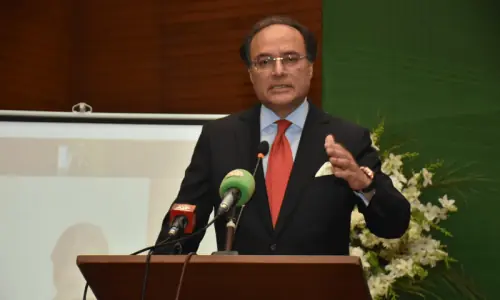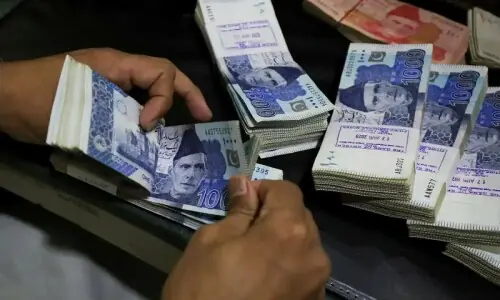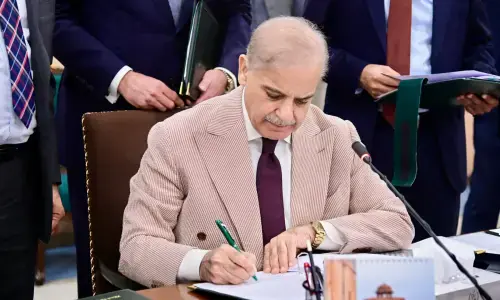


THE budget is here and the government has rarely looked happier. For a change, the budget-related press conferences were held by confident ministers, eager to answer questions. They pointed out that the petrol levy had not been increased (there were rumours to this effect) earlier. They boasted (rightly so) about the reduction in income tax rates for the salaried class, which included the reporters and anchors whose questions they were facing. And they also pointed out the incentives given to part of the industry. They spoke again and again about their efforts to provide some relief to different sections while still being in an IMF programme.
Indeed, the expectations were so low thanks to the previous years of heavy taxation that critics and commentators are conceding that the government has been able to carve out fiscal space for some concessions in the budget exercise — so far.
I say so far because changes may be made as the document makes its way through parliament over the next two weeks. The committees overseeing it may suggest changes as the government has to make sure its allies remain on board. And more importantly, news reports indicate that the IMF approval for some of the proposals is yet to come.
But despite the good news, the budget even in its current shape makes it clear the government, like its predecessors, has continued with some of its bad habits. Once again, real estate has emerged as the sector which will get concessions to provide a ‘kick’ to the economy. It is fascinating how in most ivory tower discussions, real estate is the big bad villain in the Pakistan economy but the moment a government, any government, is working on ways to grow the economy, it always zeroes in on real estate. Clearly, economists know nothing — especially not about the 40 industries that are directly linked to real estate and will grow the moment people buy plots and start constructing houses.
The budget makes it clear the government has continued with some of its bad habits.
Another bad habit afflicting every government is the generosity with which increments are given to the vast bureaucratic machine. This budget too has done the same. Salary increments are officially said to be a mere seven per cent but, in reality, the number goes higher, according to media reports. And some of the salary increases cannot even be mentioned publicly.
But even those who can find no fault with the tax relief or the decision to claw back resources from the provinces cannot praise the budget for being one that will stop the decline and help the shift to sustainable growth. The word that I have learnt from the commentary on the budget this year is ‘transformative’; this is not a transformative budget. The government may have made the best of a bad situation but there is little evidence of the kind of growth that is needed for a society and population of Pakistan’s size: yesterday’s crisis is still there today and will be there tomorrow.
How much of this will be discussed in detail is unclear, for there are but two weeks for a debate in parliament. And the debates on television appear as free as the media is.
In other words, there is little likelihood of the kind of growth and expansion that is needed to provide employment and economic mobility to a growing populace. A populace that is also far from healthy and well educated because of the little that Pakistan invests in these fields.
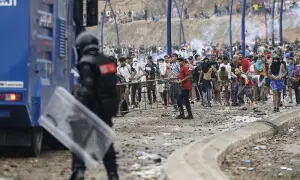
What will this mean domestically? Economists and other experts are best placed to answer the question, but what some of us economic illiterates fear is that the young, unemployed and resentful populace will continue to push back against the state. At places, it will be in the shape of militancy, at others, an angry, alienated and sullen citizenry, and in still others, a population waiting for another chance to protest. This is not a sweeping statement. Time and again, people have written on the link between the youth bulge, the socioeconomic changes in recent decades in Pakistan and the politics that is now pressuring its traditional form.
From the emergence of the PTM in parts of KP to the long-running insurgency in Balochistan to the continuing support for the PTI and even the protests rocking Kashmir at the moment, many of these movements or forms of pushback are being led by the educated and the middle class. Additionally, the support for these phenomena is primarily coming from similar groups.
These are parties/movements/struggles that are essentially interested in demanding or negotiating for more rights — economic and political — from the state. This much is clear if one goes through their demands rather than simply focusing on how the latter are made and the rigidity with which some approach the idea of negotiations. Both the manner in which the groups are negotiating and their inability to be flexible stem from their lack of trust in the state/status quo. For many of them, for a number of reasons, the state has become a bad-faith actor.
And because the state is not willing to ‘transform’ the economy, it is using heavy-handed tactics, such as blatant election rigging and violence. This has been the hallmark of the past few years and there is little evidence that it will change anytime soon. From this perspective, this budget is neither ‘good’ nor desirable. It simply indicates that the state and the ruling elite will continue to suppress the people at large and beat them into submission. This is not about a budgeting exercise but a larger and long-running battle between the people and the state. It is hard to tell when it will end.
The writer is a journalist.
Published in Dawn, June 16th, 2026