Against a backdrop of geopolitical uncertainty, regional conflict and lingering climate-related disruptions, Pakistan’s economy posted its strongest growth in four years during FY26, though it still fell short of official targets.
Unveiling the Pakistan Economic Survey (PES), Finance Minister Muhammad Aurangzeb announced provisional GDP growth of 3.7 per cent, up from 3.18pc in FY25, 2.6pc in FY24 and a marginal contraction of 0.2pc in FY23.
While marking a visible recovery in economic activity, growth remained below the government’s 4.2pc target. The size of the economy expanded to a record Rs126.9 trillion ($452.1 billion), with per capita income rising to $1,901 from $1,751 a year earlier.
Aurangzeb noted that the recovery had taken place amid a slowing global economy, where growth eased to 3.1pc from 3.7pc. “We had expected growth to cross 4pc,” he said, citing regional instability and escalating conflict in the Middle East as key drags.
The standout performer was LSM, which rebounded by 6.1pc after several subdued years, with 16 of 22 sub-sectors posting growth
Despite external headwinds, macroeconomic stabilisation continued under the IMF’s Extended Fund Facility. Fiscal consolidation remained on track, with the Federal Board of Revenue collecting Rs11.23tr in taxes and the economy generating a primary surplus of 3.5pc of GDP. The standout performer was large-scale manufacturing (LSM), which rebounded by 6.1pc after several subdued years, with 16 of 22 sub-sectors posting growth.
Industrial momentum was broad-based: fertiliser consumption rose 17pc, cement dispatches 10pc, and petroleum product sales 5pc. Consumer-linked industries also strengthened, with automobile production surging 31pc and mobile phone assembly rising 9pc.
Overall manufacturing expanded by 6.6pc, while construction grew 5.73pc and mining and quarrying also posted gains. However, these improvements were partially offset by a contraction in electricity, gas and water supply services due to reduced subsidies, lower Wapda output and higher input costs.
Agriculture delivered a mixed performance, expanding 2.89pc against a 4.5pc target, improving from 1.53pc last year but still constrained by climate shocks.
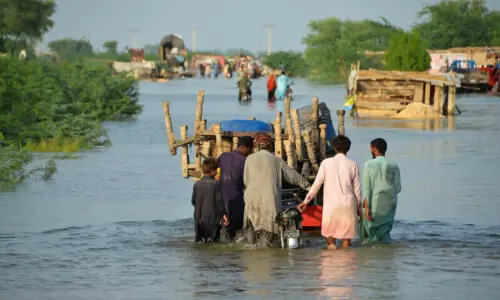
The sector remained under pressure from the aftermath of severe monsoon floods, which caused widespread economic losses, displacement and disruption across rural areas. Climate-related disasters inflicted damages of around Rs822bn in 2025, affecting millions of people and reinforcing Pakistan’s high vulnerability to extreme weather events.
Despite contributing less than 1pc of global emissions, Pakistan remains among the most climate-exposed countries due to its geography and reliance on monsoon systems, with poverty impacts increasingly concentrated in rural regions.
Within agriculture, crop growth slowed to 1.44pc, supported by a strong wheat harvest that rose 4.3pc to 29.6 million tonnes, while maize declined. Livestock, however, continued to provide stability and now accounts for 14.6pc of GDP, cushioning rural incomes amid repeated climate shocks. The Economic Survey warned that lingering flood impacts could continue to weigh on employment and rural activity, posing downside risks to near-term growth.
At the policy level, climate resilience is emerging as a central priority. The government is advancing the Pakistan Climate Prosperity Plan, Green Taxonomy framework and the Monsoon 2026 Strategic Plan, alongside reforms under the International Monetary Fund’s (IMF) Resilience and Sustainability Facility.
These initiatives aim to mobilise climate finance, strengthen disaster preparedness and shift policy away from reactive relief toward risk-informed development and resilient infrastructure.
The services sector, accounting for 58.42pc of GDP, remained the main growth driver, expanding 4.09pc and slightly exceeding the official target.
External accounts came under renewed pressure. Exports fell 5.4pc to $25.8bn during July–April FY26, while imports rose 8.5pc to $52.8bn as restrictions were eased to support industrial activity. As a result, the current account shifted from a surplus of $1.7bn to a deficit of $200 million.
This deterioration was partly offset by workers’ remittances, which rose 9pc, supporting external stability alongside improved foreign exchange reserves.
Inflation eased significantly compared to recent years, averaging around 7pc during the first 11 months, close to the 7.5pc FY26 target. However, monthly inflation spiked to 11.66pc in May 2026, raising concerns over price stability ahead of new fiscal measures.
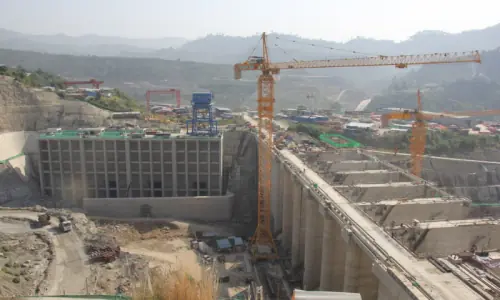
The energy sector underwent a structural change during the year. Installed capacity increased by 8.5pc to 49,651MW, driven largely by rapid adoption of solar net metering, which added 7,319MW. The share of hydel, nuclear and renewables rose to 53.1pc, reducing dependence on imported thermal fuels.
Meanwhile, the information and communication technology (ICT) sector continued to expand as a key source of export diversification. ICT export remittances rose 19.7pc to $3.38bn (July–March), with projections of $4.5bn by year-end. Freelance exports surged 51pc to $856m, while registered IT companies crossed 34,400.
Digital infrastructure also expanded through over 50 Software Technology Parks. Policy initiatives such as the Digital Nation Pakistan Bill 2025 and the Artificial Intelligence Policy 2025 further reinforced the sector’s momentum, alongside preparations for 5G spectrum rollout and expanded fibre connectivity.
Despite these gains, structural weaknesses persist. Investment remains low at 14.4pc of GDP, while national savings have slipped to 14pc, underscoring persistent constraints on sustainable expansion.
Overall, the Economic Survey portrays an economy that has regained macroeconomic stability and achieved its highest growth in four years. Yet the central challenge remains unchanged: translating stabilisation into sustained, investment-led growth capable of generating jobs, improving productivity and lifting long-term living standards.
The Economic Survey admits that poverty in Pakistan remains elevated despite macroeconomic stabilisation, with the national poverty rate estimated at 28.9pc (up from 21.9pc in 2018-19). This rise is attributed to a “succession of economic shocks, including inflation, currency depreciation, floods and slower growth in incomes”.
Rural areas continue to bear a disproportionate burden, with poverty significantly higher at 36.2pc compared to 17.4pc in urban centres, reflecting deep structural inequalities in income distribution and access to economic opportunities.
Published in Dawn, The Business and Finance Weekly, June 15th, 2026