AJK proscribes JAAC ahead of June 9 demo


 0
0

• Asks tourists to leave territory in peak season; orders all hotels vacated
• Security beefed up, exams postponed amid concerns
• Civil society group plans rallies to Muzaffarabad, indefinite sit-in on June 9 over issue of refugees’ seats
• AJK SC seeks stakeholders’ input on presidential reference
MUZAFFARABAD: The Azad Jammu and Kashmir (AJK) government on Friday designated the Jammu Kashmir Joint Awami Action Committee (JAAC) a proscribed organisation under anti-terrorism laws, days before the group was scheduled to stage a major protest.
The move came after AJK authorities advised tourists to leave the territory by Friday evening, and advised intending visitors to postpone their trips until June 20, citing security concerns ahead of the planned protests.
In addition, mobile data and internet access was also suspended across the territory around midnight, although phone calls could still be made by the time this report went to press.
The JAAC’s latest protest call centres around a highly contentious demand to abolish the 12 seats in the region’s Legislative Assembly that are reserved for refugees from Indian-occupied Jammu and Kashmir, who settled in mainland Pakistan after 1947.
JAAC alleged that these seats are frequently used by mainstream Pakistani political parties to influence the formation of governments in Muzaffarabad.
According to a Home Department notification, issued late on Friday night, the JAAC was “engaged in terrorism” and had acted in a manner “prejudicial to peace and security” of the state.
It further stated that JAAC is involved in “creating anarchy in the state by intimidating public, promoting hatred and creating a sense of insecurity in society and public at large etc”.
“Now, therefore, in exercise of powers conferred under section 12 of
Azad Jammu and Kashmir Anti-Terrorism Act, 2014, the President, Azad
Jammu and Kashmir has accorded approval to list the Jammu Kashmir Joint Awami Action Committee (JK-JAAC), also known by names such as Joint Awami Action Committee (JAAC) and Awami Action Committee (AAC) etc, in the First Schedule of ATA, 2014, Proscribed Organization for the purpose of the said Act.”
Blow to tourism
The advisory, which was issued at the height of tourist season, will definitely come as a blow to AJK’s hospitality industry.
“The measure has been advised to save intending visitors from any unexpected situation or inconvenience,” an official spokesperson said in a press release issued by the press information department.
“The government also requests those already in the territory for sightseeing or other purposes to leave by Friday evening so that they do not confront any unpleasant situation,” the spokesperson added.
In Mirpur district, Deputy Commissioner Sajid Aslam ordered all government and private hostels and boarding houses to vacate their occupants by midnight on June 7 as part of precautionary measures ahead of the planned protest campaign.
Zahid Aslam, a guesthouse owner in Kel in the scenic Neelum Valley, told Dawn that local authorities had directed hotel and guesthouse operators to ask visitors to leave. “I have 10 rooms, and all were booked until June 16. But now I, and many others like me, will have to make refunds,” he said.
A hotel owner in Rawalakot, requesting anonymity, said police had issued similar instructions there. “This is the third consecutive year that the hospitality sector has been hit hard by the volatile situation. It is devastating for us,” he said.
On Thursday, however, the AJK Legislative Assembly adopted a resolution strongly defending the refugee seats and supporting the holding of elections on schedule.
Preparations intensify
In a statement issued on Friday, JAAC leaders Shaukat Nawaz Mir, Umar Nazir Kashmiri, Imtiaz Aslam and Ghulam Mujtaba described the planned protest as a renewed phase of peaceful public mobilisation.
According to the programme announced by the alliance, a region-wide shutter-down and wheel-jam strike will begin on June 9, accompanied by marches from Bhimber and Mirpur towards Rawalakot via Kotli. Participants from Mirpur and Poonch divisions are expected to proceed to Muzaffarabad on June 10, where they will be joined by activists from Muzaffarabad division.
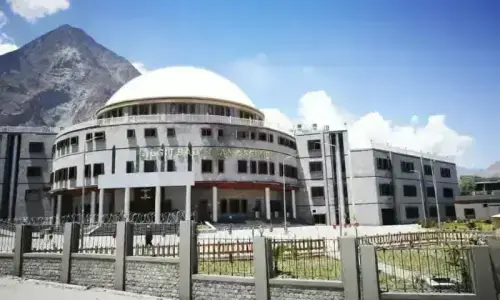
The campaign is planned to culminate in an indefinite sit-in outside the Legislative Assembly, with protesters symbolically surrounding the building to press for what they describe as democratic, social and economic rights.
However, it was not clear how the plan would be impacted by the proscription of the JAAC.
Additional deployment
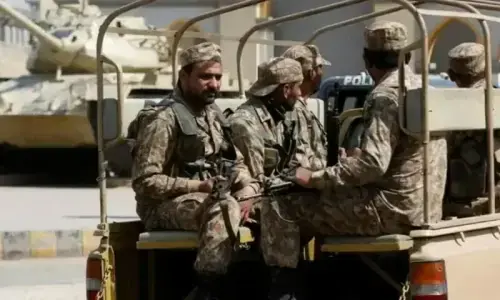
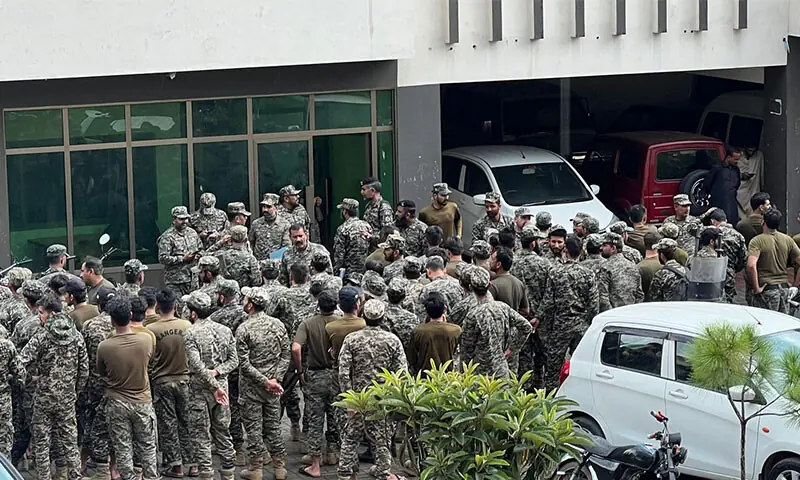
In preparation for the JAAC demonstrations, the federal government dispatched paramilitary personnel to reinforce AJK police following a request by Inspector General of Police Capt (retd) Liaqat Ali Malik for 14,000 additional personnel to maintain law and order from June 7 to 21.
Footage circulating on social media on Friday showed convoys of security personnel entering Muzaffarabad, indicating that reinforcements were already being deployed ahead of the strike.
“Our foremost responsibility is to protect public and private life and property, and the police will act in accordance with their mandate,” Mr Malik told Dawn.
“I urge people not to join any mob seeking to create unrest or attack security forces,” he added.
A senior police officer, speaking on condition of anonymity, said the number of personnel sought from the federal government might exceed 14,000 as additional requests for reinforcements had also been submitted.
Court seeks views on presidential reference
The protest marches came as a division bench of AJK Supreme Court invited political parties, lawyers and members of the public to submit their views on a presidential reference seeking court’s advisory opinion on the constitutional status of the 12 refugee seats in the Legislative Assembly.
The reference was filed by acting president Chaudhry Latif Akbar under Article 46-A of the Interim Constitution Act, 1974.
While the court had announced that Chief Justice Raja Saeed Akram, senior judge Raza Ali Khan and Justice Khalid Yousaf Chaudhry would hear the matter, Justice Khan recused himself as he was among the lawyers who had challenged the refugee seats in June 2014. Consequently, Friday’s proceedings were conducted by a two-member bench comprising the chief justice and Justice Chaudhry.
At the outset of the hearing, the chief justice said the reference sought court’s opinion on five questions about constitutional status of the refugee seats, legislature’s competence to introduce a fundamental constitutional amendment at the present stage, the constitutional limits of the rights of assembly and association, and the state’s obligation to protect the electoral process and reject extra-constitutional demands.
After hearing Advocate General Mohammad Nadeem Khan, the bench observed that the reference raised important constitutional and legal questions requiring broader consultation before a considered opinion could be formed.
The court issued notices to the prime minister, the leader of the opposition, all members of the Legislative Assembly, heads of political parties represented in the house, the vice chairman of the AJK Bar Council, and the presidents of the AJK Supreme Court and High Court bar associations. It also invited members of the public to submit their views.
Senior lawyers Raja Sajjad Ahmed Khan and Barrister Humayun Nawaz were appointed amici curiae to assist the court.
The chief justice allowed stakeholders to submit written statements before the registrar by 10pm and adjourned the hearing until Saturday.
Acting Registrar Malik Ahtisham told Dawn by 10:25pm that his office had received a dozen submissions, including some jointly signed statements.
Published in Dawn, June 6th, 2026