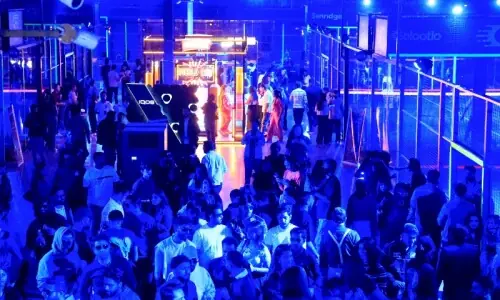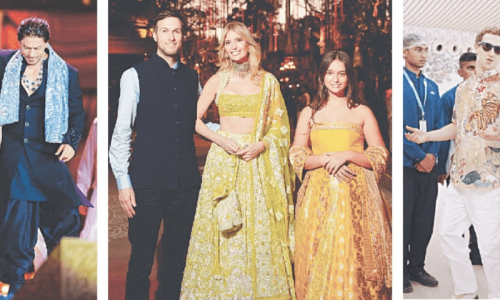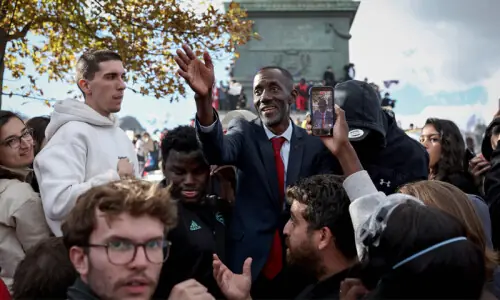
Comedian Tabish Hashmi once joked that the wedding of Indian billionaire Mukesh Ambani’s son should be a humbling experience for all those flaunting their lifestyle on Instagram. That ‘us’ nobodies should sit on the side and simply observe what actual affluence looks like.
He wasn’t wrong, given the kind of muscle the Ambanis were able to pull, from Hollywood to Bollywood. The spectacle was less a wedding and more a reminder of how far wealth can stretch the idea of celebration.
Just the images of celebrities such as Mark Zuckerberg, David Beckham and the Kardashians casually drifting through the venue like guests at some lavish exotic retreat was nauseating to most — and perhaps deeply inspiring to the local elite circles, who must have spent the endless wedding feeling painfully ordinary by comparison.
However, the masses, Indian masses in particular, weren’t moved by that. The masses continued to stage their own versions of spectacle — Bollywood lookalikes lip-syncing to ’90s hits, carefully choreographed nostalgia repackaged as glamour. If anything, it seemed to confirm an older suspicion: that mass culture would always trail behind, reproducing the gestures of the elite in ‘cheaper’, cruder forms — the kitsch in its various manifestations.
Then a gorilla walked in.
Not because it belonged there, but because it didn’t. The gorilla did not resemble wealth, nor did it attempt to imitate it. It arrived as interruption: loud, excessive and completely out of place within the carefully managed ambit of celebration.
From TikTok weddings to medical school farewells, the dancing gorilla has gone from viral gag to cultural fixture. But beneath the absurdity lies a revealing story about spectacle, virality and modern celebration…
PRIMING THE PRIMATE
What began on wedding dance floors has now entered private parties and elite university events in Pakistan; the rubber gorilla — the costume inflated by a built-in fan — has become a fixture not just of Instagram algorithms but of celebration itself.
That the gorilla now appears as comfortably at elite university events as at TikTok weddings suggests something larger than a viral trend. Older distinctions between prestige and parody, it seems, no longer hold.
Looking at any of these viral gorilla videos, you will find a number of unifying tropes. First of all, the gorilla’s performance itself is almost secondary to its documentation. Most guests encounter the gorilla not directly but through their phone screens, filming from a safe distance, as though absurdity only becomes complete once captured and reposted.
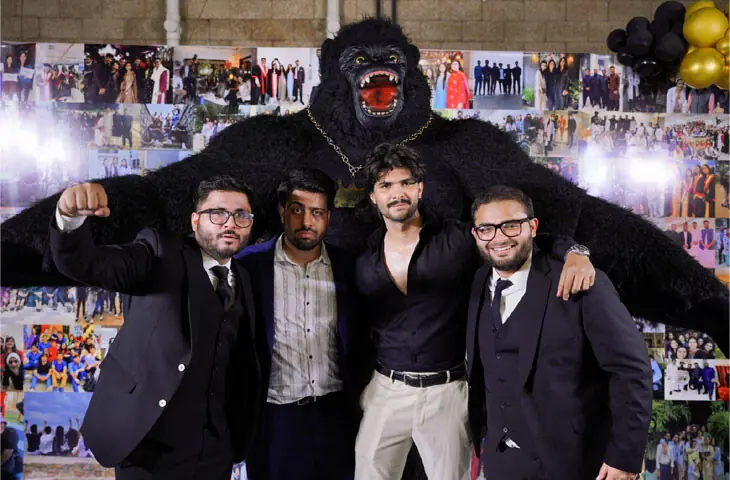
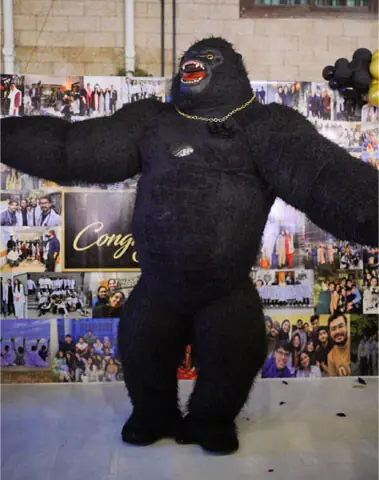
At one such recent farewell event at a medical college, the gorilla arrived to loud Punjabi music and immediate laughter. Young men in suits cleared space for it, while others rushed to record the moment on their phones. The costume was visibly artificial — oversized black fur, inflated arms, a cheap gold chain hanging around its neck — yet the crowd embraced it completely.
Gen Z vibes with the gorilla, Gen Alpha poses for photos, and the older generation — less convinced but quietly accommodating — facilitates it, as if being forced to keep pace with a new cultural normal, defined by a restless urge to experience the absurd… by booking it.
RITUAL BY REQUEST
Those curating such events suggest the gorilla is no longer a novelty but a request — something clients now ask for alongside lighting, music DJs and décor.
Mohammad Noman Shah, who runs a company involved in organising such events, says dedicated “gorilla packages” are already becoming standard, with appearances priced according to duration and scale. “You can book the gorilla for an hour or for the entire event,” Shah tells Eos, noting that demand has surged even before the arrival of newly imported costumes from China.
Shah’s social media presence may still be modest, but the bookings for the gorilla, he suggests, are already ahead of the algorithm, with demand for the gorilla outpacing its social media reach. “I am offering gorilla packages ranging from 15,000 to 40,000 rupees for the duration of four hours, and it’s pretty much the same across the board.”
Faizan Amin runs the company that provided the gorilla for the event at the medical college. He tells Eos that, in his five years in event management, he has never seen a trend catch on so quickly. “Nothing else really matches the craze around the gorilla right now,” Amin adds. “It was funny even for us as organisers, but the energy it created was unbelievable.”
The spectacle, however, also came with practical challenges. “We had to make sure the marquee was large enough for an eleven-foot figure to walk through,” Amin continues. “We actually had to rethink parts of the space and entry design to make the gorilla’s entrance work smoothly. We were no longer just catering to humans.”
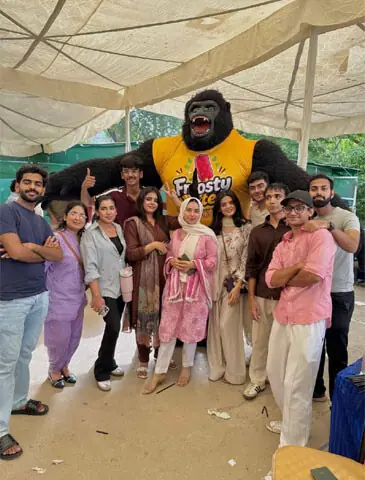
Dr Ahmed Zubair Abbasi, who recently finished medical school at Ziauddin University, hired the gorilla for his batch’s graduation event. In their now-viral video, the young doctors can be seen dancing and circling around the giant creature with a kind of ecstatic release, as though participating in some strange, ancient ritual they only half-understood.
“We booked the gorilla for the energy and surprise it would bring,” Abbasi tells Eos. “It was still a formal dinner and everyone was suited, so we were unsure how people would react,” he continues. “But the moment the gorilla walked in, everyone forgot where they were and what for.”
The gorilla’s success may also lie in the fact that it tapped into an already familiar internet language of exaggerated characters and performative absurdity.
But part of the gorilla’s appeal also lies in the fact that nobody fully commits to whether this showcase, this exhibit, is ironic or sincere. Guests laugh at the gorilla while dancing with it, as if accepting, even mocking the moment’s absurdity, while insisting the same moment be recreated at their own event.
NOT CRINGE, NOT CAMP
Rapper and comedian Ali Gul Pir sees the gorilla phenomenon as an extension of an earlier internet obsession: videos of men dressed as Spider-Man dancing to Punjabi songs at parks and gatherings.
While those performers were probably just dancing to local tunes to entertain the crowd physically present there, the clips also gave them the chance to ride a viral trend online.
“I think it’s a trend people will eventually get tired of,” Pir tells Eos. “It’s like the laser boys at every corporate event doing that laser dance which, honestly, isn’t even that good, but it has become a fixture at every corporate event.”
The comparison with Spider-Man does hold but, strangely enough, those characters never really entered the ritual itself. Nobody wanted Spider-Man standing next to the groom during the dulha’s [bridegroom] entry or have the character dancing alongside the baraat [wedding procession]. He remained cringe content — something to watch, laugh at and scroll past.
The gorilla somehow crossed that line. It became less a character people looked at and more a presence people wanted to dance with, similar to how Klç-Kalkan — the Turkish folk sword-and-shield wedding dance — from Dirili: Erturul was replicated at many Pakistani weddings.
“You also have to understand that these gorillas are huge — almost nine feet tall,” says Pir. “They look big, powerful, more masculine.”
In a wedding culture where exaggerated displays of masculinity already exist — from aggressive dance performances to celebratory gunfire — the gorilla may simply become another extension of that performance.
THE CIRCUS COMES HOME
To an older pair of eyes, the current cultic obsession with the absurd can appear sudden, very Gen Z, even baffling — as though celebration has tipped into self-parody. But the instinct itself is not new.
Old rituals have always made room for new ones, by adding on or removing from its predecessor or, as the American author and podcaster Sasha Sagan reminds us, what we call tradition is often far more recent than it appears.
The absurd has always existed within celebration. What has changed is the speed at which it now travels. Trends emerge online, circulate through algorithms and settle into ritual before anyone has time to question them.
Trends that might once have remained local now arrive pre-packaged, already familiar, their origins traceable not to a place but to a feed — where pieces of performance circulate long before they are encountered in person. Just like the gorilla-at-the-wedding trend that started ‘somewhere’ on Indian TikTok and then took over the internet by storm.
South Asian entertainment cultures have long been fascinated by exaggerated or non-human figures — from circus animals to masked performers and mythological characters. The gorilla reproduces that fascination in a portable internet-age form: strange enough to disrupt the event, but safe enough to remain playful.
ABSURDITY IN RITUAL
Manahil Tahira, an editor at a literary magazine, argues that part of the gorilla’s strange success lies in the fact that people are not necessarily dancing with it so much as around it.
“We are laughing at it,” says the 26-year-old, describing the gorilla as the kind of “radical nonsense” that instantly produces the familiar response of ‘Yaar kuchh bhi?’ [Whatever even is this?] before compelling audiences to keep watching and recording. The spectacle cuts across class and aesthetic categories precisely because it demands so little interpretation.
But the spectacle depends on a quieter erasure. “This fun is only possible if you forget there is an actual person under this thick coat of faux hair,” Manahil notes. The gorilla appears most effective once the labouring body inside disappears completely into the spectacle itself.
Tahira’s comment makes us rethink the sheer brilliance and tyranny of a traditional showcase such as the Lucky Irani Circus or the many versions that have existed before; they rely on the human urge to be fascinated by the inhuman or by poking fun at the inhuman.
One of the most violent iterations of such rituals is how weddings in rural Punjab were once notorious for inviting differently abled, short-heighted or dark-skinned individuals for their ‘services’ to be shamed, trolled and mocked by the friends of the groom, as means of sheer entertainment and masculine release.
What has changed is not that impulse, but its form. Where such encounters were once contained within specific spaces, classes and occasions, they are now portable, repeatable and stripped of context. The gorilla does not simply entertain; it reproduces that moment on demand — less dangerous, perhaps, but no less revealing of a long-standing desire to confront and toy with the abnormal.
American anthropologist Clifford Geertz described rituals as stories societies tell themselves about themselves. What makes the dancing gorilla interesting is not merely its absurdity, but the speed with which absurdity itself now becomes ritual.
The internet no longer just documents celebration; it increasingly manufactures the forms through which celebration is performed, repeated and remembered.
The writer is Assistant Professor of Practice at Habib University and writes on pop culture and contemporary media practices in South Asia. X: @rafay_mahmood
Published in Dawn, EOS, May 24th, 2026