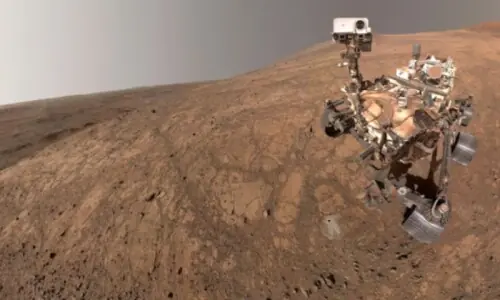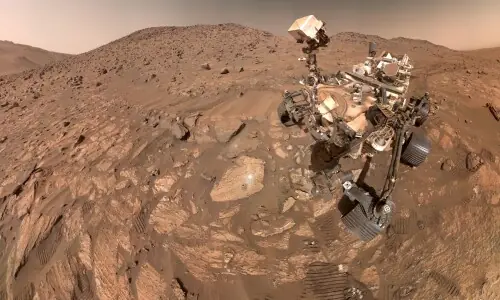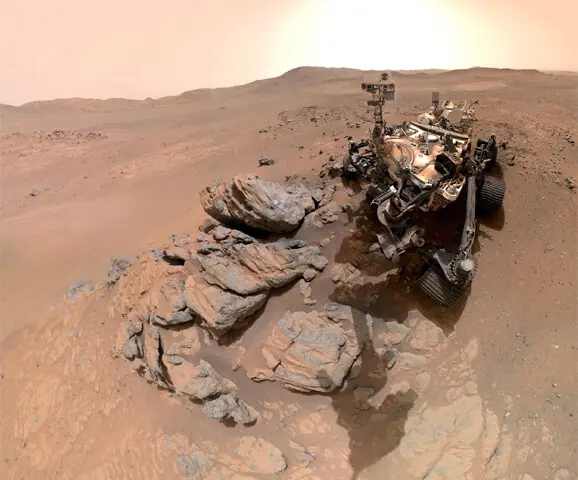
WASHINGTON: For Nasa’s Perseverance Rover, life on Mars has been a marathon, not a sprint. For more than five years, the six-wheeled robotic explorer has been steadily traversing the Martian surface seeking signs of ancient life, studying its geology and climate, and collecting rock samples for possible return to Earth.
The rover has now traveled 26.09 miles, just shy of the official marathon distance of 26.22 miles, and, according to Perseverance mission manager Robert Hogg, it will exceed that distance likely in the next month.
The car-sized rover landed on February 18, 2021, with a mission duration initially planned to last one Martian year, about 687 Earth days. “The rover continues in good health with at least a decade left in its power source. The duration of the mission will depend on choices Nasa makes,” Ken Farley, Perseverance’s deputy project scientist at Caltech, said in comments.
Perseverance, toting a suite of scientific instruments, has operated in and around Jezero Crater, an area in the Martian northern hemisphere believed to have been flooded with water and home to an ancient lake basin. Among various water-related features, it exhibits an ancient fan-shaped sedimentary deposit where a river flowed into a lake more than three billion years ago.
Mars, now cold and desolate, long ago possessed a thicker atmosphere and warmer climate, allowing for liquid water on its surface. Scientists are eager to determine whether Mars ever harbored life. Water is considered a fundamental ingredient for life, making Jezero Crater — with its wet past — a prime place for the rover to study.
Perseverance’s most important discovery was announced by Nasa last year — a sample from inside the crater of reddish rock formed billions of years ago from sediment on the bottom of the lake that bore potential signs of ancient microbial life. Researchers said minerals detected by the rover could reflect ancient microbial activity but also could form through nonbiological processes.
“Further work evaluating whether these are truly evidence of Martian life requires analysis in terrestrial laboratories that contain the kinds of instrumentation necessary to make that determination,” Farley said.
“Perseverance will continue to collect rock samples with the hope for return to Earth by a future robotic or crewed mission,” Farley said. It also has gathered evidence about organic molecules on Mars. In some other findings, Perseverance documented that the Martian atmosphere is electrically active, detecting electrical discharges often associated with whirlwinds called dust devils, and observed an aurora on Mars in visible light for the first time, with the sky glowing softly in green.
Published in Dawn, May 21st, 2026