NASA rover detects some of the oldest evidence of water flowing on Mars
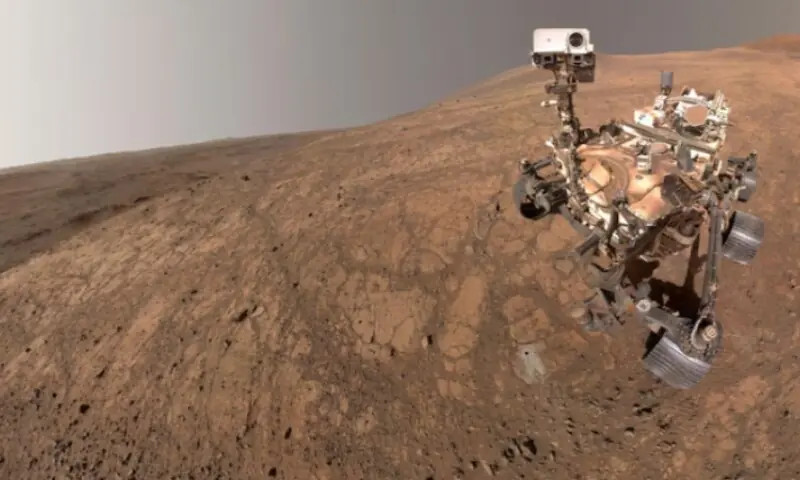

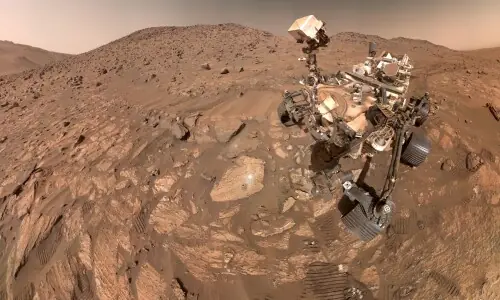
Using ground-penetrating radar, NASA’s Perseverance rover has detected underground remains of an ancient river delta on Mars in some of the oldest evidence yet obtained showing how water once flowed on the surface of Earth’s planetary neighbour.
Researchers said the six-wheeled rover revealed geological features up to 115 feet (35 meters) underground while traversing 3.8 miles (6.1 km) of terrain inside Jezero Crater, an area in the Martian northern hemisphere believed to have been flooded with water and home to an ancient lake basin long ago.
Perseverance identified layered sediments and eroded surfaces indicative of a delta environment, a large-scale fan-shaped deposit of sediment formed at the location where a river enters a larger body of water like a lake.
They estimated that the now-buried delta dates to about 3.7 to 4.2 billion years ago. Mars, like Earth, formed roughly 4.5bn years ago, meaning this delta existed relatively early in its history.
The researchers said this delta predated a similar nearby surface feature called the Western Delta that dates to about 3.5 to 3.7 billion years ago.
The rover’s RIMFAX instrument sends radar pulses downward and records pulses bouncing back off underground features, allowing a three-dimensional mapping of the subsurface. The new findings were based on RIMFAX’s deepest data collected to date, obtained from September 2023 to February 2024 over a span of 250 Martian days
Because water is considered crucial to the possibility of past life on Mars, the mounting evidence of its wet past is of particular interest. Mars, now cold and desolate, long ago possessed a thicker atmosphere and warmer climate, allowing for liquid water on its surface.
“From the features mapped by RIMFAX, we believe that Jezero Crater hosted an ancient water-rich environment, capable of biosignature preservation that existed prior to the formation of Jezero’s Western Delta,” said UCLA planetary scientist Emily Cardarelli, a member of the Perseverance science team and lead author of the research published on Wednesday in the journal Science Advances.
A biosignature refers to chemical or physical evidence indicating past or present life.
On Earth, river deltas are places that concentrate sediments and create niches favorable to microbial life.
Scientists last year announced that a sample of rock obtained by Perseverance in Jezero Crater contained a potential biosignature suggestive of ancient microbial life, though the minerals in the sample also can form through nonbiological processes. The rock dated to roughly 3.2 to 3.8bn years ago.
Perseverance since 2021 has been exploring Jezero Crater. Scientists believe river channels spilled over the crater wall and created a lake.
“It’s very exciting that RIMFAX was able to provide such a detailed view of these deposits, and thus help solve the puzzle of their origin,” UCLA planetary scientist and study co-author David Paige, also a member of the Perseverance rover science team, said of the new findings. “This further cements the notion that ground-penetrating radar is indeed an extremely valuable new tool for studying planetary geology.”
Chinese scientists last year said ground-penetrating radar employed by China’s Zhurong rover detected subsurface evidence of what look like sandy beaches from the shoreline of an ocean that may have existed on the northern plains of Mars.
“Over time, we’ve seen more and more evidence for liquid water on the Martian surface at various rover landing sites, areas we’ve traversed to, as well as from orbital imagery. We have seen channels where water may have flowed, crater lakes where water once ponded, and deltaic sediments deposited as rock outcrops and now as buried remnants, with this (research) paper,” Cardarelli said.
“Mars is diverse, and each rover mission reveals another piece of its puzzling past and the early development of our rocky neighbor,” Cardarelli said.