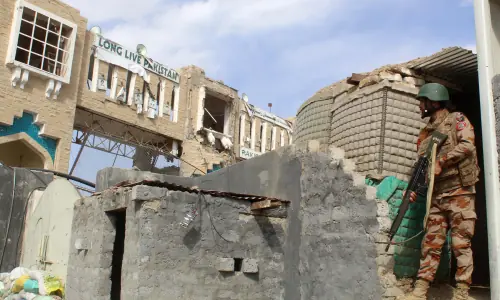
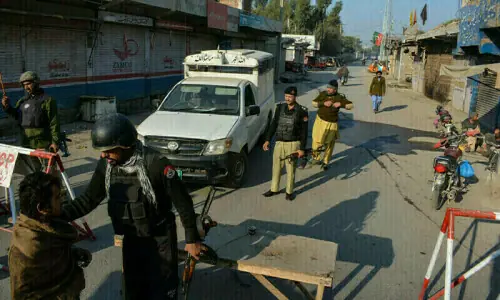
AFTER consecutive months of decline in terrorist violence in March and April, a wave of fatal incidents in recent days has raised fresh doubts over Afghanistan’s commitment to preventing the misuse of its territory against Pakistan. Over the course of five days starting May 9, terrorists struck a police post in Bannu, a traffic police deployment in Lakki Marwat, and a security deployment in Bajaur, KP.
The Afghan chargé d’affaires was issued a “strong demarche” by the Foreign Office (FO) following the Bannu incident. It was a sophisticated attack, involving a vehicle-borne IED and a multipronged ground assault with heavy weaponry and quadcopters, and it claimed the lives of 15 police personnel. The FO said technical intelligence had definitively proven that the attack was masterminded by actors in Afghanistan. The Afghan representative was told that Pakistan reserved the right to respond, and the defence minister later warned that Pakistan would consider “open war” if the attacks did not stop.
It had seemed for a while that Operation Ghazab lil-Haq had established a level of deterrence that would encourage the Afghan authorities to adopt a more proactive approach towards containing threats launched from their soil. The involvement of China in the arbitration process between Kabul and Islamabad, which culminated in the suspension of kinetic measures after talks in Urumqi, also stayed Pakistan’s hand. But with a mounting death toll, pressure will once again start to grow to reconsider military responses.
Pakistan has previously demonstrated that it is prepared to use force in order to achieve peace and eliminate threats to its interests. It is to its own peril that the Afghan side seems to be mistaking Islamabad’s restraint for lack of resolve. At the same time, Pakistan has repeatedly made it clear it does not prefer violence for achieving its security goals. It would be better if Afghanistan respects that position instead of taking a complacent stance on Islamabad’s concerns.
Meanwhile, KP’s security apparatus must close ranks with the federal authorities, and Pakistan’s security establishment must go on the offensive against infiltrating terrorists, instead of taking a reactive approach. The PTI-led provincial government should reconsider its narrative, which has inadvertently lent credence to militant propaganda, particularly around quadcopter attacks.
Data indicates terrorists launched 246 such attacks this year alone, the bulk targeting police in Bannu. Criticising the security apparatus while staying silent on this sustained offensive against law enforcement is a double standard that must end. Better intelligence sharing and coordination between police, federal security authorities and the armed forces will help isolate and target hostile elements effectively.
Pakistan has shown it can take a zero-tolerance approach towards problematic actors. That resolve must be concentrated on eliminating violent elements and the criminal networks that fund and enable them.
Published in Dawn, May 18th, 2026