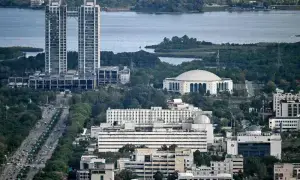
The new Karachi Chamber of Commerce and Industry (KCCI) leadership, headed by Talat Mahmood, faces the formidable challenge of representing a business community diverse in scale, sectors and ethnicity across one of the world’s largest and densest cities. The task is compounded by Karachi’s deficient infrastructure, civil services and fragmented governance, where multiple agencies with overlapping mandates often evade responsibility.
Can Karachi’s business community take a cue from relatively smaller Sialkot and mobilise its own resources to bridge infrastructure and service gaps to improve the business environment?
Sialkot’s business community has distinguished itself by collectively financing major capital-intensive infrastructure initiatives. Most city leaders, however, see little prospect of Karachi replicating this model, citing deep trust deficits, weak unity, and the sheer scale of the city’s infrastructure deficiencies. Other constraints include the national rather than local focus of Karachi’s large conglomerates, their preference for separate representative platforms, and what some describe as the short-term, narrow focus of the dominant group within the KCCI.
Last week KCCI elections for the 30-member managing committee and four-member leadership body were decisively won by the Businessmen’s Group (BMG). Its older rival, the Businessmen’s Association (BMA), contested only 26 managing committee seats, according to information gathered.
Can Karachi’s business community take a cue from relatively smaller Sialkot and mobilise its own resources?
BMA virtually monopolised KCCI until 2000 under leaders including Tariq Saeed, Latif Ebrahim Jamal, Basheer Janmohammad, Rauf Tarmuhammad, Mian Rafi, Riaz Tata and Haji Razzak Janoo. BMG emerged in 2000, led by figures such as SM Munir, Siraj Teli, Zubair Motiwala, Majyd Aziz and Haroon Farooki.
Interestingly, most KCCI members and leaders contacted were unable to identify any clear differences between BMG and BMA in terms of agenda, platform or policy priorities.
As of June 30, KCCI reportedly had 26,500 members — companies with annual turnover of at least Rs50 million alongside associate members including partnerships, trade bodies and market associations. If indirect members are included, representation reaches 75-80,000 city businesses.
About 16,000 members were eligible to vote this year, comprising 52 per cent corporate and 48pc associate members. An unwritten KCCI convention reportedly divides the 30 managing committee seats equally among three dominant linguistic communities: Gujarati-speaking Memons, Urdu-speaking Muhajirs, and Punjabis. While some independents contest, chamber politics is largely dominated by the two main groups.
According to insiders, KCCI top offices traditionally rotated among three linguistic communities, each free to nominate its candidate when its turn came. They contend that this autonomy has since eroded, alienating many members and pushing some to the sidelines.
Most city leaders see little prospect of Karachi replicating this model, citing deep trust deficits, weak unity, and the sheer scale of the city’s infrastructure deficiencies
“The Memon community currently dominates KCCI and its politics, with some leaders using the platform for self-promotion and advancing the textile lobby’s narrow interests while other sectors are ignored. As a result, problems facing traders and entrepreneurs keep mounting, forcing members to seek individual solutions in the absence of effective collective action,” a disgruntled chamber leader said.
Haroon Farooki, a prominent leader, urged the new KCCI’s leadership to make the chamber more inclusive and pursue a collective agenda focused on removing bureaucratic hurdles and accelerating implementation of business-friendly policies.
Majyd Aziz, president of the Employers Federation of Pakistan, attributed Sialkot’s success to cohesion, self-reliance and its export orientation. Unlike diverse Karachi, he said, Sialkot’s business community is more unified and, being distant from ports, developed its own infrastructure — including a dry port, airport, airline, think tank and training institutions — rather than waiting for government approvals and funding.
The chamber also exercises greater influence over export associations, unlike Karachi, where multiple competing business leaders dilute collective action. Sialkot has developed an export-oriented industrial base spanning at least 10 sectors, with thousands of units exporting most of their output. Mr Aziz credited its entrepreneurs with innovation, business acumen and strong social responsibility. He believes greater integration between Sialkot, Gujrat and Gujranwala could create a powerful export triangle for Pakistan.
Ehsan Malik, former CEO of the Pakistan Business Council, declined to comment on KCCI’s elections and the body’s composition, focusing instead on why Sialkot’s businesses have collectively invested in their city while Karachi’s have not.
Despite its smaller size, Sialkot’s business community financed a dry port, roads, an international airport and eventually AirSial, with exporters voluntarily contributing 0.25pc of export proceeds to city development.
Mr Malik identified five structural differences. Sialkot’s business community is smaller, geographically concentrated and interconnected, making collective action easier. Its predominantly export-oriented industries also share common needs in logistics, customs, certification and infrastructure, making returns on joint investment clearer.
Business owners are locally embedded, unlike Karachi’s mix of multinationals, banks and large professionally managed corporations with broader interests. Karachi also faces a much greater free-rider problem: businesses question why they should finance infrastructure while already contributing heavily in taxes.
Most importantly, Karachi’s fragmented governance—divided among provincial, municipal, cantonment, port, utility and federal authorities—makes coordinated intervention difficult.
“Karachi’s weakness is not a shortage of business talent, wealth or institutions; it is a collective-action problem,” Mr Malik said. Sialkot, he argued, has less corporate power but greater social capital and alignment of interests.
Defending BMG, Shariq Vohra described it as diverse and inclusive, citing 28 years of community service and uninterrupted electoral success. Memons dominate its leadership because of their numerical strength and community support, he said, but BMG has never excluded other communities.
Mr Vohra said KCCI largely represents traders and smaller industrialists, while conglomerates prefer sectoral associations or the Pakistan Business Council. Karachi’s business community itself is highly diverse, with different communities prominent across textiles, commodities, construction, finance, pharmaceuticals, transport and trade.
He attributed the low election turnout partly to KCCI’s focus on federal macroeconomic and tax issues, while smaller businesses are more concerned with provincial and civic problems such as roads, water, sewerage and law and order. He acknowledged Sialkot Chamber as an exceptional model of collective responsibility and project execution.
A senior business leader pointed to a deepening rift between Karachi’s corporate community and the PPP, which has governed Sindh since 2008. “The corporate sector largely holds the PPP responsible for the decline of a city that remained far ahead of its peers until the 1980s. But the record of other political parties has hardly inspired confidence either. Many business leaders have consequently lost faith in political rhetoric and lofty democratic ideals. What they want is a shake-up that delivers better governance and restores the city,” he said, requesting anonymity.
The writer is a former Dawn staffer
Published in Dawn, The Business and Finance Weekly, October 5th, 2026