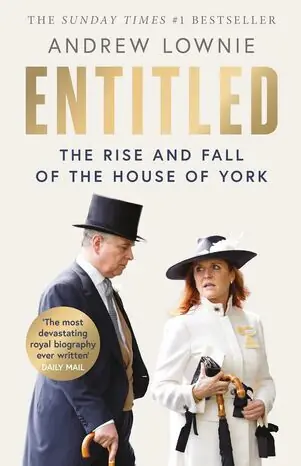
Entitled: The Rise and Fall of the
House of York
By Andrew Lownie
HarperCollins
ISBN: 9780008775452
448pp.
Magdalene College, Cambridge alumnus Andrew Lownie has authored this riveting exposé of his namesake, Prince Andrew and his ex-wife, Sarah Margaret Ferguson, the former Duke and Duchess of York.
Riveting, however, does not mean that the book is written in good taste. Ostensibly, Entitled appears to be meticulously researched. Lownie contacted no fewer than 3,000 people while soliciting information for his unauthorised biography. Only about 10 percent of those contacted agreed to cooperate, but even the information gained from that percentage resulted in a text that comes across as damaging to the point of being downright vitriolic.
Many have known for decades of Sarah Ferguson’s sexual indiscretions with American financier John Bryan, which were part of the reason the Crown urged the couple to divorce. It is all too easy for non-perceptive readers to take a self-righteous stance on this front; however, I should underscore that she was ‘legally separated’ from Prince Andrew at the time when the compromising photos of Bryan sucking her toes were taken.
Given that this judicial point has been noted by well-informed authors who cover royalty, such as Lady Colin Campbell for example (one of whose books is cited in Lownie’s bibliography), readers need to keep such facts in mind before rushing to condemn Sarah.
An unauthorised biography of the former Duke and Duchess of York attempts a sweeping exposé of Andrew Mountbatten-Windsor and Sarah Ferguson, but raises questions about balance and fairness
Far more recently, Prince Andrew’s rather damning relationship with convicted sex trafficker Jeffrey Epstein has come to light. According to Lownie, the ill-fated Virginia Giuffre claimed that she was forced by Epstein and his accomplice Ghislaine Maxwell to have sex with the prince on no less than three separate occasions. Also serious are Lownie’s documented allegations that Sarah was paid substantial amounts of American dollars by Jeffrey Epstein himself. (Lownie probably felt vindicated, not to mention gleeful, when Andrew was recently arrested by the British police for having leaked privileged information to the now-deceased Epstein.)
The former Duchess of York would often either be late with payments to individuals for services rendered or simply not bother to pay them at all. Lownie recounts how the Coutts Bank staff were exasperated by her extensive overdrafts. On occasion, the duchess would claim, with feigned naivete, that she considered certain services rendered (such as travel expenses, hotel stays etc) to be ‘gifts’!
She did not settle even a minor bill of GBP 7,000 with an artist she had commissioned to paint a portrait of Andrew and Sarah’s daughters. The former duchess always was, and still remains, one of Andrew’s staunchest supporters, but her sense of entitlement comes across as far less admirable than her loyalty to the father of her children.
A flip-through of the photographs in the book will reveal that, aside from a touching one of Andrew next to a smiling Queen Elizabeth, virtually no major current royal (such as the present king and queen, or the Duke and Duchess of Cambridge, now of Wales) appear to have consented to have pleasant images of themselves posing alongside Andrew and Sarah to be included in the book. However, the photograph where Andrew has his arm around a young, midriff-baring Virginia Giuffre is also included, as is one of Andrew and Donald Trump looking relatively chummy.
I might be in the minority for considering these pictures in and of themselves to be relatively harmless, but even Lownie is forced to make note of the point that the hapless Giuffre’s story that she and Andrew sat in a bathtub together should be taken with a grain of salt. The tub simply wasn’t large enough to accommodate both of them! Had the prince known that the consequences of his actions would have led to him being severely censured by his own brother when Charles became monarch, he may have been more wary of Epstein.
Similarly, when Andrew took on a global role representing the United Kingdom’s trade and investment interests abroad, had he known that he would eventually be condemned in writing for his association with the former president of Kazakhstan, whose son-in-law bought the duke’s home Sunninghill Park for three million GBP over and above the asking price, he may have been more circumspect about engaging in such negotiations.
While I can understand why UK taxpayers are now peeved at their funds having been used to support a number of the prince’s numerous trips overseas (on some of which his daughter Eugenie accompanied him in order to gain experience), Lownie’s assertion that, in aggregate, the prince did very little actual work while networking doesn’t ring true at points.
In spite of a certain arrogance or the occasional rude outburst (which many of the British royals are guilty of to varying degrees), Andrew was generally affable, sporting and obliging when liaising with other royals, presidents and prime ministers the world over. That his mother protected his reputation to the best of her ability is significant.
Several of Andrew’s performance reports when he served in the Royal Navy (he held the title of vice-admiral, along with his royal appellations) were quite positive. According to some sources, he was far from being an incompetent pilot and displayed a genuine love of flying. Rather tastelessly, Lownie quotes extensively from the only report that is more critical when it comes to praise. Equally tastelessly, he hammers home the point that Andrew had to retake his O-Levels. Unlike Diana Spencer, however, he eventually passed them.
The writer neglects to mention that Beatrice and Eugenie hold sound undergraduate degrees from Goldsmith’s and Newcastle, respectively, but underscores that the London Business School (LBS) refused to accept Andrew as its patron, simply because the prince asked them to place his younger daughter in an MBA programme free of charge. However, this brief and unsubstantiated point regarding LBS calls into question the institute’s own attitude as much as that of the prince.
Lownie’s main agenda appears to be to try to make his audience forget that Andrew was born a royal in a kingdom in which royalty still seems one step away from being divine. But one can never truly forget that, as long as the face of the former Duke of York’s blood-brother graces the currency notes of the entire United Kingdom.
What is almost criminal about this book is how little is stated about the strong parent-child bonds that the family demonstrates, or how hard Sarah Ferguson worked to restore her tarnished image. She was a superb, impassioned spokesperson for Weight Watchers. It is strange how Lownie smoothly glosses over the point that, unlike Diana, Sarah gave no Panorama-style interviews. The fact that Sarah was exposed (as claiming she had considerable influence with her ex-husband) during nothing more honourable than a sting operation speaks volumes in and of itself.
Jackie Kennedy once said, “If you bungle raising your children, I don’t think whatever else you do well matters very much.” Perhaps Andrew Lownie should have fair-mindedly kept in mind that the former Duke and Duchess of York didn’t fail on the parenting front. Indeed, in a rare, non-skewed moment, he does note that there is no disputing the pride the former Yorks have in their daughters. Even if, as Lownie underscores nastily, their girls preferred the company of children who shopped only at high-end stores.
If he is knighted, Andrew Lownie’s personal coat-of-arms should read ‘Not Loyal to a Royal’!
The reviewer is Associate Professor of Social Sciences and Liberal Arts at the Institute of Business Administration. She has authored two collections of short stories, Timeless College Tales and Perennial College Tales and a play, The Political Chess King
Published in Dawn, Books & Authors, May 17th, 2026