Tehran sends response to US peace proposal via Pakistan

Prime Minister Shehbaz Sharif confirmed on Sunday that Pakistan had received Iran’s response to a US proposal to end the war in the Middle East.
Speaking at a ceremony held in Islamabad to commemorate Marka-i-Haq, the premier mentioned Pakistan’s efforts for de-escalation between the US and Iran, stating that Chief of Defence Forces and Chief of the Army Staff Field Marshal Asim Munir had informed him “a while ago” that Pakistan had received Iran’s response.
“I cannot go into more detail. But, I commend the efforts of Deputy Prime Minister Ishaq Dar and congratulate Field Marshal Asim Munir, who has dedicated himself [to this cause],” he said.
Earlier, Iranian media reported that Iran had sent its response to the US proposal via Pakistan.
“The Islamic Republic of Iran sent today through Pakistani mediators its response to the latest text proposed by the United States to end the war,” the official IRNA news agency said.
Iranian news agency ISNA reported that Tehran’s response to the latest US peace proposal focuses on “ending the war and maritime security”.
“It should be noted that the main focus of Iran’s response to the US proposal is on ‘ending the war and maritime security’ in the Persian Gulf and the Strait of Hormuz,” the ISNA news agency said, without offering further details.
Iranian state broadcaster IRIB reported that Tehran’s response to the US plan focused on ending the war “on all fronts, especially Lebanon”, as well as on “ensuring shipping security”.
Later, Reuters reported, citing a Pakistani government official involved in the negotiations, that Pakistan had received Iran’s response and sent it to the US.
Iran had been reviewing the 14-point proposal from the US for formally ending hostilities and opening a 30-day negotiating window for detailed discussions on Iran’s nuclear programme, sanctions relief and secure transit through the Strait of Hormuz.
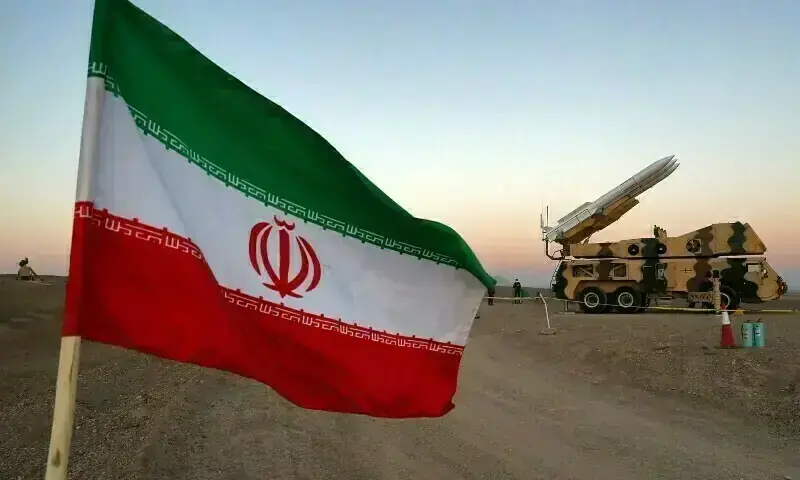
Tehran has largely blocked non-Iranian shipping through the narrow Strait of Hormuz, which before the war carried one-fifth of the world’s oil supply and has emerged as one of the central pressure points in the war.
Diplomatic sources earlier confirmed that the proposal had been conveyed to Tehran through Pakistani mediators.
With US President Donald Trump due to visit China this week, there has been mounting pressure to draw a line under the war, which has ignited a global energy crisis and poses a growing threat to the world economy.
Trump had said on Friday that he was expecting Iran’s response to Washington’s proposal for a deal to extend a fragile truce and launch peace talks — “supposedly tonight”.
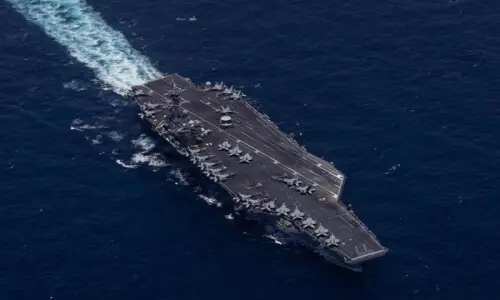
Earlier, he had also announced the suspension of ‘Project Freedom’, the US naval plan to escort commercial ships through the Strait of Hormuz, citing progress in talks and requests from Pakistan and others, while maintaining the broader naval blockade of Iranian ports.
Meanwhile, Pakistan had also expressed optimism that the United States and Iran could soon move towards a peace agreement.
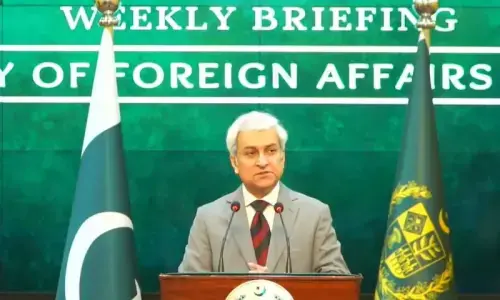
At the weekly media briefing on Thursday, Foreign Office spokesman Tahir Andrabi said Islamabad expected an agreement “sooner rather than later”.
“We remain optimistic. A simple answer would be that we expect an agreement sooner rather than later,” he said. “We hope that the parties will come to a peaceful, sustainable solution and bring peace, not just to our region but internationally as well.”
Deputy Prime Minister and Foreign Minister Ishaq Dar also spoke with Iranian Foreign Minister Abbas Araghchi earlier this week amid indications that Washington and Tehran were edging closer to a preliminary understanding on ending hostilities.
But the optimism dimmed on Friday when a US fighter jet fired on and disabled two Iranian-flagged tankers that Washington accused of challenging its naval blockade of Iran’s ports. An Iranian military official told local media the country’s navy had responded “to American terrorism with strikes” and that “the clashes have now ceased”.
The latest incident came after a previous flare-up overnight Thursday to Friday in the Strait of Hormuz, which Iran is seeking to control to extract tolls from foreign vessels and wield economic leverage over the US and its allies.
On Sunday, Iran’s Islamic Revolutionary Guard Corps threatened to target US sites in the Middle East and “enemy ships” if its tankers come under fire, Iranian media reported.
“Any attack on Iranian tankers and commercial vessels will result in a heavy attack on one of the American centres in the region and enemy ships,” it said, a day after US attacks against two Iranian tankers in the Gulf of Oman.
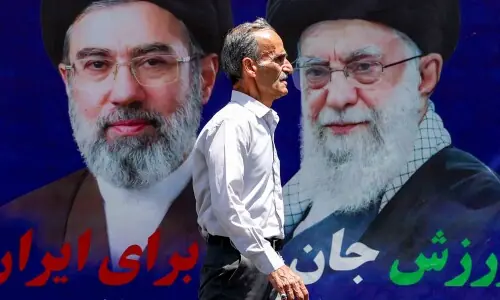
Meanwhile, Iranian state television reported that the head of the military central command, Ali Abdollahi, had met with the country’s supreme leader, Mojtaba Khamenei, who has not been seen in public since his appointment in March.
Khamenei issued “new directives and guidance for the continuation of operations to confront the enemy”, state TV said, without specifying when the meeting took place.
The conflict between the US and Iran began more than two months ago when the US and Israel launched strikes in Iran on February 28.
While a deal for a complete end to the war is yet to happen, the hostilities have largely ceased since the two sides agreed on a Pakistan-brokered ceasefire on April 8.
Following the truce, a first round of historic direct US-Iran talks was held in Islamabad on April 11 and 12, with Pakistan playing the role of a mediator. The talks had ended without an agreement, but also without a breakdown.
With challenges in convening a second round, Islamabad has shifted back to its role as a facilitator and go-between.
Among the main issues that remain a sticking point between the two sides are unrestricted navigation through the Strait of Hormuz and Washington’s demand for long-term commitments on Iran’s nuclear programme, including constraints on enrichment and safeguards against weaponisation.