0
0

ACROSS the Middle East, three main hotspots should remain cause for concern for the international community: the ‘frozen’ Iran war, the Lebanese conflict, and the dire humanitarian situation in Gaza.
All these crises are interlinked as they involve either direct US military intervention or Washington-backed aggression by Israel. Therefore, in the interests of peace, America must refrain from further militaristic adventurism, while also restraining its bellicose ally Israel. Short of this, it is difficult to see these conflicts being resolved peacefully.
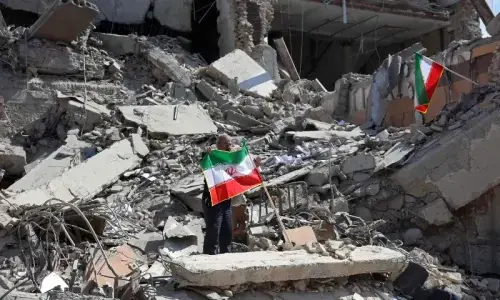
Instead of external actors, such as the US, playing the role of imperial saviour and invading and bombing the affected countries into ‘freedom’, regional states should take the lead and resolve their differences themselves. The situation vis-à-vis the US-Israeli war on Iran remains tense, with hostilities likely to resume if the diplomatic process fails. Similarly, the ceasefire in Lebanon reached last month is a truce only in name. Israel has continued its aggression against the Arab state, while the pro-Iran Lebanese group Hezbollah has responded to Israeli attacks forcefully.
In Gaza, the occupied Strip’s people are still feeling the trauma from the Israeli genocide. The humanitarian situation remains appalling, but Gaza is no longer in the headlines with other regional conflicts taking its place. Yet nearly 1.4m people are living in squalid conditions, susceptible to rodent attacks, while the sanitation situation remains poor. The reconstruction and rehabilitation promised at the time of last year’s ceasefire is nowhere to be seen. In all these situations, the international community has failed to hold the US and Israel to account for launching illegal wars, and causing massive humanitarian suffering.
We stand at a precipice. If this irresponsible behaviour continues, these wars may spread across the region, taking an even heavier human and economic toll. The closure of the Strait of Hormuz has caused global pain. If the fighting spreads, the economic impact will be even greater, especially for countries that are struggling to hold their finances together.
The other option before the US is to end its destructive interventions, and stop Israel from causing havoc in the region. America has plenty of options in its toolkit to ensure that Israel behaves itself — such as stopping the billions of dollars of aid it gives the Zionist state annually, and halting weapons transfers to it.
Instead of these malign external influences, let the states of the region come together and reach a modus vivendi. For example, the Saudis and Iranians ended a running feud in 2023, thanks largely to Chinese facilitation. Even during the current hostilities, Riyadh and Tehran have kept diplomatic channels open. It is time the Arab and Muslim states of the region took control of their destiny, and worked together to establish a lasting peace.
Published in Dawn, May 4th, 2026