0
0

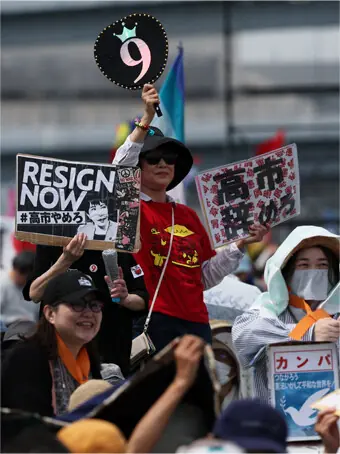
THE postwar international order based on multilateral cooperation and free trade is on the verge of collapse. People now live in an era where merely advocating for peace is no longer enough to protect their nation’s security. It is the duty of politics to bring the supreme law in line with the times to tackle new challenges.
It has been 79 years since the Constitution came into effect. Japan has enjoyed peace and successfully achieved economic development after the end of World War II. It goes without saying that the pacifist Constitution has served as the foundation for this.
Universal principles — popular sovereignty, respect for fundamental human rights, and pacifism — must continue to be upheld.
At the same time, it is also a fact that the current Constitution has failed to keep up with the times. The ruling and opposition parties should first draft specific text for articles to amend the Constitution and hold discussions based on these drafts. This is likely to allow the points that need to be amended to be clarified.
The preamble to the Constitution states that the people of Japan have determined to preserve the nation’s security, “trusting in the justice and faith of the peace-loving peoples of the world.” However, permanent members of the UN Security Council — countries that should bear responsibility for world peace — are now threatening peace.
Russia has continued its aggression against Ukraine for more than four years. The United States has also disregarded international law by launching attacks on Iran. China is stepping up pressure on neighboring countries and regions by wielding its economic and military power.
Amending pacifist constitution
The principle of the preamble — that the Japanese people place trust in other nations — does not hold true anymore. The era in which Japan relies on the United States for security and maintains the Self-Defence Forces at a minimum level of capability is over. Discussions on the Constitution are essential also from the standpoint of what role Japan should play in protecting the security of the entire Asian region.
The Liberal Democratic Party has proposed maintaining Article 9 and creating a new clause called “Article 9-2” to explicitly mention the SDF. However, the Japan Innovation Party and the Democratic Party for the People have argued that just stipulating the existence of the SDF could leave constraints on the exercise of the right to self-defence. Given that, these parties have called for deleting a provision in Paragraph 2 of Article 9 that bans Japan from maintaining “war potential,” and to explicitly reference the right to self-defence.
Debate on amending Article 9 has been on the wane lately, but this is an issue that should not be put off. As for lawsuits concerning disparities in the value of votes in national elections in recent years, the judiciary has interpreted equality under the law as equality in the value of votes and has called on the Diet to correct these disparities.
Based on these judicial decisions, the ruling and opposition parties have reduced the number of regional electoral constituencies in the House of Representatives. In the House of Councillors, electoral districts in prefectures that neighbour each other were merged to create the Tottori-Shimane and Tokushima-Kochi constituencies.
Changing methods of warfare
The security environment surrounding Japan is becoming more severe than ever before. Japan also has to deal with new methods of warfare, including those involving the use of unmanned aerial vehicles, commonly known as drones. How can the necessary funding be secured to further strengthen the nation’s defence capabilities in response to these circumstances?
It is essential for the government to identify challenges involved in safeguarding peace and safety in the entire Asian region, and to establish a framework to translate these challenges into actions, based on the opinions of experts.
By the end of the year, the government plans to revise three security documents, including the National Security Strategy, which sets forth the basic security policy, and the Defence Buildup Programme, which specifies defence spending for the five years that started in fiscal 2023. A panel of experts tasked with discussing how the documents should be revised has held its first meeting.
The current documents, which were revised at the end of 2022, explicitly state the need to possess counterattack and other capabilities to enhance Japan’s ability to deal with missiles from China and North Korea. Defence spending was set at ¥43 trillion over five years.
Since then, however, China has continued to build up its military capabilities. It has begun deploying aircraft carriers in the Pacific and has repeatedly conducted military exercises. Russia and North Korea are deepening their military cooperation.
It is clear that the security environment has deteriorated compared to the situation four years ago. It is appropriate for the government to advance the revision of the three documents to be prepared for these threats.
The focus of the discussions leading up to the revisions is how to deal with new methods of warfare. Iran is deploying large numbers of low-cost drones to counter attacks by the United States and Israel.
Currently, Japan lacks the foundation to produce drones that can be used in combat. It is essential for the government to help rapidly foster defense companies in order to procure high-performance drones.
Ukraine, which is being subjected to Russia’s aggression, constantly faces a shortage of weapons. Maintaining combat sustainability is a significant challenge for any country.
The government has revised the Three Principles on Transfer of Defence Equipment and Technology and their operational guidelines, paving the way for the export of lethal defense equipment. Expanding sales channels overseas and establishing a framework for mutual cooperation with like-minded nations is extremely important for Japan. If domestic production capacity can be improved through such steps, the nation’s combat sustainability will also be enhanced.
Government support is essential for companies to export defence equipment smoothly. Perhaps government involvement in such matters as price negotiations should be considered.
Going forward, the extent to which security-related expenditures, including defence spending, should be increased will also be a topic of discussion at the expert panel.
Enhancing defence capabilities requires permanent fiscal resources. There should not be a casual reliance on government bonds, nor should stopgap measures be used. The government should directly seek the public’s understanding regarding the securing of permanent fiscal resources.
Published in Dawn, May 4th, 2026