Pakistan’s gas sector has an allocation problem, not a supply problem. The country already produces and imports enough gas to serve the existing network more intelligently.
Pakistan’s energy ladder runs in cruel reverse. The poorest households, those in places where clean-fuel access remains thin and where firewood, dung, crop residue, or cylinders remain the default, pay the most for energy. Around 40 per cent of Pakistani households still use wood or sticks for cooking, while only 38pc have access to clean fuel for cooking, lighting, and heating. In Balochistan, that clean-fuel figure is only about one in four households. The household outside the pipe is the majority experience, not an exception.
LPG, one rung up the income ladder, is also expensive once converted into useful heat. At official notified consumer prices, LPG is roughly Rs4,900 per metric million British thermal unit (MMBtu) on a gross energy basis. After accounting for burner losses, cylinder handling, retail margins, and delivery frictions, the useful-heat cost is closer to Rs9,000-10,000 per MMBtu and can be higher for commercial use.
Purchased firewood and biomass can still be more expensive in terms of useful energy. The point is simple: the poorer and less connected the consumer, the more expensive the energy.
Pakistan is effectively using a dollar-priced fuel to heat water in subsidised urban homes, while business that can pay a fair price buy cylinders, and poorer households outside the network rely on firewood
Piped gas sits at the other end of the ladder. Pakistan has around 10.8 million gas connections, roughly a quarter of households. These are predominantly urban, networked, and relatively better-off households by the very fact of being connected. Yet the most protected domestic consumers are still sold gas at commodity rates as low as Rs200 per MMBtu, before fixed charges.
Even after the Rs600 protected-consumer fixed charge, meter rent, and burner inefficiency are included, the all-in useful-energy cost for a low-volume protected gas household remains a fraction of LPG or purchased biomass. The exact multiple changes by consumption volume. The injustice does not.
On a more granular level, a very large share of residential piped gas is not going into cooking at all. It is going into heating water. If roughly 55pc of residential piped gas is used in gas geysers, the gas burned for household water heating is approximately 126,000 million cubic feet (MCF) per year. At an import-parity value of $18 per MMBtu, and using the standard conversion of approximately 1.037 MMBtu per MCF, that volume is worth about $2.35 billion a year. Even at a lower valuation, it remains one of the largest and least productive uses of a scarce imported molecule.
That is the core absurdity. Pakistan is effectively using a dollar-priced fuel to heat water in subsidised urban homes, while businesses that can pay a fair price buy LPG cylinders, and poorer households outside the network rely on firewood.
An electric alternative is not experimental; it exists. Heat-pump water heaters deliver three to four units of heat for every unit of electricity consumed. With honest gas pricing, the payback can be less than two years. A national electrification programme for geysers and space-heating loads could convert 4m piped-gas households by 2030.
On conservative assumptions, that alone could avoid roughly $800m to $900m per year in import-equivalent gas use. Combined with thermal storage, rooftop solar, and off-peak electricity pricing, it can reduce gas demand without creating new evening peak stress on the grid.
A national shift to electrify geysers and space heating could avoid roughly $800–900 million annually in import-equivalent gas consumption
Freeing gas from inefficient residential uses is, therefore, a resource shift. The question becomes how it is reallocated.
The obvious answer is to redirect it to users for whom gas is an input into productive economic activity. Pakistan’s dependence on LPG imports has risen sharply. Public sector data show FY25 LPG imports of roughly Rs295bn, while FY24 LPG imports were around 1.3m tonnes.
The common assumption that this burden is driven mainly by household cooking is incomplete. However, commercial and industrial users together account for nearly two-thirds of LPG consumption.
The baker in Faisalabad, the restaurant owner in Gulshan-e-Iqbal, the hospital laundry in Karachi, and the small industrial unit running on process heat are not buying LPG because cylinders are a superior fuel. They are buying it because there is no gas in the pipe, the pressure is unreliable, or they were never connected in the first place. Many of them are willing to pay. Many of them are already paying more. What they lack is not willingness to pay, but access to a reliable molecule at a rational price.
Converting commercial and industrial LPG users within the existing network reach should not be sold on one heroic savings number. The foreign-exchange saving depends on the replacement molecule.
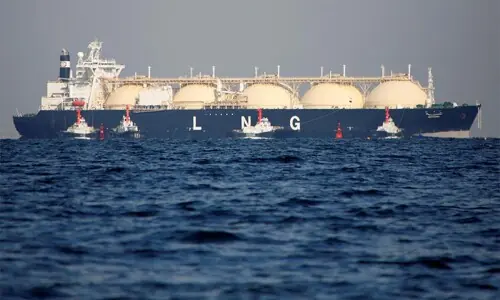
If displaced LPG is replaced by domestic gas or lower-priced contracted LNG, a large-scale conversion programme can generate additional annual savings of a few hundred million dollars. If replacement occurs at marginal RLNG prices near $18 per MMBtu, foreign exchange gains narrow. Even then, benefits remain significant in terms of efficiency, safety, and system-level allocation.
The more powerful reform is therefore sequential. First, electrify the worst residential uses of gas, especially geysers and space heating. Second, reallocate the freed gas to commercial and industrial LPG users who can pay a fair tariff. Third, enable urban LPG-dependent households within network reach to shift to piped gas at cost-reflective prices, not subsidised ones, thus choosing economic value over a politically subsidised price.
The enabling condition is tariff rationalisation. Honest gas pricing is what makes heat-pump economics self-executing, encourages users to conserve, and gives distribution companies an incentive to serve customers who value the fuel.
But rationalisation without protection is regressive, and this is where reform has historically stalled. The protected-consumer category is defined by gas consumption volume, not income. That difference matters enormously.
Approximately 7m to 8m households may fall into the protected slab, but every one of them is already part of the privileged minority with a gas connection. Within that cohort, low consumption is a poor proxy for poverty.
A wealthy Karachi household with an electric geyser and low gas use may qualify. A lower-middle-class Lahore household heating through winter may not.
Meanwhile, millions of households using wood, sticks, other non-clean fuels, or LPG cylinders receive no comparable protection from the gas subsidy system at all. A gas metre cannot be a test for poverty.
The solution is straightforward: redirect the subsidy from the pipeline to the person. A Benazir Income Support Programme-linked cash top-up for eligible low-income connected households, costing roughly Rs38bn to Rs50bn annually, can protect a lifeline level of consumption while allowing gas tariffs to move toward economic cost.
The present subsidy does the opposite. It subsidises the connected, because they have a gas meter. It misses the unconnected because they are invisible to the gas metre.
A gas molecule freed from a geyser and redirected to a commercial LPG user creates a dual efficiency gain: reduced import-equivalent residential consumption and reduced LPG dependence in productive sectors.
If most residential water-heating gas is eliminated and reallocated efficiently, the annual foreign-exchange benefit could approach $2.5bn under import-parity valuation. That is available without a single new gas field, without a major expansion of the pipeline network, and without a technology that does not already exist at a commercial scale.
The woman cooking over wood in Nushki, the bakery buying LPG in Karachi, and the connected household in Lahore, heating water on subsidised gas are all part of the same policy failure. The first receives no meaningful support. The second pays for the failure of allocation. The third consumes the cheapest molecule for the least productive purpose. That is not social protection. That is energy policy turned upside down.
Pakistan does not need to wait for a miracle gas discovery to begin fixing the gas sector. It needs to price gas honestly, protect people directly, electrify inefficient residential heat, and reallocate scarce molecules to productive users. The gas sector is not short of arithmetic. It is short of courage.
The writer is an assistant professor of practice at IBA, member of the Thar Coal Energy Board, and CEO of NCGCL
Published in Dawn, The Business and Finance Weekly, May 4th, 2026