

I ONCE made the mistake of watching one Republic TV reel, and now my algorithm refuses to believe I want nothing to do with Arnab Goswami and his nightly shouting festival. Lately, the familiar theatre has returned on my timeline, and this time, the speculation-fuelled ‘geopolitical analysis’ is pure comedy. And that too not the sharp wit of satire, but the kind of ‘comedy’ associated with the comedian Carrot Top in full performance mode.
“This just in: our sources say US Vice President J.D. Vance would turn back mid-flight rather than reach Pakistan for talks,” declared one anchor in a reel. Another gravely informed viewers that Donald Trump was “scared” for Vance’s security in Pakistan. Yet another featured Arnab Goswami on the verge of a literal meltdown, demanding to know how Pakistan could mediate between the US and Iran.
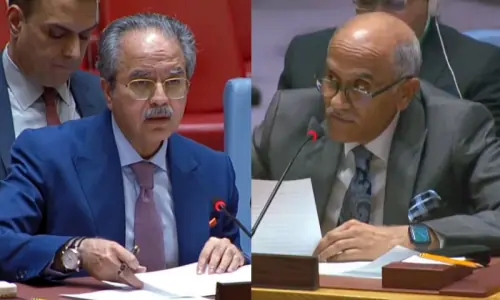
And the theatre continues, as usual. Anyone who has ever watched these studios knows the format: shouting anchors, flashing graphics and outrage dressed up as analysis. None of that is new. What is new this time is the target of the anger: peace talks between the US and Iran, hosted and mediated by Islamabad.
On the face of it, they are criticising Pakistan for facilitating diplomacy. But that invites a simple question: is this war not hurting India too? The conflict has already pressured the Indian rupee, raised fuel costs, disrupted gas supplies, and unsettled markets. India’s dependence on Middle Eastern energy, its shipping exposure around the Strait of Hormuz, and its large workforce in the Gulf mean regional instability carries real economic consequences. Even Indian markets recovered on hopes of de-escalation. In other words, Pakistan-backed peace efforts stand to benefit ordinary Indians as much as anyone else.
Rather than explain why peace serves Indian interests, the ‘Godi media’ sells anger against Pakistan.
And yet a substantial segment of the Indian media — sarcastically called ‘Godi media’ for its perceived closeness to Narendra Modi and his government — chooses hostility over honesty. Rather than explain why peace serves Indian interests, it sells anger against Pakistan. Which raises another obvious question: if peace serves Indian material interests, why the visible rage? And the answer is simple: because outrage rates better than economics.
To understand this, one has to deconstruct what I call the ‘Outrage Machine’, a conceptual model I developed to explain the political economy of hate. It applies with unsettling consistency across countries and contexts: in India, Bangladesh, Pakistan, the US, and nearly anywhere resentment can be converted into revenue, ratings, votes or influence.
At its core, the Outrage Machine is a system in which rage and hate are not accidents of public life but are deliberately manufactured, amplified and monetised products. Politicians harvest it for power, media outlets package it for attention, platforms reward it with reach and audiences are conditioned to consume it daily. Hate in this model becomes the actual currency of the system.
The mechanics of the Outrage Machine are cyclical, which is why it is so effective.
Television studios manufacture nightly anger through sensational framing, selective panels and theatrical language. But much of this content is now designed for social media first: short, explosive clips built to travel fast and provoke reaction. Platforms then amplify the loudest material because outrage drives engagement. Political demagogues harvest that sentiment, posing as defenders against permanent enemies they often helped invent in the first place. Citizens absorb and repeat the narratives, mistaking repetition for truth.
That public anger is then fed back into newsrooms as proof of ‘national mood’, giving media an even clearer strategy for the next cycle of rage. Media creates it, platforms spread it, politics weaponises it, the public performs it, and the machine begins again. It is a closed loop of profit, power and prejudice, and every major player profits.
Once audiences are repeatedly fed a diet of grievance and perpetual threat, they begin to require stronger doses. What once seemed extreme becomes normal. What once seemed theatrical becomes expectation. Calm starts to feel dull. Negotiation appears weak. Peace becomes suspicious because it interrupts a revenue model built on conflict. The deeper tragedy is that societies eventually pay a price for consuming too much synthetic rage. Public debate becomes infantilised. Citizens are encouraged to think in binaries rather than interests. Economic pain is ignored if hatred remains emotionally satisfying. Diplomacy is judged theatrically rather than strategically.
Pakistan’s role in peace talks did not create the backlash. It merely exposed the dependence. When media systems, digital platforms and political entrepreneurs become accustomed to extracting value from hostility, any gesture that lowers tensions becomes a threat to business. In such an environment, peace is not opposed because it fails. It is opposed because it works. This is why it is too simple to describe what we are witnessing as mere hate, especially about the case at hand, ie, the peace talks mediated by Pakistan. Hate suggests raw emotion. What often appears on screen is more calculated than that. It is curated antagonism, and conflict packaged for ratings, monetised through clicks, rewarded by algorithms and repurposed into political capital.
Brewing hate for use against an external enemy is like overloading a nuclear plant to generate more power. For a while, the energy seems useful: ratings rise, votes consolidate and the crowd stays mobilised. But systems built on dangerous excess eventually turn inward. Pressure builds, safeguards erode and what was meant for the outside begins exploding within. India has already seen warnings of this blowback. BBC reported that from 2016 to 2018, at least 31 people were killed in lynchings linked to rumours spread largely through social media. Hate manufactured for export rarely stays at the border; sooner or later, it detonates at home.
The writer is the founder of Media Matters for Democracy.
Published in Dawn, May 1st, 2026