Iran expected to make new offer to ‘reluctant’ US


• Iranian envoy lauds Pakistan for ‘persistent labour’ to pave way for dialogue
• Trump claims Tehran asked him to lift Hormuz blockade
• Spy agencies studying ‘likely response’ to US declaring victory
• Iran’s military says ‘still in state of war’
• Vance questions Pentagon assessment of conflict with Iran
• UAE tanker evades Hormuz blockade
WASHINGTON: Even as US President Donald Trump appeared reluctant to accept an Iranian offer to end the Middle East war, reports suggested Tehran would share a fresh proposal with Pakistan “in the next few days”, despite a public show of defiance.
According to CNN, Foreign Minister Abbas Araghchi will consult Iranian leaders upon his return from Russia for the new proposal, but “process is slow” due to “difficulty in communicating with Supreme Leader Mojtaba Khamenei, whose location is being kept secret”.
The development came as President Trump reviewed the Iranian proposals amid concerns over the Pentagon’s assessment of the ongoing war with Iran. Senior Iranian officials told Reuters the proposal carried by Iran’s Araghchi to Islamabad over the weekend envisioned talks in stages, with the nuclear issue to be set aside at the start.
A first step would require ending the US-Israeli war on Iran and providing guarantees that the US cannot start it up again. Then negotiators would resolve the US Navy’s blockade of Iran’s trade by sea and the fate of the Strait of Hormuz, which Iran aims to reopen under its control. Only then would talks look at other issues, including the longstanding dispute over Iran’s nuclear programme.
In a post on Truth Social, President Trump appeared to confirm the contents of the Iranian proposal, saying that Tehran wanted the US to “open the Hormuz strait”.
“Iran has just informed us that they are in a ‘State of Collapse’,” he said. “They want us to “Open the Hormuz Strait,” as soon as possible, as they try to figure out their leadership situation (Which I believe they will be able to do!).”
CNN, however, reported that Trump was unlikely to accept Iran’s proposal to restore traffic in the strait, as Qatar warned of the possibility of a “frozen conflict” if a resolution was not found.
Meanwhile, Iran’s ambassador to Pakistan Reza Amiri Moghadam appreciated Foreign Minister Ishaq Dar and the foreign ministry officials for facilitating talks. “As trusted harbingers of international harmony, diplomats are the architects of peace, entrusted with navigating the delicate complexities of international relations through the patient craft of dialogue, empathy, and understanding,” he said in a tweet.
“Their dedicated efforts translate political will and principled determination into the practical avenues and arrangements necessary for any diplomatic process to take shape. This is diplomacy in its truest sense…” he said in a comment on Pakistan’s efforts.
‘State of war’
As the US mulled its offer, Iran struck a defiant tone, with its UN envoy also seeking guarantees that Washington and Israel would not attack again in return for security assurances for the Gulf.
Iranian defence ministry spokesman Reza Talaei-Nik, meanwhile, said that Washington “must abandon its illegal and irrational demands.”
According to Iran’s army spokesperson, it was still “a war situation” for Iran. “There is continuous monitoring … surveillance,” Fars news agency quoted Amir Akraminia as saying. “If the enemy takes a new action, they will be faced with new tools, methods, and arenas.”
Separately, Reuters reported that in order to understand the implications of Trump potentially pulling back from the damaging war, US intelligence agencies are studying how Iran would respond if the US were to declare “unilateral victory”.
The intelligence community is analysing the question along with others at the request of senior administration officials, Reuters reported, adding that some are worried the war could contribute to deep Republican losses at the midterm elections later this year.
Vance questions Pentagon assessment
In the US, President Trump faces domestic pressure as the conflict led to a spike in gas prices, while his deputy, JD Vance, appeared concerned over the Pentagon’s assessment of the Iran war.
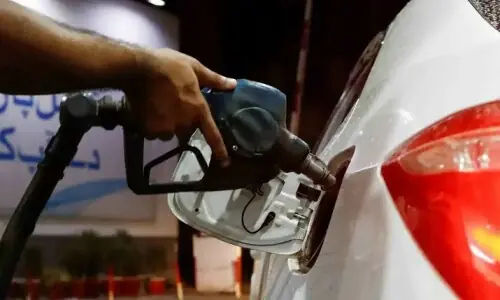
Average US gas prices have climbed to their highest level since the start of the Iran war, as concerns grow over a prolonged energy crisis amid the Hormuz deadlock. According to AAA data, gasoline prices rose to an average of $4.18 a gallon on Tuesday — the highest since 2022.
Behind closed doors, Vance is said to have questioned whether the extent of depletion in US missile stockpiles had been fully reflected in official briefings.
Although the Strait of Hormuz remained blocked, it was reported that a UAE-flagged LNG ship had managed to slip through.
According to marine tracking firm Kpler, the LNG carrier Mubaraz is operated by the Emirati national oil company ADNOC.
Published in Dawn, April 29th, 2026