Power Division urges Nepra to abolish licence requirement, fee for solar consumers below 25kW
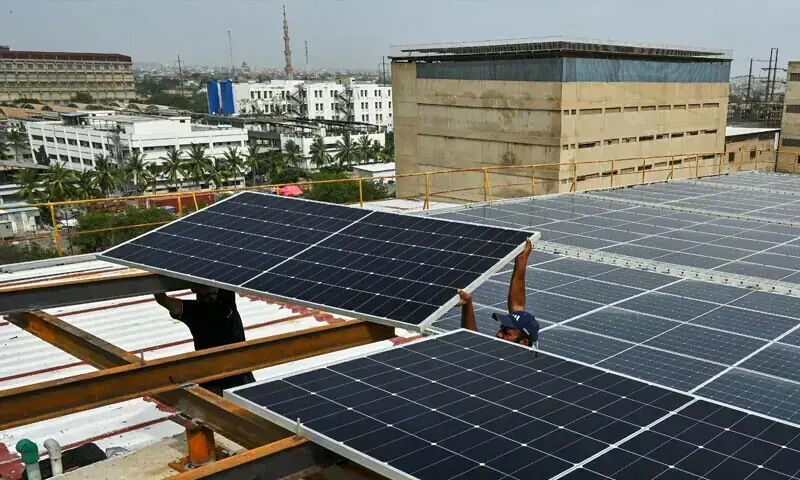


Facing severe public criticism for “taxing sunlight”, the Power Division on Sunday directed the National Electric Power Regulatory Authority (Nepra) to abolish the requirement of a licence and licence fee for solar prosumers below 25 kilowatt capacity.
In a statement issued on Sunday — a weekly holiday — the Power Division said that on the directives of Power Minister Awais Leghari, it has “formally asked Nepra for a review to abolish the application fee and remove the license requirement for solar consumers of 25 kilowatts and below”.
The Power Division recalled that it had previously alerted Nepra about the adverse effects of this decision and requested that it be aligned with the old regulations.
Announcing the decision on X, Leghari said, “Our government is pro-solar, pro-consumer, and committed to clean energy. We want to remove unnecessary barriers, reduce costs, and provide as much relief as possible to the people of Pakistan.”
Under the previous 2015 regulations, distributed generation facilities of 25kW or below did not require a license from Nepra. Applications were processed directly by power distribution companies (Discos) without any fee, serving as a major fiscal incentive for residential users.
However, the new Prosumer Regulations centralised approval authority with Nepra and imposed application fees even on these small facilities, it said.
The Power Division noted that the Private Power and Infrastructure Board (PPIB) had flagged the regulatory shift and requested Nepra to maintain consistency with the earlier approvals regime for systems of 25 kW or below.
Additionally, during public hearings, the Pakistan Solar Association, Primage (Pvt) Ltd, the Pakistan Alternative Energy Association, and Siddiq Renewable Energy (Pvt) Ltd formally objected to the changes, arguing that removing approval authority from Discos would create unnecessary bureaucratic hurdles.
Following Leghari’s directive, the Power Division has now formally requested Nepra to reinstate the earlier practice for systems of 25kW and below, warning that the current approach risked slowing the national drive toward alternative energy adoption.
Over the last few years, the Nepra has become a virtual rubber stamp for the requirements of the government, particularly the Power Division.
The Power Division originally made several attempts to shift solar net metering to net-billing to significantly curtail financial benefits to prosumers and backtracked after public criticism.
Then it shifted the responsibility to Nepra, which reduced benefits to prosumers in November last year by even withdrawing many benefits for existing prosumers having valid licences.
As the government faced criticism, Nepra restored the net-metering facility to existing prosumers and introduced new applications for net-billing, and the requirements of a licence from Nepra at a one-time licence fee of Rs1000 per kW in February this year.
As applications started to pour in at Nepra, a social media campaign emerged against the government and the power minister for allegedly fleecing the public for a god-given energy resource, thus discouraging solar adoption.
The Power Division had distanced itself from the licence fee for weeks, saying it was Nepra’s domain and outside its powers. As media pressure continued, the power minister issued directives for an end to the licence fee and discreetly sought licensing to return to Discos instead of the regulator.