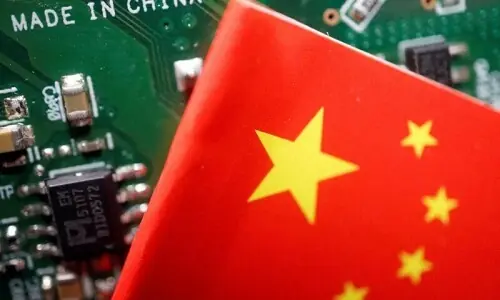
The conflict in the Middle East has disrupted supplies of crucial raw materials and pushed up prices of the printed circuit boards (PCB) used in almost all electronic devices, from smartphones and computers to AI servers, industry sources and executives said.
The disruption is a fresh blow to electronics manufacturers which are already grappling with soaring memory chip costs and highlights the broadening impact of the Iran war that has wreaked havoc on supply chains, plastics, and oil supplies.
Iran struck Saudi Arabia’s Jubail petrochemical complex in early April, forcing a halt in production of high-purity polyphenylene ether (PPE) resin a critical base material used to manufacture PCB laminates.
SABIC, which accounts for approximately 70 per cent of the world’s high-purity PPE supply and operates in the Jubail complex on the Gulf coast, has been unable to resume output, severely tightening the availability of the material worldwide, according to one source. Shipping in and out of the Gulf has also been severely disrupted by the war.
PCB prices have been climbing since late last year, driven by a growing appetite for AI servers. Demand has been accelerating sharply since March as manufacturers scramble to secure raw material supplies and soften the impact of skyrocketing costs, three industry sources told Reuters.
In April alone, PCB prices surged as much as 40pc from March, Goldman Sachs analysts said in a recent note. Cloud service providers are willing to accept further increases as they expect demand will outstrip supplies over the coming years, they added.
The global PCB industry is projected to increase by 12.5pc to reach $95.8 billion in 2026, according to a recent report from Prismark.
Daeduck Electronics, a South Korean PCB maker whose customers include Samsung Electronics, SK Hynix and AMD, has begun discussions with customers over price increases, a senior executive at the company told Reuters.
The executive, who declined to be named due to sensitivity of the subject, said his priority has now changed from meeting customers to suppliers, as the waiting time for chemical materials such as epoxy resin have stretched to 15 weeks from three weeks previously.
The sharp rise in PCB prices was also driven by a shortage of other key materials, including glass fiber and copper foil, according to one source. Copper foil prices have surged as much as 30pc so far this year, with the rally gaining momentum in March, the source added.
Copper accounts for around 60pc of total raw material costs in PCB manufacturing, according to Victory Giant Technology, a major Chinese PCB supplier for Nvidia. The Chinese firm warned earlier this month that the Middle East conflict could push up prices for key materials including resin and copper.
Multi-layer PCBs can cost around 1,394 yuan ($204) per square metre, with higher-end models for AI servers costing around 13,475 yuan, according to Victory Giant.