Hafez & Hormuz
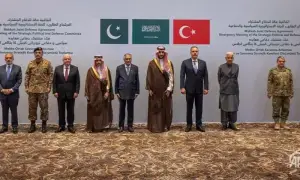
THE ‘Hafez’ in this piece refers to none other than the oracle of Shiraz. The region is in the throes of war. Pakistan has positioned itself as a mediator and peacemaker. India is being criticised at home for ceding the role of regional stabiliser to a country it considers out of its league.
Congress MP Shashi Tharoor, who was sent around the world to present the Indian case after Operation Sindoor, has been particularly scathing in his criticism of the BJP government. What the opposition, civil society and non-Godi media portray as ambivalence is actually the logical course of action for a government that has unambiguously allied itself with the murderous and genocidal Israeli regime. During his visit to Jerusalem, Prime Minister Narendra Modi addressed the Knesset, saying that Israel was the fatherland and India the motherland of the two peoples.
In all fairness, India and the UAE can decide what is best for their people and which course to take in their international relations. At our end, we need not get too excited about our newfound stardom and ‘utility’. The price we will pay for the role we have assumed should not be difficult to predict; the down payment is telling and embarrassing in equal measure. We have become favourites of the world’s most derided leader, Donald Trump, whom we earlier proposed for the Nobel Peace Prize. Trump is largely responsible for the Gaza genocide. He attacked Iran on the false pretext of attempting to acquire weapons of mass destruction and has underwritten the hell let loose on Lebanon by Israel.
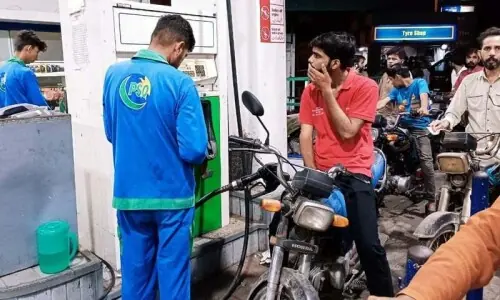
Who gets the Nobel Peace Prize should concern us far less than what’s in it for us, especially in the long run. Will energy prices ever return to levels before the Israeli-US attack on Iran? Will loans and foreign-exchange safe-deposits into the State Bank ever translate into investment in our manufacturing sector? If and when that happens, will the investment windfall ever reach the citizens, or will they continue to be dominated by the security mantra?
Divination steers both weddings and wars.
North and south India, despite their distinct historical identities, have absorbed enough of each other’s cultures to make it incumbent upon South Asians to host a range of initiatives to restore peace in the Persian Gulf. As Audrey Truschke notes in her seminal work, India: 5,000 Years of History on the Subcontinent, in Shiraz, 2,400 kilometres west of Delhi, Hafez was reading Ameer Khusrau in the 14th century. A 1355 copy of Khusrau’s Khamsa, a collection of five narrative poems, handwritten by Hafez, survives to date. Of late, Manu S. Pillai has written extensively on the Hindu-Muslim syncretic history of south India and on how both the Muslim Bahmani sultanate and the Hindu Vijayanagara empire used Persian as the court language, employed officials and soldiers from the opposing camp, and competed to lure talent from the faraway Persian, Arab and African regions.
Bahmani Sultan Muhammad II, who ruled the Deccan between 1378 and 1397, invited Hafez to his capital, Gulbarga. Hafez set out on the journey but changed his mind at the port of Hormuz and sent the sultan a poem explaining that he could not bring himself to leave the glades, wines and the friends he loved for the riches the sultan offered.
The region is caught in the flames of war. Divination, the seeking of metaphysical omens, is among the oldest traditions in the Neo-Assyrian-Greek region. The subcontinent is no different. So entrenched is the practice that not only auspicious dates for nuptials but also graver matters like war call for seeking divine signs, even if only to justify and legitimise them as religious duties rather than to set their course. No wonder a cabinet member is called a minister and a mantri in the Indo-European languages. This interplay of languages is a subject for another day, but suffice it to say that most cabinets and war councils around the world have nothing more than incantations to fall back on.
One very common way of seeking divination is to randomly open the anthology of Hafez, seek guidance from the first line on the page, and interpret the rest of the poem for a detailed prediction. This method of drawing divination is called faal in Persian and Urdu/ Hindi. Keeping in view what we all have on our minds, I drew a digital faal from a Diwan-i-Hafez portal; it threw up ghazal 41, its first two, and the last couplet, when combined, roughly mean: ‘Though the wine is joyous, the wind is fragrant/ Desist merriment; the cop is stringent/ This earth and sky are no more than a bleeding sieve/ That sifts and sorts kingly crowns and courts/ Invaded are the Persian and Iraqi ports/ It is now the turn of the Baghdad and Tabrizi forts.’
The writer is a poet. His latest publication is a collection of satire essays titled Rindana.
Published in Dawn, April 29th, 2026