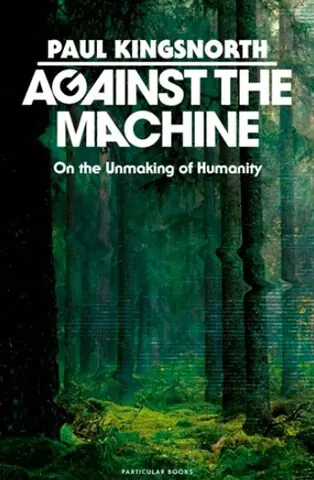
Against The Machine: On the Unmaking Of Humanity
By Paul Kingsnorth
Particular Books
ISBN: 978-024178840-0
368pp.
In the current year, the United States and China are set to significantly expand their lunar exploration programmes. While couched in the language of scientific discovery, these initiatives encompass efforts directed at exploring the conditions for human presence beyond Earth.
This interest in extra-terrestrial habitation signals an implicit acknowledgement that the planet’s resources may be insufficient to sustain the prevailing patterns of human life in the long term. These efforts also signify that, instead of reckoning with the restraints on growth, the contemporary lords of mankind are looking for a technological escape from crises generated by expansionary capitalism.
It is precisely this impulse towards expansion, control and ambition that Paul Kingsnorth takes aim at in his collection of essays, an impulse he terms “the culture of the machine.” This culture, which has become the dominant logic of the present age, is marked by the pursuit of limitless growth, a constant drive to master nature and an expanding ambition of technology to pervade everyday life. The machine, as Kingsnorth puts it, is “a tendency within us, made concrete by power and circumstance, which coalesces in a huge agglomeration of power, control and ambition.”
Kingsnorth traces the origins of this cultural logic to the scientific worldview, which took hold in the wake of the Enlightenment. The Enlightenment, he argues, brought about a decisive rupture in how the world was understood. Pre-enlightenment thought conceived of the universe as an ordered organism, in which human beings were embedded rather than distinct from nature. This cosmological order was oriented towards supra-terrestrial or transcendental ends that set moral limits on human actions towards the natural world.
A collection of essays takes aim at the pursuit of limitless growth, the constant drive to master nature and the expanding ambition of technology to pervade everyday life that marks the present age
Early Enlightenment thought sought to make the world understandable through decomposition and analysis, which involved breaking down complex phenomena into their constituent parts and explaining them in terms of causal relations. To this end, humanity was conceptually set apart from nature, and the primary role of nature was recast as an instrument in advancing human purposes.
This epistemic shift, Kingsnorth contends, gave rise to a mechanistic worldview that understood the “Earth as mechanism, life as machine.” The machine metaphor reflects an attempt to comprehend life as an assemblage of parts which can be analysed separately.
Over time, this mechanistic outlook spread beyond the natural world to living beings themselves. What started out as a method for understanding the external world, gradually came to reshape conceptions of life and, ultimately, of human beings. This led to the remaking of human nature itself. As Kingsnorth puts it, “The end point of that worldview is not simply the age of climate change and mass extinction — though it is that — but the abolition of human nature itself.”
Kingsnorth further argues that the machine of global capitalism has torn away family life, older cultures and inherited ways of life, often passed off as liberation from tradition. This process of “unsettling” is illustrated in his discussion of the transformation of the meaning attached to home.

Once, the home was a site of shared life, where family members got together, sat around the fire, exchanged stories and passed down skills to the next generation. Today, the home has turned into “a dormitory, probably owned by a landlord or a bank, in which two or more people of varying ages and degrees of biological relationship sleep when they’re not out being employed by a corporation or educated by the state in preparation for being employed by a corporation. The home’s needs are met through pushing buttons, swiping screens or buying-in everything from food to furniture; for who has time for anything else, or has been taught the skills to do otherwise?”
This dismantling of older traditions and local practices, and supplanting them with mechanistic logic, paves the way for global capitalist expansion, which thrives in a standardised and homogenised environment. As a result, rather than delivering emancipation, the machine has left us more dependent.
Kingsnorth takes his critique further to movements that hold themselves up as alternatives to capitalist expansion. Twentieth-century ideologies of communism and fascism claimed to oppose capitalism, but they reproduced similar logics of domination and control. Kingsnorth is also dismissive of green initiatives, which he sees as providing sustenance to global capitalism. Instead of challenging the drive for limitless growth, most environmentalists aim to make existing economic arrangements more efficient and sustainable. By doing this, they allow the same structures to persist that they purport to challenge.
Capitalism thus carries on expanding with minimal adjustments while its fundamental extractive logic remains intact. As he laments, “The great genius of the machine, and one reason for its flourishing, is that… often those who promote what they imagine is an alternative find themselves doing its work.”
Kingsnorth’s narrative fits within a broader tradition of critiques of modernity and progress that cast a sceptical light on the legacy of the Enlightenment. While the post-Enlightenment era undeniably displaced communal and traditional forms of life, it also produced substantive social and material gains. Such gains range from significant extensions in lifespan and major advances in medicine and public health, to reductions in violence and extreme poverty, as well as the expansion of individual freedoms. Steven Pinker has documented these improvements with extensive statistical evidence in his book Enlightenment Now.
Furthermore, Kingsnorth’s line of argument can also be questioned by challenging the claim that the culture of the machine is an inevitable outcome of the ascendancy of reason. The central problem of limitless growth stems less from reason per se than from the instrumental forms of rationality that dominate once the moral and social guardrails are eroded.
Notwithstanding these disagreements with Kingsnorth’s portrayal of the Enlightenment, his collection rightly brings into focus the contemporary condition of digital capitalism and its corrosive effect on essential aspects of human life. The dawn of the internet age was accompanied by the promise of expanding individual freedom and democratic access to information. Yet, driven by the underlying logic of profit, this promise gave way to the dominance of big technology corporations that control what we read and how we see things through algorithms.
Ultimately, Kingsnorth makes an appeal to recover what it means to be human in the relentless march of progress. Although he himself has retreated to the countryside in Ireland, Kingsnorth does not suggest a hermetic withdrawal from the modern world. He also acknowledges that the past cannot be reborn. Instead, he calls for the cultivation of a culture that stands counter to that of the machine.
He suggests beginning with a change in outlook and training ourselves to look at the world not solely through the brain’s left hemisphere. By resisting “dogmatic insistences” and “easy answers and false divisions” and by distinguishing “intelligence from wisdom”, we can work towards an integrated and humane approach to understanding the world.
Moreover, Kingsnorth urges the need to nourish local, particular and human-scale practices as a way of resistance to the abstraction of the machine.
The reviewer is an academic based in the UK.
Email: naumanlawyer@gmail.com
Published in Dawn, Books & Authors, April 26th, 2026