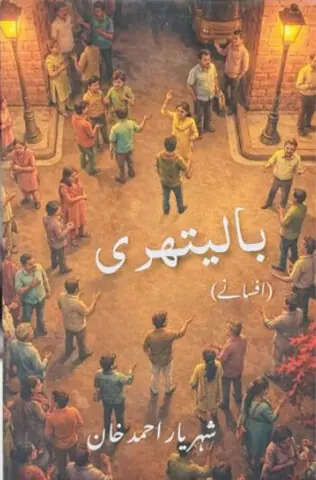
Balithri
By Shehryar Ahmad Khan
Sang-e-Meel Publications
ISBN: 978-969-35-3743-7
194pp.
Shehryar Ahmad Khan is a professor, an oncologist and a researcher of international repute. He is also a student of life and Pakistani society, and this is evident in Balithri, his debut short story collection, which consists of 24 Urdu stories and offers proof of his prowess with the pen.
Khan discloses why he has resorted to writing with his nuqta-i-nazr [point of view] with which he opens his book. According to him, he wants to vent his frustrations, to explain the tragedies of life, to direct attention toward problems in society and, lastly, to find like-minded people.
The stories are all quite short. They are well written and there is a flow to their narratives which makes them very approachable. The angst and exaggeration often found in Urdu afsanay [short stories] are, thankfully, absent. Instead, the author’s skill is evident in perfectly turned-out sentences which touch the reader’s heart and mind. The author also brings sensuousness into his fiction. He describes scenes and emotions with words that are vivid without being salacious.
The book is named after one of the stories in the collection. ‘Balithri’ is the name of the female protagonist in that tale. Many stories are about Hindus, as is this one and they obviously have Hindu names. But rather uncommon names crop up in stories featuring Muslims. Another quirk is the inordinate use of Hindi words in the text.
A debut collection of 24 Urdu short stories by a medical practitioner and academic are thought-provoking and wise observations drawn from life and characters around us
The stories ‘Balithri’, ‘Sandli’, ‘Aik Meel’ [One Mile] and ‘Bagrri’ focus on the poor. ‘Balithri’ is the story of a young, nubile housemaid who becomes the victim of male lust. She is sometimes assaulted, sometimes wooed and sometimes blackmailed into submission. However well-to-do or well-known the man in question is, he still considers Balithri to be fair game. Unfortunately, the circle of exploitation continues even as Balithri’s daughter reaches adolescence.
In ‘Sandli’, the heroine and her husband go to the big city to escape penury. Contrary to expectations, only misery awaits them there and they even lose their self-respect. The hero in ‘Aik Meel’ faces the consequences of not being able to provide for his family adequately. On the other hand, in ‘Bagrri’, the author shows that when the poor love with their whole hearts, many obstacles can be overcome. However, the lack of finances can finally sound the death knell to their devotion, both literally and figuratively.
There are also a number of tales about love, every sort of love. They rarely end in joy. ‘Murti’ [Statue] talks of a man who falls in love with a statue. He then compares all women to it and almost no one comes up to his standards. ‘Barra Bhai’ [Big Brother] is a story of how responsibility weighs heavily on the young shoulders of the eldest son. His behaviour under stress does not always remain within familial norms. In ‘Mohabbat’ [Love], one-sided love is discussed and the story ‘Peepal’ champions the love of a man for a tree. It is a beautifully related tale of a young boy and his tree and their lives together, till death parts them.
A serious story about a young man who fails repeatedly to attain his love is called ‘Zindagi’ [Life]. He then decides to love only animals who love him back unconditionally, but their shorter life spans leave him bereft. He finds solace only when it dawns upon him that adversities cannot be evaded — they have to be faced and overcome.
Khan has also broached the subject of human behaviour and psychology in at least four of his tales. The story ‘Sufi’ is about a character who has difficulty tolerating the hypocrisy and pretensions of this world. Sufi responds automatically and uncontrollably and so comes to a sad end. ‘Anu Bhag’, the title character of another anecdote, is a brilliant scholar of economics who starves himself rather than be guilty of devouring more than his share of the resources of the planet.
In ‘Tooth Fairy’, the main character loses his trust in humans. He is short-changed in his dealings with them again and again and falls apart when he finds that even the tooth fairy is just a figment of the imagination. The story ‘Fifty Fifty’ demonstrates that humans are neither all good nor all bad. Once this lesson is learned, it becomes easier for the hero to understand them.
Social ills are discussed in several stories. Khan writes about the blasphemy law, the bureaucratic mindset, paedophilia, transgender issues, guilt-ridden remorse, jealousy and halala nikah [a method of remarrying a husband who has divorced his wife] with a sure touch and a wealth of knowledge.
The story that stands out for its content matter as well as its execution, however, is ‘Kaun Jeeta, Kaun Hara’ [Who Won, Who Lost]. It opens with a description of the region of Potohar and then introduces a hunter who has spent time and effort in training himself to bag an urial. He considers himself to be a merciful man, since he wants to kill the animal cleanly with a single shot. The hunter’s ‘humanity’ is starkly juxtaposed with the innate sense of duty of the beast. The male urial gives his own life to save his mate, who is in the throes of childbirth. The title of the story is an apt commentary on the hunt.
‘Faisla’ [Decision], the last offering in the book, revolves around a very modern problem, a conundrum that Khan may have had to face often in his medical practice. It is the end-of-life dilemma: when is it correct to pull the plug of a terminally ill patient who is being kept alive on machines?
It is hoped that Balithri is the precursor of many other books by the author. Shehryar Ahmad Khan not only writes well, but he also has an inventive and artistic streak. His stories are thought-provoking, yet easy to read. They are small nuggets of wise observations about everyday events. It would be a pity if such talent is not nurtured and promoted.
The reviewer is a freelance writer, author of the novel The Tea Trolley and the translator of Toofan Se Pehlay: Safar-i-Europe Ki Diary
Published in Dawn, Books & Authors, April 26th, 2026