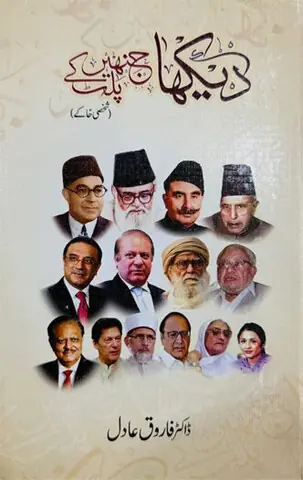
Dekha Jinhain Palat Ke
By Dr Farooq Adil
Qalam Foundation International
ISBN: 978-9697463305
348pp.
From its title, the book Dekha Jinhain Palat Ke [Those I Looked Back At] may seem like a collection of personal sketches of celebrities the author has met. However, this 348-page book is far broader and deeper.
It includes sketches of political, religious, literary and social figures from different times, and none of them are directly connected. It is not just a list of people the author has met. Rather, it presents thoughtful and detailed portraits drawn from the author’s experiences, research and conversations with those who knew their subjects, as well as insights from other people’s stories, writings and memories. In this way, each sketch becomes more than just a small memoir — it blends personal experience with shared memories and knowledge.
Dr Farooq Adil was my senior colleague at DawnNews, although our work hours rarely matched — I worked the night shift, and he led the day shift. Our contact was usually just a short handover, long before he became the Dr Farooq Adil. Even in those brief moments, his speed and clarity in preparing news were clear.
Later, I realised that the same sharpness would shape his writing. Publishing nearly two books a year, Dr Adil has become a writer many see as standing on the right side of history. Each new book raises expectations — and this one too meets them.
A collection of personal sketches of renowned figures from history and current times in Urdu encourages readers not just to remember the past but also to reflect on the present
Like many of his peers, Dr Adil worked in newspapers and magazines before moving to television. He also served as the media adviser and spokesperson for former president Mamnoon Hussain. He has seen Pakistan’s politics up close, had access to important centres of power and watched how Urdu has changed in modern media. While reading the book, one can sense his worries about sensational news and the slow loss of careful, elegant language. This feeling may explain why the book tries to reconnect journalism with literature — two fields that are drifting apart.
This is Dr Adil’s second book of sketches, following Jo Surat Nazar Aayi [The Face That Appeared]. This one features over 60 personalities and is spread over seven chapters. While most sketches draw from personal observation, the author’s journalistic background adds lesser-known details, giving the book freshness and credibility.
Sketches of journalists such as Shorish Kashmiri and Mujeeb-ur-Rehman Shami highlight how the press often challenged those in power, while portraits of figures like Bal Thackeray and Sheikh Hasina Wajid demonstrate that Dr Adil’s writing reaches beyond national boundaries.
The writing is simple, clear and free of heavy words or complicated ideas. It seems aimed at younger readers, who may find old expressions difficult to understand. But this simplicity does not weaken the writing style — it makes the book easier to read and more enjoyable. The book’s best quality is that it leaves the reader wanting more.
The author begins with Maulana Maudoodi, sharing both well-known and little-known moments, giving a subtle picture of this major figure of the Jamaat-i-Islami, while also showing his human side. The author does not exaggerate — instead, he shows character, context and beliefs naturally, keeping the reader engaged.
The sketches of people from the Pakistan Movement are very interesting. They are often short — sometimes only two or three pages in length — but written so carefully that the reader gets the full picture. In Liaquat Ali Khan’s sketch, Dr Adil showcases his rare honesty — like when Khan sat on a mat at a Muslim League meeting, wearing torn socks, quietly saying he could not afford new ones. As a prime minister, he reprimanded a friend who went out of his way to help his son by securing work for him. Such moments stay with the reader.
One of the most powerful sketches is that of Sardar Abdur Rab Nishtar, titled ‘Qutub Sahib Ki Laath.’ It is carefully researched and emotionally strong, making the reader think about Pakistan’s founders and how the politicians of today are very different from their ideals. Nishtar, even as the governor of Punjab, cycled to work and did not let his children use official telephones.
One of the most powerful sketches is that of Sardar Abdur Rab Nishtar, titled ‘Qutub Sahib Ki Laath.’ It is carefully researched and emotionally strong, making the reader think about Pakistan’s founders and how the politicians of today are very different from their ideals. Nishtar, even as the governor of Punjab, cycled to work and did not let his children use official telephones. Dr Adil also explains how Nishtar was buried near the mausoleum of the Quaid-i-Azam — a decision influenced by public pressure, which even challenged the establishment.
The book also brings back memories of people younger readers may not know — Nawabzada Nasrullah Khan, for example. Pakistan’s first president, Iskander Mirza, thought politicians were useless and believed martial law was the only solution. The Nawabzada predicted that martial law would soon end Mirza’s own government, and this turned out to be true. Within two weeks of his prediction, Gen Ayub Khan removed Mirza from power — showing Nawabzada’s political sagacity.
The book also includes a sketch of Imran Khan, which is expected because he is central to today’s politics. The author does not admire Khan’s political style and mainly uses opinions from Khan’s critics and former associates. This shows the author’s view, but it slightly affects the balance.
Like the author, I also met the legendary broadcaster Azeem Sarwar once. But the way Dr Adil describes this meeting, with a vivid ‘B-roll’ in the background, takes the reader straight back to the golden days of radio, when voices were powerful and memories had a sound of their own.
Alongside sketches of political, social, religious, literary and journalistic figures, there is also a touch of showbiz glamour. Junaid Jamshed is called a rock star, and a heartfelt tribute is paid to a music diva whose gentle presence the author still remembers — known to the world as Nayyara Noor.
One of the last personalities to leave a strong impression upon the author, and still fresh in the reader’s memory, is another ‘doctor’ — Dr Amir Liaqat Hussain. He not only transformed television but also became a favourite of many. The way Dr Adil recounts Amir Liaqat’s journey, from the editor of Parcham to one of the most celebrated public figures, is truly remarkable.
The book ends on a personal note with a sketch of the author’s father, a traditional herbal doctor. Warm, nostalgic and vivid, this chapter will especially touch readers familiar with rural life, reminding us that every son sees his father as a hero.
For anyone interested in personal sketches, political history or the human side of public figures, this book offers both insight and quiet reflection. It informs, sometimes surprises, and often reminds us of what has been lost — and what might still be regained. Above all, however, it provides perspective. By looking at lives shaped by conviction, compromise, courage and consequence, it encourages readers not just to remember the past but also to reflect on the present.
In this way, the book is more than mere personal sketches — it is a conversation between generations, asking us to value honesty, question power and see that history is shaped by those who dare to act.
The reviewer writes on old films and music and loves reading books.
X: @suhaybalavi
Published in Dawn, Books & Authors, April 26th, 2026