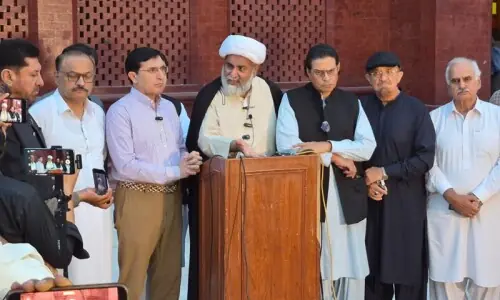
WITH the failing health of several incarcerated political leaders again in the news, the state risks inviting unnecessary criticism at a sensitive time. The PTI has once more raised concerns over the medical condition of former prime minister Imran Khan, his spouse Bushra Bibi and party stalwart Senator Ejaz Chaudhry, attributing their deteriorating health to neglect and restricted access to medical care. According to the party, prolonged detention and restrictions on medical access have worsened the issues faced by its jailed leaders, leading to serious complications in each case. Mr Khan and his spouse are reportedly suffering from serious eye ailments, while Mr Chaudhry’s kidney disease has progressed to stage 3. The party is demanding the transfer of these individuals to proper medical facilities and for the ailing leaders to be given access to their personal physicians so that they may be treated with more vigilance and care. As such, these are not unreasonable asks, and the state must, as a show of good faith, try to accommodate them. It should not risk something untoward happening to these politicians, including cancer survivor Yasmin Rashid, while they are completely dependent on the state for their well-being.
Regardless of whether one supports the PTI narrative of political persecution or the government’s insistence on due process and the letter of the law, the health and well-being of prisoners must not be turned into a matter of contention. There is no extra ‘justice’ that can be extracted by subjecting an individual already deprived of their civil liberties to prolonged solitary confinement, or restricting their access to family and personal physicians, or delaying shifting seriously ill prisoners to proper medical facilities. Such actions merely erode public trust in the entire system by sending the signal that the country’s administrative and judicial mechanisms are operating well short of the minimum standards expected of a civilised state. The courts, the prison authorities and the government need to realise that it is not a political favour to grant prisoners adequate medical attention and treatment. They have the right to be treated with dignity, like all Pakistani citizens, under Article 14 of the Constitution. Their suffering in custody reflects poorly not only on those currently in power but on the moral character of the state itself. And the state must now rise above it and set a better example.
Published in Dawn, April 15th, 2026