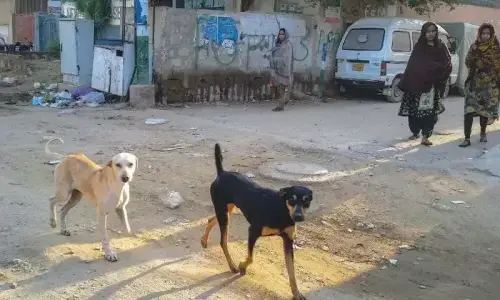
Study detects high prevalence of rabies virus in Karachi’s street dogs

• Most cases linked to Korangi and Malir; study stresses immediate wound care and timely post-exposure treatment to prevent deaths
• Findings point to substantial virus burden in stray dogs; experts call for scaling up vaccination and improved dog population management
KARACHI: A study published in an international journal has found that the rabies virus — one of the deadliest infectious diseases in the world — is widely circulating among the city’s dog population, highlighting a high risk of exposure to the virus and an urgent need for prevention, surveillance, and prompt treatment.
In a first, researchers at the Indus Hospital detected rabies virus RNA in samples taken directly from fresh bite wounds, offering a breakthrough for surveillance.
The study, titled Detection of rabies virus RNA in dog-bite wounds in a rabies-endemic area: evidence from an observational cohort study, is published in eBioMedicine, part of The Lancet Discovery Science.
Under the study, a total of 100 patients with World Health Organisation-defined Category III dog-bite injuries were enrolled, and swabs were collected from wounds before and after washing. Serum samples were obtained before and 14 days after the initiation of post-exposure prophylaxis (PEP).
Rabies virus RNA was detected using genotype-1 and pan-lyssavirus PCR (Polymerase Chain Reaction) assays. The simple, non-invasive approach demonstrated that wound swabs from untreated bites could be a practical method for identifying rabies virus exposure.
“By using human bite cases as a real-time indicator, the method offers a new way to monitor rabies circulation in dog populations, particularly in regions where traditional surveillance is limited by diagnostic challenges,” the study states.
The findings revealed a strikingly high level of rabies virus circulation in the local canine population, with the virus detected in 64 per cent of samples. Although the study focused on patients at high risk of rabies exposure, the results strongly suggest that the burden of circulating virus in Karachi’s stray dogs is substantial.
Most cases originated from the Korangi and Malir districts, which are in proximity to the health centre.
“The study is a breakthrough in the diagnosis of the rabies virus, achieved by swabbing dog-inflicted wounds. The findings confirm what we have long suspected — that rabies is widely circulating among the local dog population,” said Dr Naseem Salahuddin, head of the Department of Infectious Diseases at the Indus Hospital.
According to her, the study has identified a large burden of circulating rabies virus in the Korangi and Landhi districts, which can spread to other areas and to animals, especially farm animals, in the city.
“It serves as a warning and dispels the notion among animal activists that dog bites and rabies are not connected,” she said, underscoring the urgent need to scale up dog vaccination campaigns and strengthen dog population management to reduce risk to communities.
The study also highlighted the critical importance of immediate wound care, as swabs taken after washing showed a significant reduction in viral presence, reinforcing that thorough washing with soap and water should be the first step after any animal bite.
However, viral RNA was still detected in many cases after washing alone, underscoring that PEP remains essential and cannot be skipped.
“From a laboratory perspective, this method provides a minimally invasive and highly informative way to detect rabies virus RNA directly at the site of exposure,” said Dr Geurts van Kessel from Erasmus MC in Rotterdam, the Netherlands.
“It opens new possibilities for improving surveillance in endemic settings, where reliable data on rabies circulation are often lacking.”
All patients in the study received WHO-recommended treatment, including intradermal vaccination and infiltration of rabies immunoglobulin into deep wounds.
Encouragingly, 93pc developed protective antibody levels within two weeks, confirming that the one-week intradermal vaccination schedule with a quality vaccine is effective in preventing rabies.
About the seven per cent of dog-bite victims who did not test positive for protective antibodies, Dr Salahuddin explained that they were below the level of detection of antibodies.
“We were unable to call them back for a retest. We kept a follow-up on the phone with each of them for six months, and all were well. They were all treated adequately with PEP.
“By combining improved awareness, surveillance, expanded prevention efforts, and timely treatment, these measures provide a clear, actionable pathway aligned with the goal of the WHO and its partners to achieve zero human deaths from dog-mediated rabies by 2030,” concluded Dr Salahuddin.
Published in Dawn, April 12th, 2026